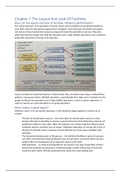
Chapter 7 The Layout And Look Of Facilities
How can the layout and look of facilities influence performance?
The ‘layout and look’ of an operation or process means how its facilities are positioned relative to
each other and how their general appearance is designed. These decisions will dictate the pattern
and nature of how transformed resources progress through the operation or process. They also
affect how both the people who staff the operation and, in high-visibility operations, how customers
judge their experience of being in the operation.
Layout and look are important decisions. If done badly, they can lead to over-long or confused flow
patterns, long process times, inflexible operations, unpredictable flow, high costs, frustration for the
people working in the operation and, in high-visibility operations, a poor customer experience. A
radical re-layout can cause disruption to on-going operations.
What makes a good layout?
Whatever ‘good’ is for any specific operation, it will usually be judged against a common set of
criteria:
- The flow of transformed resources – the route taken by transformed resources as they
progress through an operation or process is governed by how its transforming resources are
positioned relative to each other. Often the objective is to achieve high flow efficiency that
minimizes distance travelled, but not always. Additional objectives can include the clarity of
the flow of materials and/or customers and an effective use of the space available in the
operation.
- The interaction between parts of the process – the individual facilities or parts of a process
can suffer or benefit from being positioned close to each other. Conversely there may be a
positive effect of locating parts of an operation close to each other.
- Staff experience – an obvious prerequisite for any layout in any type of operation is that it
should not constitute any physical or emotional danger to staff. Unnecessary movement,
caused by poor layout, will take productive time away from value-adding tasks.
, - Customer experience – in high-visibility operations the layout and particularly the look of an
operation can help to shape its image and the general experience of customers.
Reconciling objectives
There are many and various objectives to attempt to achieve during the layout activity.
What are the basic layout types used in operations and how do they affect
performance?
Most practical layouts are derived from only four basic layout types:
1. Fixed-position layout
2. Functional layout
3. Cell layout
4. Line (sometimes called ‘product’) layout
Fixed-position layout
The recipient of the processing is stationary and the facilities and people who do the processing
move as necessary. Examples:
- Motorway construction – the product is too large to move
- Open-heart surgery – patients are too delicate to move
- High-class service restaurant – customers would object to being moved to where food is
prepared.
- Shipbuilding – the product is too large to move
- Mainframe computer maintenance – the product is too big and probably also too delicate to
move, and the customer might object to bringing it in for repair
Functional layout
In functional layout, similar transforming resources are located together. This may be because it is
convenient to group them together, or because their utilization is improved. It means that when
transforming resources flow through the operation, they will take a route from activity to activity
according to their needs. Examples:
- Hospital – some processes are required by several types of patient; some processes can
achieve high staff and bed utilization
- Supermarket – some products are convenient to restock if grouped together. Others might
be together because that way they look more attractive to customers. Others need the
common technology of freezer cabinets
How can the layout and look of facilities influence performance?
The ‘layout and look’ of an operation or process means how its facilities are positioned relative to
each other and how their general appearance is designed. These decisions will dictate the pattern
and nature of how transformed resources progress through the operation or process. They also
affect how both the people who staff the operation and, in high-visibility operations, how customers
judge their experience of being in the operation.
Layout and look are important decisions. If done badly, they can lead to over-long or confused flow
patterns, long process times, inflexible operations, unpredictable flow, high costs, frustration for the
people working in the operation and, in high-visibility operations, a poor customer experience. A
radical re-layout can cause disruption to on-going operations.
What makes a good layout?
Whatever ‘good’ is for any specific operation, it will usually be judged against a common set of
criteria:
- The flow of transformed resources – the route taken by transformed resources as they
progress through an operation or process is governed by how its transforming resources are
positioned relative to each other. Often the objective is to achieve high flow efficiency that
minimizes distance travelled, but not always. Additional objectives can include the clarity of
the flow of materials and/or customers and an effective use of the space available in the
operation.
- The interaction between parts of the process – the individual facilities or parts of a process
can suffer or benefit from being positioned close to each other. Conversely there may be a
positive effect of locating parts of an operation close to each other.
- Staff experience – an obvious prerequisite for any layout in any type of operation is that it
should not constitute any physical or emotional danger to staff. Unnecessary movement,
caused by poor layout, will take productive time away from value-adding tasks.
, - Customer experience – in high-visibility operations the layout and particularly the look of an
operation can help to shape its image and the general experience of customers.
Reconciling objectives
There are many and various objectives to attempt to achieve during the layout activity.
What are the basic layout types used in operations and how do they affect
performance?
Most practical layouts are derived from only four basic layout types:
1. Fixed-position layout
2. Functional layout
3. Cell layout
4. Line (sometimes called ‘product’) layout
Fixed-position layout
The recipient of the processing is stationary and the facilities and people who do the processing
move as necessary. Examples:
- Motorway construction – the product is too large to move
- Open-heart surgery – patients are too delicate to move
- High-class service restaurant – customers would object to being moved to where food is
prepared.
- Shipbuilding – the product is too large to move
- Mainframe computer maintenance – the product is too big and probably also too delicate to
move, and the customer might object to bringing it in for repair
Functional layout
In functional layout, similar transforming resources are located together. This may be because it is
convenient to group them together, or because their utilization is improved. It means that when
transforming resources flow through the operation, they will take a route from activity to activity
according to their needs. Examples:
- Hospital – some processes are required by several types of patient; some processes can
achieve high staff and bed utilization
- Supermarket – some products are convenient to restock if grouped together. Others might
be together because that way they look more attractive to customers. Others need the
common technology of freezer cabinets