CPAN, CAPA Cert Questions With 100% Correct Answers |Verified |Latest Update|2025/2026(Graded A+)
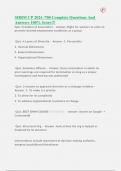
CPAN, CAPA Cert Questions With 100% Correct Answers |Verified |Latest Update|2025/2026(Graded A+) The nurse providing conscious sedation to a patient: 1. will not have duties that interfere with monitoring of the patient. 2. may circulate as long as monitor alarms are set. 3. may administer propofol for short procedures. 4. may monitor ASA IV patients - answer-1. Domain: Safety Needs Content Area: Protect patient from harm and take preventive measures related to the use of protective safety devices and equipment (including, but not limited to, padded side rails, safety straps, restraints) Reference: American Society of PeriAnesthesia Nurses. Perianesthesia Nursing Standards, Practice Recommendations, and Interpretive Statements . ASPAN, Cherry Hill, NJ, 2015. Pg 63. In caring for a patient at risk for noncardiogenic pulmonary edema, the perianesthesia nurse understands that the best method for prevention is to: 1. elevate head in high fowler's position. 2. maintain blood pressure below 180 systolic. 3. prevent fluid overload by limiting IV fluids in the elderly. 4. maintain airway and administer supplemental O2. - answerA patient with type 2 diabetes mellitus is admitted the day of surgery with a glucose of 610 mg/dl. The perianesthesia nurse is aware that the patient may be at risk for: 1. diabetic ketoacidosis. 2. hypercalcemia. 3. diabetes insipidus.4. hyperkalemia. - answer-1. DKA Domain: Physiological Needs Content Area: Stability of Endocrine System Reference: Fleisher, L. and Roizen, M. Essence of Anesthesia Practice, 3rd Ed. Elsevier Health Sciences, December, 2011. Pg 122. The perianesthesia nurse is aware that which drug is contraindicated in the pregnant patient? 1. Acetaminophen 2. Famotidine 3. Ondansetron 4. Ketorolac - answer-4. Ketolorac Domain: Physiological Needs Content Area: an appropriate medication regimen (including, but not limited to, minimal interruption of normal medication regimen, preemptive interventions) Reference: Hodgson, B., and Kizior, R. Saunders Nursing Drug Handbook 2015. Saunders (Elsevier), 2015. Pg 660-661 During discharge planning of a patient who has received 6 units of regular recombinant human insulin (Humulin) subcutaneously, the perianesthesia nurse recognizes that the PEAK action will occur in: 1. 1-5 hours. 2. 5-7 hours. 3. 10-20 minutes. 4. 30-45 minutes - answer-1. 1 to 5 hours Domain: Physiological Needs Content Area: stability of endocrine system Reference: Hodgson, B., and Kizior, R. Saunders Nursing Drug Handbook 2015. Saunders (Elsevier), 622-623. A patient in the PACU who received general anesthesia is awake and alert with stable vital signs. When the perianesthesia nurse removes the patient's oxygen the O2 saturation periodically drops to 88%. The perianestheisa nurse's next best action is to:1. notify the anesthesia provider 2. administer albuterol nebulizer 3. begin the stir-up regimen 4. perform chin lift - answer-3. begin the stir-up regimen Domain: Physiological Needs Content Area: Stability of respiratory system Reference: Urden, L., et al. Thelan's Critical Care Nursing, Diagnosis and Management, 7th Ed. Elsevier, 2014. pg 1103.
Geschreven voor
- Instelling
- CPAN, CAPA Cert
- Vak
- CPAN, CAPA Cert
Documentinformatie
- Geüpload op
- 9 oktober 2025
- Aantal pagina's
- 6
- Geschreven in
- 2025/2026
- Type
- Tentamen (uitwerkingen)
- Bevat
- Vragen en antwoorden
Onderwerpen
-
cpan capa cert questions with 100 correct answer