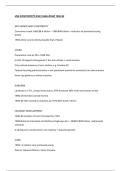
BRITAIN
Attlee pursued moderate socialist policies.
1945-79 became known as the consensus years as both parties broadly agreed with
each other on economic policy – Thacher shattered the maintenance of full
employment over inflation.
By 1979 – liberals held less than 2% of seats, labour 42%
The change must be attributed to the momentous impact of the 2 world wars and the
hard economic circumstances.
Labour seats 1910 = 42, 1929 = 288
POLITICS
LIB SPLIT/ FAILINGS
Liberals failed to adapt to more class-based voting habits. (can consider)
War forced lib to take illiberal measures, state intervention: economic controls,
rationing, conscription.
Lloyd George in favour of these measures, drove out the traditional Asquith, seen as a
traitor, the party split during the coalition. Failed to reunite for 1918 election.
1918 ‘Maurice debate’ - cemented the personal bitterness between the two.
‘Coupon election’, conservatives needed lib support as had not won an election since
1900, Lloyd George needed con as many liberal MPs stayed loyal to Asquith.
(Basically, libs emerged from the war divided into two camps)
May 1920 = Asquith liberals voted to eject Lloyd Goerge; he made serious but
unsuccessful efforts to convert the lib-con coalition into a permanent anti-labour
‘centre party’
Cash for honours, rumours of corruption (amassed huge political fund, knighthood
could be bought for £10,000) refused to share any with libs until they followed his ideas/
replaced Asquith men with his supporters in top party jobs.
No money - libs couldn't maintain an effective local party machine/ field enough
candidate, only handed them money when Asquith stepped down in 1926 (was too late)
+ warmongering turkey 1922 ‘Chanak incident’
Forced to resign as PM, led a much smaller group of lib MPs after the general election.
Asquith backed a minority lab gov post 1923 election, thought would rely on lib support
(Lloyd George feared losing a separate lib identity) His gambled flopped.
,OTHER
ROTPA- trebled electorate from 7.7 million in 1910, to 21.4 million in 1918 = working
class now made up 80% of electorate. Women,43%.
But working-class vote was split between all 3 parties throughout 20s anyway
working class women likely to vote conservative as they perceivably stood more for
stability and family values
FPTP favoured a two-party contest – libs failed to convert large electoral support into
seats, failure to revise the system led to their fall. System of proportional
representation would have helped avoid the catastrophic decline.
LAB RISE
1923, more votes than lib, 1924, Macdonald = 1st lab PM (1929 = second term)
Emerged united post war unlike lib, split in 1914 over whether to support the war. 1917
lab ministers in the coalition resigned, the party was reunited.
War led to boom in TU membership, who funded the party + their backing allowed them
to run successful local political machines/ field similar number of candidates to con
(unlike lib)
Ability to represent newfound sense of WC identity, as opposed to regional/ religious,
helped to win lib supporters.
LAB FALL (short term)
Macdonald ruled with economic caution/ good conduct in foreign affairs, but forced to
resign
Campbell ‘workers weekly’ - communist paper, accused of inciting mutiny. Mac used
influence to drop the case, lost vote of no confidence.
Resignation led to general election, 4 days before = daily mail + Zinoviev letter to BCP,
saying lab promoted communism by acknowledging the Soviet Union
- these clearly boosted con victory in 1924, but 1929 lab victory due to Mac’s economic
prudence.
CON SUCCESS
,Successful rebranding of party under Benjamin Disraeli, 1876 – promoted it as a ‘one
nation’ party of empire, national defence and patriotism – appealed to many WC.
Baldwin built upon this rebranding in 1923, despite wealth portrayed himself as
ordinary man of the people.
Pioneered use of radio to talk directly to the people
Ran his factories fairly, promoted harmony between employer and worker.
Same time = clear goal to promote class – based politics/ destroy the lib party
Won Lloyd Georges remaining supporters by adopting protectionism in 1923 – dropping
it after it was rejected by voters in 1924, this removed the one issue that had briefly
reunited the libs = free trade
Attracted the remaining M/UC libs to con as the best defence against lab socialism
+
Until 1948 ROTPA – existed a loophole, graduates residing for some time in a Uni town
were able to vote more than 1 constituency, some landowners voted 3. Connections
meant usually voted Con
1921 Irish free state independence, libs lost support of around 80 Irish MPs, Con
continued to receive that of 10 Northern Irish MPs
FPTP benefited the con, they needed less votes to return an MP
The fragmentation within the Liberal Party created an opening for Labour’s ascent
while simultaneously diminishing Liberal influence.
1931 crash – almost all lab ministers against proposed cuts, Esp 10% cut on
unemployment benefit. Macdonald forced to press ahead, was expelled from lab
PM w/o party, but remained head of national gov, con chose to support as Baldwin saw
Mac would bear the blame for the unpopular economic measures – would lead to con
triumph – public voted national gov in huge numbers
1935, Mac resigned poor health, Baldwin elected for 3 rd time – controversy in appeasing
fascist Italy by offering 2/3 of Abyssinia + rearmament issue
Some wanted growth cos of Nazi threat, others reduction + cooperation with league of
nations
, Ww2 broke out - Baldwin attacked for having appeased Hitler, but recovered rep as
advised Edward viii abdication
Handed reigns to chamberlain, also attacked for appeasing Hitler – vote of no
confidence
National gov continued till 1945, held centre ground, so lasted so long
EXTREMISM
Oswald Mosley, 1932 British union of fascists, ‘the battle of cable street’. 1936
Unpopular due to national gov success + WW2 Hitler trauma, Mosley imprisoned for 3
years, BUF banned
Far left more successful, Communist party gained 2 MPs in 1945, but only 0.4% of vote,
some support due to Soviet role in defeating Hitler
Public used to home grown socialism of lab and TU, over revolutionary communism
Only way forward was through ‘entryism’ - infiltration into the lab party
POST WAR LAB VITCORY (a short-term political impact of war, long term is consensus)
Con defeat partly cos failure to build ‘home fit for heroes’ post WW1/ failure to solve
30s crisis + lacklustre election, Churchill assumed victory was assured
+ criticised for besmirching lab as radical, threat of secret police
Attlee broke off coalition to fight election as separate party, lab more in tune with
demands of public, after 6 years of sacrifice/suffering
Promised to implement 1942 Beveridge report advice in 1945 manifesto ‘Let us face the
future’
+lab wartime contributions - Attlee as dep PM, Herbert Morrison as home sec
coordinated blitz, Hugh Dalton economic competence as Minister for war economy etc
CONSENSUS
National gov preceded this, an important foundation
War presented success of collectivism, national struggle = con + public could now
accept policies previously labelled radical/ socialist (e.g. nationalisation of coal mining/
the NHS)
Attlee pursued moderate socialist policies.
1945-79 became known as the consensus years as both parties broadly agreed with
each other on economic policy – Thacher shattered the maintenance of full
employment over inflation.
By 1979 – liberals held less than 2% of seats, labour 42%
The change must be attributed to the momentous impact of the 2 world wars and the
hard economic circumstances.
Labour seats 1910 = 42, 1929 = 288
POLITICS
LIB SPLIT/ FAILINGS
Liberals failed to adapt to more class-based voting habits. (can consider)
War forced lib to take illiberal measures, state intervention: economic controls,
rationing, conscription.
Lloyd George in favour of these measures, drove out the traditional Asquith, seen as a
traitor, the party split during the coalition. Failed to reunite for 1918 election.
1918 ‘Maurice debate’ - cemented the personal bitterness between the two.
‘Coupon election’, conservatives needed lib support as had not won an election since
1900, Lloyd George needed con as many liberal MPs stayed loyal to Asquith.
(Basically, libs emerged from the war divided into two camps)
May 1920 = Asquith liberals voted to eject Lloyd Goerge; he made serious but
unsuccessful efforts to convert the lib-con coalition into a permanent anti-labour
‘centre party’
Cash for honours, rumours of corruption (amassed huge political fund, knighthood
could be bought for £10,000) refused to share any with libs until they followed his ideas/
replaced Asquith men with his supporters in top party jobs.
No money - libs couldn't maintain an effective local party machine/ field enough
candidate, only handed them money when Asquith stepped down in 1926 (was too late)
+ warmongering turkey 1922 ‘Chanak incident’
Forced to resign as PM, led a much smaller group of lib MPs after the general election.
Asquith backed a minority lab gov post 1923 election, thought would rely on lib support
(Lloyd George feared losing a separate lib identity) His gambled flopped.
,OTHER
ROTPA- trebled electorate from 7.7 million in 1910, to 21.4 million in 1918 = working
class now made up 80% of electorate. Women,43%.
But working-class vote was split between all 3 parties throughout 20s anyway
working class women likely to vote conservative as they perceivably stood more for
stability and family values
FPTP favoured a two-party contest – libs failed to convert large electoral support into
seats, failure to revise the system led to their fall. System of proportional
representation would have helped avoid the catastrophic decline.
LAB RISE
1923, more votes than lib, 1924, Macdonald = 1st lab PM (1929 = second term)
Emerged united post war unlike lib, split in 1914 over whether to support the war. 1917
lab ministers in the coalition resigned, the party was reunited.
War led to boom in TU membership, who funded the party + their backing allowed them
to run successful local political machines/ field similar number of candidates to con
(unlike lib)
Ability to represent newfound sense of WC identity, as opposed to regional/ religious,
helped to win lib supporters.
LAB FALL (short term)
Macdonald ruled with economic caution/ good conduct in foreign affairs, but forced to
resign
Campbell ‘workers weekly’ - communist paper, accused of inciting mutiny. Mac used
influence to drop the case, lost vote of no confidence.
Resignation led to general election, 4 days before = daily mail + Zinoviev letter to BCP,
saying lab promoted communism by acknowledging the Soviet Union
- these clearly boosted con victory in 1924, but 1929 lab victory due to Mac’s economic
prudence.
CON SUCCESS
,Successful rebranding of party under Benjamin Disraeli, 1876 – promoted it as a ‘one
nation’ party of empire, national defence and patriotism – appealed to many WC.
Baldwin built upon this rebranding in 1923, despite wealth portrayed himself as
ordinary man of the people.
Pioneered use of radio to talk directly to the people
Ran his factories fairly, promoted harmony between employer and worker.
Same time = clear goal to promote class – based politics/ destroy the lib party
Won Lloyd Georges remaining supporters by adopting protectionism in 1923 – dropping
it after it was rejected by voters in 1924, this removed the one issue that had briefly
reunited the libs = free trade
Attracted the remaining M/UC libs to con as the best defence against lab socialism
+
Until 1948 ROTPA – existed a loophole, graduates residing for some time in a Uni town
were able to vote more than 1 constituency, some landowners voted 3. Connections
meant usually voted Con
1921 Irish free state independence, libs lost support of around 80 Irish MPs, Con
continued to receive that of 10 Northern Irish MPs
FPTP benefited the con, they needed less votes to return an MP
The fragmentation within the Liberal Party created an opening for Labour’s ascent
while simultaneously diminishing Liberal influence.
1931 crash – almost all lab ministers against proposed cuts, Esp 10% cut on
unemployment benefit. Macdonald forced to press ahead, was expelled from lab
PM w/o party, but remained head of national gov, con chose to support as Baldwin saw
Mac would bear the blame for the unpopular economic measures – would lead to con
triumph – public voted national gov in huge numbers
1935, Mac resigned poor health, Baldwin elected for 3 rd time – controversy in appeasing
fascist Italy by offering 2/3 of Abyssinia + rearmament issue
Some wanted growth cos of Nazi threat, others reduction + cooperation with league of
nations
, Ww2 broke out - Baldwin attacked for having appeased Hitler, but recovered rep as
advised Edward viii abdication
Handed reigns to chamberlain, also attacked for appeasing Hitler – vote of no
confidence
National gov continued till 1945, held centre ground, so lasted so long
EXTREMISM
Oswald Mosley, 1932 British union of fascists, ‘the battle of cable street’. 1936
Unpopular due to national gov success + WW2 Hitler trauma, Mosley imprisoned for 3
years, BUF banned
Far left more successful, Communist party gained 2 MPs in 1945, but only 0.4% of vote,
some support due to Soviet role in defeating Hitler
Public used to home grown socialism of lab and TU, over revolutionary communism
Only way forward was through ‘entryism’ - infiltration into the lab party
POST WAR LAB VITCORY (a short-term political impact of war, long term is consensus)
Con defeat partly cos failure to build ‘home fit for heroes’ post WW1/ failure to solve
30s crisis + lacklustre election, Churchill assumed victory was assured
+ criticised for besmirching lab as radical, threat of secret police
Attlee broke off coalition to fight election as separate party, lab more in tune with
demands of public, after 6 years of sacrifice/suffering
Promised to implement 1942 Beveridge report advice in 1945 manifesto ‘Let us face the
future’
+lab wartime contributions - Attlee as dep PM, Herbert Morrison as home sec
coordinated blitz, Hugh Dalton economic competence as Minister for war economy etc
CONSENSUS
National gov preceded this, an important foundation
War presented success of collectivism, national struggle = con + public could now
accept policies previously labelled radical/ socialist (e.g. nationalisation of coal mining/
the NHS)