

Behavirouable and cognitive neuroscience
LES 1: Personality novelty seeking addiction
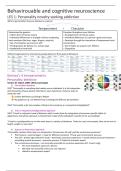
What is personality? How you behave as a person
Determined by genetics Develops throughout your lifetime
= Inborn form of human nature = Emergent form of human nature
= Individual differences in strength of drives underlying = Individual differences in a person’s goals and values
basis emotions (like fear, anger, disgust, surprise) = Develops through the interaction of temperament and
= Set of inclinations we are born with environment
= Predisposition (to behave in a certain way) = Set of habits we acquire over lifetime
= Hardwired in from birth = Disposition
Different approaches to characterize people based on their general behaviour
Keirsey’s 4 temperaments
Personality: definition
Gordon W. Allport (1897-1967) psychologist
1) The omnibus definition
1937 “Personality is everything that makes you an individual. It is the integration
and interaction of your genetic inheritance, your experience, and your ways to
relate the two”
Useless definition according to Allport
No guidance e.g. not defined how to distinguish different personalities
1955 “Personality is far too complex a thing to be trussed up in a conceptual straightjacket”
2) Trait or Integrative/Configurational approach
1961 “A trait is a dynamic trend of behavior which results from the integration of numerous specific habits of
adjustment, and which expresses a characteristic mode of the individual's reaction to his surroundings”
“A trait is a predisposition to act the same way in a variety of situations. Traits are real, not concepts; they are as real as
height, weight, or eye color”
3) Systems or Hierarchical approach
“Personality contains three layers or components: the persona, the self, and the unconscious processes“
▪ The Persona = external layers = mask for different occasions → how your environment sees you
▪ The self = private ego behind the mask = dominates conscious experience = closely tied to personal memories =
controlling mental processes = executive process → linked to character aspect
▪ The unconscious processes = not normally accessible to conscious awareness (cfr. Freud, Jung)
▪ The most important aspect of a person
▪ Normally not accessible unless you use hypnosis
▪ Linked to temperament aspect
,Which of the 3 definitions would you use to study behaviour? 2, because this you can analyse → trait is something
unique as a certain behaviour
Revival Trait theory late 20th century
“THE BIG FIVE”
I. Extraversion: energy, positive emotions, surgency, tendency to seek stimulation and the company of others
II. Agreeableness: tendency to be compassionate and cooperative towards others
III. Conscientiousness: tendency to show self-discipline, act dutifully, and aim for achievement
IV. Neuroticism: tendency to experience unpleasant emotions easily
V. Openness: appreciation for art, emotion, adventure, unusual ideas, imagination, curiosity, and variety of
experience
Psychobiological model of temperament and character
C.R. Cloninger, M.D. (°1944) psychiatrist and geneticist
▪ Twin and family studies Not only looking at what is produced
▪ Studies of longitudinal development (behaviourable) but also linking it to
▪ Neuropharmacology studies underlying physiobiological processes
▪ Neurobehavioural studies of learning
▪ Psychometric studies of personality in individuals and twin pairs
↓
Psychobiological model of personality
Tridimensional personality questionnaire (TPQ)
3 dimensions/traits of personality
▪ Novelty seeking
▪ Harm avoidance
▪ Reward dependence
4 subdivisions of each dimension
Postulated to be genetically independent
Self-report inventory, paper-and-pencil format, 15 min to complete
100 true/false questions regarding attitudes, interests, opinions, and other personal feelings
TPQ: subdivisions
,TPQ: disadvantages
▪ Poor differentiation personality disorders of poor social judgement vs. well-adapted individuals with extreme
personality profiles
▪ Neglected some DSM-III-R personality disorders
▪ e.g. paranoid and schizotypal personality
▪ Lack explanation some personality factors explained by other dimensional models
▪ e.g. Neuroticism-Extraversion-Openness personality inventory; aggression scale of MPQ
↓
Temperament and Character Inventory
Temperament and Character Inventory (TCI)
7-factor personality scale
▪ 4 factors ~ temperament
▪ 3 factors ~ character
▪ 240 questions (true/false or on a 5-point Likert scale)
▪ Self-report, 35-45 min time required, automated scoring
TCI: Psychobiological model
Automated responses personal development
TCI: Self-Directedness - the individual TCI: Cooperativeness - the environment
TCI: Self-Transcendence - the world
, TCI temperament cube
Different configurations of dimensions
Description of a person’s general emotional style (in absence
of major trauma of behavioural conditioning)
Or
Subtyping personality disorders
Personality = unique combination of universal
building blocks
Genetic variance ~ Gaussian distribution
→ most people have intermediate values
Resulting behavior = balance between two/more dimensions
Extreme (high or low) variants → personality disorders
Sex differences?
• Harm avoidance (HA) and reward dependance (RD): >
o Effect RD ~ age and cultural factors
• Novelty Seeking (NS) and PS: =
Novelty Seeking
Heritable tendency toward intense excitement in response to:
▪ novel stimuli / new stimuli Personality trait that will activate to behave in
▪ cues for potential rewards a certain situation
▪ potential relief of punishment
Genetically independent from each other
→ Behavioral activation aiming at:
▪ active avoidance of monotony
▪ pursuit of potential rewards
▪ active avoidance of punishment
LES 1: Personality novelty seeking addiction
What is personality? How you behave as a person
Determined by genetics Develops throughout your lifetime
= Inborn form of human nature = Emergent form of human nature
= Individual differences in strength of drives underlying = Individual differences in a person’s goals and values
basis emotions (like fear, anger, disgust, surprise) = Develops through the interaction of temperament and
= Set of inclinations we are born with environment
= Predisposition (to behave in a certain way) = Set of habits we acquire over lifetime
= Hardwired in from birth = Disposition
Different approaches to characterize people based on their general behaviour
Keirsey’s 4 temperaments
Personality: definition
Gordon W. Allport (1897-1967) psychologist
1) The omnibus definition
1937 “Personality is everything that makes you an individual. It is the integration
and interaction of your genetic inheritance, your experience, and your ways to
relate the two”
Useless definition according to Allport
No guidance e.g. not defined how to distinguish different personalities
1955 “Personality is far too complex a thing to be trussed up in a conceptual straightjacket”
2) Trait or Integrative/Configurational approach
1961 “A trait is a dynamic trend of behavior which results from the integration of numerous specific habits of
adjustment, and which expresses a characteristic mode of the individual's reaction to his surroundings”
“A trait is a predisposition to act the same way in a variety of situations. Traits are real, not concepts; they are as real as
height, weight, or eye color”
3) Systems or Hierarchical approach
“Personality contains three layers or components: the persona, the self, and the unconscious processes“
▪ The Persona = external layers = mask for different occasions → how your environment sees you
▪ The self = private ego behind the mask = dominates conscious experience = closely tied to personal memories =
controlling mental processes = executive process → linked to character aspect
▪ The unconscious processes = not normally accessible to conscious awareness (cfr. Freud, Jung)
▪ The most important aspect of a person
▪ Normally not accessible unless you use hypnosis
▪ Linked to temperament aspect
,Which of the 3 definitions would you use to study behaviour? 2, because this you can analyse → trait is something
unique as a certain behaviour
Revival Trait theory late 20th century
“THE BIG FIVE”
I. Extraversion: energy, positive emotions, surgency, tendency to seek stimulation and the company of others
II. Agreeableness: tendency to be compassionate and cooperative towards others
III. Conscientiousness: tendency to show self-discipline, act dutifully, and aim for achievement
IV. Neuroticism: tendency to experience unpleasant emotions easily
V. Openness: appreciation for art, emotion, adventure, unusual ideas, imagination, curiosity, and variety of
experience
Psychobiological model of temperament and character
C.R. Cloninger, M.D. (°1944) psychiatrist and geneticist
▪ Twin and family studies Not only looking at what is produced
▪ Studies of longitudinal development (behaviourable) but also linking it to
▪ Neuropharmacology studies underlying physiobiological processes
▪ Neurobehavioural studies of learning
▪ Psychometric studies of personality in individuals and twin pairs
↓
Psychobiological model of personality
Tridimensional personality questionnaire (TPQ)
3 dimensions/traits of personality
▪ Novelty seeking
▪ Harm avoidance
▪ Reward dependence
4 subdivisions of each dimension
Postulated to be genetically independent
Self-report inventory, paper-and-pencil format, 15 min to complete
100 true/false questions regarding attitudes, interests, opinions, and other personal feelings
TPQ: subdivisions
,TPQ: disadvantages
▪ Poor differentiation personality disorders of poor social judgement vs. well-adapted individuals with extreme
personality profiles
▪ Neglected some DSM-III-R personality disorders
▪ e.g. paranoid and schizotypal personality
▪ Lack explanation some personality factors explained by other dimensional models
▪ e.g. Neuroticism-Extraversion-Openness personality inventory; aggression scale of MPQ
↓
Temperament and Character Inventory
Temperament and Character Inventory (TCI)
7-factor personality scale
▪ 4 factors ~ temperament
▪ 3 factors ~ character
▪ 240 questions (true/false or on a 5-point Likert scale)
▪ Self-report, 35-45 min time required, automated scoring
TCI: Psychobiological model
Automated responses personal development
TCI: Self-Directedness - the individual TCI: Cooperativeness - the environment
TCI: Self-Transcendence - the world
, TCI temperament cube
Different configurations of dimensions
Description of a person’s general emotional style (in absence
of major trauma of behavioural conditioning)
Or
Subtyping personality disorders
Personality = unique combination of universal
building blocks
Genetic variance ~ Gaussian distribution
→ most people have intermediate values
Resulting behavior = balance between two/more dimensions
Extreme (high or low) variants → personality disorders
Sex differences?
• Harm avoidance (HA) and reward dependance (RD): >
o Effect RD ~ age and cultural factors
• Novelty Seeking (NS) and PS: =
Novelty Seeking
Heritable tendency toward intense excitement in response to:
▪ novel stimuli / new stimuli Personality trait that will activate to behave in
▪ cues for potential rewards a certain situation
▪ potential relief of punishment
Genetically independent from each other
→ Behavioral activation aiming at:
▪ active avoidance of monotony
▪ pursuit of potential rewards
▪ active avoidance of punishment


