Religious Language – Full Top
Revision Sheet
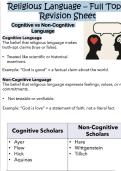
Cognitive vs Non-Cognitive
Language
Cognitive Language
The belief that religious language
makes truth-apt claims (true or false).
• Treated like scientific or historical
assertions.
Example: “God is good” = a factual claim about the world.
Non-Cognitive Language
The belief that religious language expresses feelings, value
moral commitments.
• Not testable or verifiable.
Example: “God is love” = a statement of faith, not a literal
Cognitive Non-Cognitive
Scholars Scholars
• Ayer • Hare
• Flew • Wittgenstein
• Hick • Tillich
• Aquinas
, Religious Language – Full Top
Revision Sheet
The Verification
Principle – A.J. Ayer
Key Ideas -
Originates from Logical Positivism
(Vienna Circle).
A statement is meaningful only if it is:
o Analytic (true by definition)
or
o Synthetic and empirically verifiable (testable by observa
Application to Religious Language
“God exists” is neither analytic nor observable.
Therefore, religious statements are cognitively meaning
Evaluatio
n
Strengths Weaknesses
Clear criteria for meaning. Makes ethics, aesthetics,
metaphysics meaningless
too.
Supports scientific enquiry. The principle fails its ow
test — it is neither analyt
nor verifiable.
Revision Sheet
Cognitive vs Non-Cognitive
Language
Cognitive Language
The belief that religious language
makes truth-apt claims (true or false).
• Treated like scientific or historical
assertions.
Example: “God is good” = a factual claim about the world.
Non-Cognitive Language
The belief that religious language expresses feelings, value
moral commitments.
• Not testable or verifiable.
Example: “God is love” = a statement of faith, not a literal
Cognitive Non-Cognitive
Scholars Scholars
• Ayer • Hare
• Flew • Wittgenstein
• Hick • Tillich
• Aquinas
, Religious Language – Full Top
Revision Sheet
The Verification
Principle – A.J. Ayer
Key Ideas -
Originates from Logical Positivism
(Vienna Circle).
A statement is meaningful only if it is:
o Analytic (true by definition)
or
o Synthetic and empirically verifiable (testable by observa
Application to Religious Language
“God exists” is neither analytic nor observable.
Therefore, religious statements are cognitively meaning
Evaluatio
n
Strengths Weaknesses
Clear criteria for meaning. Makes ethics, aesthetics,
metaphysics meaningless
too.
Supports scientific enquiry. The principle fails its ow
test — it is neither analyt
nor verifiable.