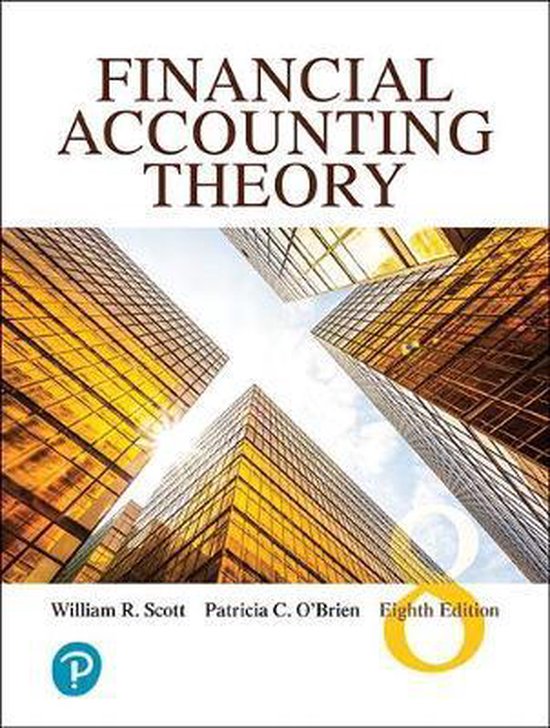
Solution Manual For Financial Accounting Theory
7th Edition by William R. Scott, Patricia O'Brien
Chapters 1 - 13, Complete
, Contents
Chapter 1 s Introduction.................................................................................................. 1
Chapter 2 s Accounting Under Ideal Conditions ........................................................... 7
s s s
Chapter 3 s The Decision Usefulness Approach to Financial Reporting ........................ 68
s s s s s s
Chapter 4 s Efficient Securities Markets .......................................................................129
s s
Chapter 5 s The Value Relevance of Accounting Information .......................................153
s s s s s
Chapter 6 s The Measurement Approach to Decision Usefulness ..................................194
s s s s s
Chapter 7 s Measurement Applications.........................................................................237
s
Chapter 8 s The Efficient Contracting Approach to Decision Usefulness ...................... 285
s s s s s s
Chapter 9 s An Analysis of Conflict ........................................................................... 321
s s s
Chapter 10 Executive Compensation .......................................................................... 371
s ss s
Chapter 11 Earnings Management .............................................................................. 425
s ss s
Chapter 12 Standard Setting: Economic Issues ........................................................... 487
s ss s s s
Chapter 13 Standard Setting: Political Issues .............................................................. 527
s ss s s s
Pearson Canada Inc.
,Scott, Financial Accounting Theory Instructor’s Solutions Manual Chapter 1
CHAPTER 1 s
s INTRODUCTIO
N
1.1 The Objective of This Book
s s s s
1.2 Some Historical Perspective
s s
1.3 The 2007-2008 Market Meltdowns
s s s
1.4 Efficient Contracting s
1.5 A Note on Ethical Behaviour
s s s s
1.6 Rules-Based v. Principles-Based Accounting Standards
s s s s
1.7 The Complexity of Information in Financial Accounting and Reporting
s s s s s s s s
1.8 The Role of Accounting Research
s s s s
1.9 The Importance of Information Asymmetry
s s s s
1.10 The Fundamental Problem of Financial Accounting Theory
s s s s s s
1.11 Regulation as a Reaction to the Fundamental Problem
s s s s s s s
1.12 The Organization of This Book
s s s s
1.12.1 Ideal Conditions s
1.12.2 Adverse Selection s
1.12.3 Moral Hazard s
1.12.4 Standard Setting s
1.12.5 The Process of Standard Setting
s s s s
1.13 Relevance of Financial Accounting Theory to Accounting Practice
s s s s s s s
, Scott, Financial Accounting Theory Instructor’s Solutions Manual Chapter 1
LEARNING OBJECTIVES AND SUGGESTED TEACHING APPROACHES
s s s s s
1. The Broad Outline of the Book
s s s s s
I use Figure 1.1 as a template to describe the broad outline of the book. Since the
s s s s s s s s s s s s s s s s
s students typically have not had a chance to read Chapter 1 in the first course
s s s s s s s s s s s s s s
session, I stick fairly closely to the chapter material.
s s s s s s s s s
The major points I discuss are:
s s s s s
• Accounting in an ideal setting. Here, present-value-based accounting s s s s s s s
s is natural. I go over the ideal conditions needed for sucha basis of
s s s s s s s s s s s s s
s accounting to be feasible, but do not go into much detail because this s s s s s s s s s s s s
s topic is covered in greater depth in Chapter 2.
s s s s s s s s
• An introduction to the concept of information asymmetry and resulting
s s s s s s s s s
s problems of adverse selection and moral hazard. These problems are s s s s s s s s s
s basic to the book and I feel it is desirable for the students to have a “first
s s s s s s s s s s s s s s s s
s go” at them at this point. I concentrate on the intuition underlying the
s s s s s s s s s s s s
s two problems. For example, adverse selection can be illustrated by
s s s s s s s s s
s asking who would be first in line to purchase life insurance if there was
s s s s s s s s s s s s s
s no medical examination, or what quality of used cars are likely to be
s s s s s s s s s s s s
s brought to market. For moral hazard I try to pin them down on how hard
s s s s s s s s s s s s s s
s they would work inthis course if there were no exams.
s s s s s s s s s s
• The environment in which financial accounting and reporting
s s s s s s s
s operates. My main goal at this point is that the students do not takethis s s s s s s s s s s s s s s
s environment for granted. I discuss the procedures of standard setting s s s s s s s s s
s briefly and point out that this is really a process of regulation. In the
s s s s s s s s s s s s s
s past, there have been well-known cases of deregulation, such as
s s s s s s s s s
s airlines, trucking, financial institutions, powergeneration. However,
s s s s s s
s we are entering what is likely to be a period of increasing regulation, at
s s s s s s s s s s s s s
least for financial institutions. Instructors
s s s s s
7th Edition by William R. Scott, Patricia O'Brien
Chapters 1 - 13, Complete
, Contents
Chapter 1 s Introduction.................................................................................................. 1
Chapter 2 s Accounting Under Ideal Conditions ........................................................... 7
s s s
Chapter 3 s The Decision Usefulness Approach to Financial Reporting ........................ 68
s s s s s s
Chapter 4 s Efficient Securities Markets .......................................................................129
s s
Chapter 5 s The Value Relevance of Accounting Information .......................................153
s s s s s
Chapter 6 s The Measurement Approach to Decision Usefulness ..................................194
s s s s s
Chapter 7 s Measurement Applications.........................................................................237
s
Chapter 8 s The Efficient Contracting Approach to Decision Usefulness ...................... 285
s s s s s s
Chapter 9 s An Analysis of Conflict ........................................................................... 321
s s s
Chapter 10 Executive Compensation .......................................................................... 371
s ss s
Chapter 11 Earnings Management .............................................................................. 425
s ss s
Chapter 12 Standard Setting: Economic Issues ........................................................... 487
s ss s s s
Chapter 13 Standard Setting: Political Issues .............................................................. 527
s ss s s s
Pearson Canada Inc.
,Scott, Financial Accounting Theory Instructor’s Solutions Manual Chapter 1
CHAPTER 1 s
s INTRODUCTIO
N
1.1 The Objective of This Book
s s s s
1.2 Some Historical Perspective
s s
1.3 The 2007-2008 Market Meltdowns
s s s
1.4 Efficient Contracting s
1.5 A Note on Ethical Behaviour
s s s s
1.6 Rules-Based v. Principles-Based Accounting Standards
s s s s
1.7 The Complexity of Information in Financial Accounting and Reporting
s s s s s s s s
1.8 The Role of Accounting Research
s s s s
1.9 The Importance of Information Asymmetry
s s s s
1.10 The Fundamental Problem of Financial Accounting Theory
s s s s s s
1.11 Regulation as a Reaction to the Fundamental Problem
s s s s s s s
1.12 The Organization of This Book
s s s s
1.12.1 Ideal Conditions s
1.12.2 Adverse Selection s
1.12.3 Moral Hazard s
1.12.4 Standard Setting s
1.12.5 The Process of Standard Setting
s s s s
1.13 Relevance of Financial Accounting Theory to Accounting Practice
s s s s s s s
, Scott, Financial Accounting Theory Instructor’s Solutions Manual Chapter 1
LEARNING OBJECTIVES AND SUGGESTED TEACHING APPROACHES
s s s s s
1. The Broad Outline of the Book
s s s s s
I use Figure 1.1 as a template to describe the broad outline of the book. Since the
s s s s s s s s s s s s s s s s
s students typically have not had a chance to read Chapter 1 in the first course
s s s s s s s s s s s s s s
session, I stick fairly closely to the chapter material.
s s s s s s s s s
The major points I discuss are:
s s s s s
• Accounting in an ideal setting. Here, present-value-based accounting s s s s s s s
s is natural. I go over the ideal conditions needed for sucha basis of
s s s s s s s s s s s s s
s accounting to be feasible, but do not go into much detail because this s s s s s s s s s s s s
s topic is covered in greater depth in Chapter 2.
s s s s s s s s
• An introduction to the concept of information asymmetry and resulting
s s s s s s s s s
s problems of adverse selection and moral hazard. These problems are s s s s s s s s s
s basic to the book and I feel it is desirable for the students to have a “first
s s s s s s s s s s s s s s s s
s go” at them at this point. I concentrate on the intuition underlying the
s s s s s s s s s s s s
s two problems. For example, adverse selection can be illustrated by
s s s s s s s s s
s asking who would be first in line to purchase life insurance if there was
s s s s s s s s s s s s s
s no medical examination, or what quality of used cars are likely to be
s s s s s s s s s s s s
s brought to market. For moral hazard I try to pin them down on how hard
s s s s s s s s s s s s s s
s they would work inthis course if there were no exams.
s s s s s s s s s s
• The environment in which financial accounting and reporting
s s s s s s s
s operates. My main goal at this point is that the students do not takethis s s s s s s s s s s s s s s
s environment for granted. I discuss the procedures of standard setting s s s s s s s s s
s briefly and point out that this is really a process of regulation. In the
s s s s s s s s s s s s s
s past, there have been well-known cases of deregulation, such as
s s s s s s s s s
s airlines, trucking, financial institutions, powergeneration. However,
s s s s s s
s we are entering what is likely to be a period of increasing regulation, at
s s s s s s s s s s s s s
least for financial institutions. Instructors
s s s s s