BUSINESS DOCUMENTS/SOURCE DOCUMENTS
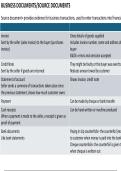
Source document= provides evidence for business transactions, used to enter transactions into financia
Invoice Gives details of goods supplied
Sent by the seller (sales invoice) to the buyer (purchases Includes invoice number, name and address of
invoice) buyer
E&OE= errors and omission accepted
Credit Note They might be faulty or the buyer was overcha
Sent by the seller if goods are returned Reduces amount owed by customer
Statement of account Shows invoice, credit note
Seller sends a summary of transactions taken place since
the previous statement, shows how much customer owes
Payment Can be made by cheque or bank transfer
Cash receipts Can be hand written or machine produced
When a payment is made to the seller, a receipt is given as
proof of payment
Bank documents Paying in slip counterfoils= the counterfoil (rec
Like bank statements to customer when money is paid into the bank
Cheque counterfoils= the counterfoil is given to
when cheque is written out
, Banks statements show:
Standing order= where a fixed payment is made at regular intervals by the bank (monthly car insurance
Direct debits= where the business grants authority to a 3rd party for fixed payments (telephone bill)
Credit transfer= where money is paid into the business bank account (customer pays)
Bank interest/charges= bank charges for its services
Cash discount= a discount given for prompt payment (payment made before a date). This is shown in ac
Trade discount= discount given for bulk purchases or B2B trading. This isn’t shown in the accounts
BOOKS OF PRIME ENTRY
Sales journal= record day to day sales of goods on credit
Sales return journal= record the return of goods from customers
Purchases journal= record day to day purchases of goods on credit
Purchase return journal= record the return of good to suppliers
The general journal= record non-regular transactions which aren’t recorded in any other journal
The cash book= record large amounts, payments, receipts of money
Source document= provides evidence for business transactions, used to enter transactions into financia
Invoice Gives details of goods supplied
Sent by the seller (sales invoice) to the buyer (purchases Includes invoice number, name and address of
invoice) buyer
E&OE= errors and omission accepted
Credit Note They might be faulty or the buyer was overcha
Sent by the seller if goods are returned Reduces amount owed by customer
Statement of account Shows invoice, credit note
Seller sends a summary of transactions taken place since
the previous statement, shows how much customer owes
Payment Can be made by cheque or bank transfer
Cash receipts Can be hand written or machine produced
When a payment is made to the seller, a receipt is given as
proof of payment
Bank documents Paying in slip counterfoils= the counterfoil (rec
Like bank statements to customer when money is paid into the bank
Cheque counterfoils= the counterfoil is given to
when cheque is written out
, Banks statements show:
Standing order= where a fixed payment is made at regular intervals by the bank (monthly car insurance
Direct debits= where the business grants authority to a 3rd party for fixed payments (telephone bill)
Credit transfer= where money is paid into the business bank account (customer pays)
Bank interest/charges= bank charges for its services
Cash discount= a discount given for prompt payment (payment made before a date). This is shown in ac
Trade discount= discount given for bulk purchases or B2B trading. This isn’t shown in the accounts
BOOKS OF PRIME ENTRY
Sales journal= record day to day sales of goods on credit
Sales return journal= record the return of goods from customers
Purchases journal= record day to day purchases of goods on credit
Purchase return journal= record the return of good to suppliers
The general journal= record non-regular transactions which aren’t recorded in any other journal
The cash book= record large amounts, payments, receipts of money