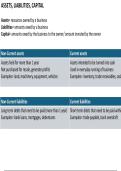
ASSETS, LIABILITIES, CAPITAL
Assets= resources owned by a business
Liabilities= amounts owed by a business
Capital= amounts owed by the business to the owner/ amount invested by the owner
Non-Current assets Current assets
Assets held for more than 1 year Assets intended to be turned into cash
Not purchased for resale, generate profits Used in everyday running of business
Examples= land, machinery, equipment, vehicles Examples= inventory, trade receivables, cash
Non-Current liabilities Current liabilities
Long-term debts that need to be paid (more than 1 year) Short-term debts that need to be paid withi
Examples= bank loans, mortgages, debentures Examples= trade payable, bank overdraft
, ACCOUNTING EQUATION
Capital= Assets-Liabilities
C=A-L or L=A-C or A=C+L
Monetary Concept= only transactions that have a monetary value are recorded (non-financial data isn’t
Duality Concept= every transaction has two accounting entries (debit and credit)
Recording transactions
Receivables ledger= contains account for customers
Payable ledger= contains accounts of suppliers
General ledger= all other accounts
T accounts/ ledger accounts
One account is credited
One account is debited
Assets= resources owned by a business
Liabilities= amounts owed by a business
Capital= amounts owed by the business to the owner/ amount invested by the owner
Non-Current assets Current assets
Assets held for more than 1 year Assets intended to be turned into cash
Not purchased for resale, generate profits Used in everyday running of business
Examples= land, machinery, equipment, vehicles Examples= inventory, trade receivables, cash
Non-Current liabilities Current liabilities
Long-term debts that need to be paid (more than 1 year) Short-term debts that need to be paid withi
Examples= bank loans, mortgages, debentures Examples= trade payable, bank overdraft
, ACCOUNTING EQUATION
Capital= Assets-Liabilities
C=A-L or L=A-C or A=C+L
Monetary Concept= only transactions that have a monetary value are recorded (non-financial data isn’t
Duality Concept= every transaction has two accounting entries (debit and credit)
Recording transactions
Receivables ledger= contains account for customers
Payable ledger= contains accounts of suppliers
General ledger= all other accounts
T accounts/ ledger accounts
One account is credited
One account is debited