Content Page
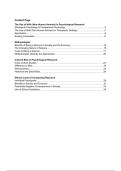
The Use of NHA (Non-Human Animals) in Psychological Research
Ethological Psychology & Comparative Psychology…………………...……….…….…....…….2
The Use of NHA (Non-Human Animals) in Therapeutic Settings………………………….……4
Speciesism…………………………………………….………………………....……………...……6
Existing Constraints………………………………………………………………………….....……8
Methodologies
Benefits of Being a Science to Society and the Economy……………….………..…...……….12
The Changing Nature of Science……………………….………………………….…………...…15
Costs of Being a Science……………………………………………….……………………….…17
Methodologies Used By the Approaches.………………………….……….…..…………..……20
Cultural Bias in Psychological Research
Cross Culture Studies……………………………………...………………..………………..……22
Difference or Bias…………………………………….……………………………………......……24
Ethnocentrism………………………………………………………………...………………..……24
Historical and Social Bias…………………………………………………..………………………26
Ethical Costs of Conducting Research
Individual Participants………………………………...…………………….………………………29
Benefits to Society and Economy………………………..……………………...…………...……31
Potentially Negative Consequences to Society………………………………….………………33
Use of Ethical Guidelines…………………..………………………….………...…………………34
,The Use of NHA in Psychological Research
Should we or should we not use non-human animals in psychological research?
(1/2) Ethological Psychology:
A01 - Animals are interesting in their own right. Humans are just studying NHA (Non-human
animals) to understand them better.
Konrad Lorenz - Geese Imprinting
Procedures:
A group of geese were placed under a goose mother, while he kept the other half hatched in
the incubator, making sure he was the first moving object the goslings encountered and
imitating a mother duck’s quacking sound.
Findings:
Geese follow the first moving object they see. The process is known as imprinting and
suggests that attachment is natural and programmed genetically. He believed that it cannot
be reversed, nor can the gosling imprint on anything else.
As proof, he mixed all the goslings together under an upturned box and allowed them to mix.
When the box was removed, the goslings separated to their respective mothers, half to the
goose and half to Lorenz
(A03) This research shows how using NHA in psychological research is justified. This is
because it improved our understanding of the species, which in return, benefited the NHS
themselves due to the correction of our behaviour. This research had been done without
harm to the species.
Dian Fossey (1967 to 1972) November 1973 - Video)
Dian studied great apes in Central Africa and in their natural environment, spending over
2000 hours observing and gaining invaluable knowledge of the species themselves.
,(1) Comparative Psychology:
● Allows for greater control and objectivity in research procedure (such as the ability to
research an animal’s life from start to finish)
● Humans and some non-human animals are very close physiologically and therefore
findings can be generalised and extrapolated. Then, these findings provide
information beneficial for humans
Harry Harlow (1958) - Monkey Experiment (A01)
Aim of the Study: How and why monkeys bonded with their mothers
Learning Theory of Attachment - an infant would form attachments with a carer that
provided food. Harry theorized that attachment developed due to the mother giving tactile
comfort.
Procedures:
The monkeys were placed into cages with two surrogate mothers, one made of wire and
another made of cloth.
In the first group, the wire mother didn’t provide food and only the cloth mother did.
Findings:
Monkeys spent more time with the cloth mother and only went to the wire mother when
hungry.
The cloth mother was used as a comforting source and decreased the monkey’s fear,
exploring when the cloth mother was present. It supports the evolutionary theory of
attachment, where the security of the caregiver was important.
There was a critical period in which these monkeys were brought up in this state and for
those who lasted outside of it had irreversible consequences. He also concluded that social
deprivation was what caused the damage to the monkeys instead of maternal deprivation.
(A03) The research helped us understand that feeding wasn’t the factor that formed the
bond between the caregiver and the infant. Comparative research is also beneficial for
the non-human animals themselves (such as breeding programs for endangered species)
and increases our understanding of the attachment process.
However, it’s overshadowed by the fact that the research could’ve been more ethical. This
criticism can be seen in research involving humans.
(A03) Schaffer and Emerson - Glasgow Baby Study
● Discovered the same results as Harlow in their Glasgow baby study
● Observed 60 babies over long periods of time
● Found that bathing and feeding were not indicators of quality attachment and
that quality interaction was much better
This research brings the question why Harlow’s research was necessary in the first
place. It was for practical reasons such as easy control and objectivity of the study but it
suggests that we should only carry out research on NHA when there are no alternatives.
, (2) The Use of NHA in Therapeutic Settings:
Karren Allen - Presence of Pets, Friends and Spouses
Objective: Examine the effects of the presence of friends, spouses, and pets on
cardiovascular reactivity to psychological and physical stress.
Methods:
Cardiovascular reactivity was examined among 240 married couples, mixed gender, half of
whom owned a pet. They were measured at rest for their baseline heart rate, asked to do a
math test as a continuous performance task and cold pressor in one of four randomly
assigned social support conditions: alone, with pet or friend (friend present for non-pet
owners), with spouse, with spouse and pet/friend. A quiet, closed-door room placed at the
participant’s home was used for the experiment, which was justified due to ecological validity
and the disturbances a pet could bring to a laboratory or hospital.
Results:
Relative to people without pets, people with pets had significantly lower heart rate and
blood pressure levels during a resting baseline, significantly smaller increases (ie,
reactivity) from baseline levels during the mental arithmetic and cold pressor, and faster
recovery. Among pet owners, the lowest reactivity and quickest recovery was observed in
the pet-present conditions.
Conclusions:
People perceive pets as important, supportive parts of their lives, and significant
cardiovascular and behavioral benefits are associated with those perceptions.
(A03) The research is rather new and has increased use of animals and the possibilities of
the results are encouraging and positive. It has allowed elderly and patients to have pets in
homes which in return, improved their health in hospital. Studies have discovered the use of
animals in prison environments that also reduced aggression.
The Use of NHA (Non-Human Animals) in Psychological Research
Ethological Psychology & Comparative Psychology…………………...……….…….…....…….2
The Use of NHA (Non-Human Animals) in Therapeutic Settings………………………….……4
Speciesism…………………………………………….………………………....……………...……6
Existing Constraints………………………………………………………………………….....……8
Methodologies
Benefits of Being a Science to Society and the Economy……………….………..…...……….12
The Changing Nature of Science……………………….………………………….…………...…15
Costs of Being a Science……………………………………………….……………………….…17
Methodologies Used By the Approaches.………………………….……….…..…………..……20
Cultural Bias in Psychological Research
Cross Culture Studies……………………………………...………………..………………..……22
Difference or Bias…………………………………….……………………………………......……24
Ethnocentrism………………………………………………………………...………………..……24
Historical and Social Bias…………………………………………………..………………………26
Ethical Costs of Conducting Research
Individual Participants………………………………...…………………….………………………29
Benefits to Society and Economy………………………..……………………...…………...……31
Potentially Negative Consequences to Society………………………………….………………33
Use of Ethical Guidelines…………………..………………………….………...…………………34
,The Use of NHA in Psychological Research
Should we or should we not use non-human animals in psychological research?
(1/2) Ethological Psychology:
A01 - Animals are interesting in their own right. Humans are just studying NHA (Non-human
animals) to understand them better.
Konrad Lorenz - Geese Imprinting
Procedures:
A group of geese were placed under a goose mother, while he kept the other half hatched in
the incubator, making sure he was the first moving object the goslings encountered and
imitating a mother duck’s quacking sound.
Findings:
Geese follow the first moving object they see. The process is known as imprinting and
suggests that attachment is natural and programmed genetically. He believed that it cannot
be reversed, nor can the gosling imprint on anything else.
As proof, he mixed all the goslings together under an upturned box and allowed them to mix.
When the box was removed, the goslings separated to their respective mothers, half to the
goose and half to Lorenz
(A03) This research shows how using NHA in psychological research is justified. This is
because it improved our understanding of the species, which in return, benefited the NHS
themselves due to the correction of our behaviour. This research had been done without
harm to the species.
Dian Fossey (1967 to 1972) November 1973 - Video)
Dian studied great apes in Central Africa and in their natural environment, spending over
2000 hours observing and gaining invaluable knowledge of the species themselves.
,(1) Comparative Psychology:
● Allows for greater control and objectivity in research procedure (such as the ability to
research an animal’s life from start to finish)
● Humans and some non-human animals are very close physiologically and therefore
findings can be generalised and extrapolated. Then, these findings provide
information beneficial for humans
Harry Harlow (1958) - Monkey Experiment (A01)
Aim of the Study: How and why monkeys bonded with their mothers
Learning Theory of Attachment - an infant would form attachments with a carer that
provided food. Harry theorized that attachment developed due to the mother giving tactile
comfort.
Procedures:
The monkeys were placed into cages with two surrogate mothers, one made of wire and
another made of cloth.
In the first group, the wire mother didn’t provide food and only the cloth mother did.
Findings:
Monkeys spent more time with the cloth mother and only went to the wire mother when
hungry.
The cloth mother was used as a comforting source and decreased the monkey’s fear,
exploring when the cloth mother was present. It supports the evolutionary theory of
attachment, where the security of the caregiver was important.
There was a critical period in which these monkeys were brought up in this state and for
those who lasted outside of it had irreversible consequences. He also concluded that social
deprivation was what caused the damage to the monkeys instead of maternal deprivation.
(A03) The research helped us understand that feeding wasn’t the factor that formed the
bond between the caregiver and the infant. Comparative research is also beneficial for
the non-human animals themselves (such as breeding programs for endangered species)
and increases our understanding of the attachment process.
However, it’s overshadowed by the fact that the research could’ve been more ethical. This
criticism can be seen in research involving humans.
(A03) Schaffer and Emerson - Glasgow Baby Study
● Discovered the same results as Harlow in their Glasgow baby study
● Observed 60 babies over long periods of time
● Found that bathing and feeding were not indicators of quality attachment and
that quality interaction was much better
This research brings the question why Harlow’s research was necessary in the first
place. It was for practical reasons such as easy control and objectivity of the study but it
suggests that we should only carry out research on NHA when there are no alternatives.
, (2) The Use of NHA in Therapeutic Settings:
Karren Allen - Presence of Pets, Friends and Spouses
Objective: Examine the effects of the presence of friends, spouses, and pets on
cardiovascular reactivity to psychological and physical stress.
Methods:
Cardiovascular reactivity was examined among 240 married couples, mixed gender, half of
whom owned a pet. They were measured at rest for their baseline heart rate, asked to do a
math test as a continuous performance task and cold pressor in one of four randomly
assigned social support conditions: alone, with pet or friend (friend present for non-pet
owners), with spouse, with spouse and pet/friend. A quiet, closed-door room placed at the
participant’s home was used for the experiment, which was justified due to ecological validity
and the disturbances a pet could bring to a laboratory or hospital.
Results:
Relative to people without pets, people with pets had significantly lower heart rate and
blood pressure levels during a resting baseline, significantly smaller increases (ie,
reactivity) from baseline levels during the mental arithmetic and cold pressor, and faster
recovery. Among pet owners, the lowest reactivity and quickest recovery was observed in
the pet-present conditions.
Conclusions:
People perceive pets as important, supportive parts of their lives, and significant
cardiovascular and behavioral benefits are associated with those perceptions.
(A03) The research is rather new and has increased use of animals and the possibilities of
the results are encouraging and positive. It has allowed elderly and patients to have pets in
homes which in return, improved their health in hospital. Studies have discovered the use of
animals in prison environments that also reduced aggression.