Biochemistry
Amino Acids
Structure of Amino Acids
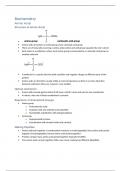
Amino acids all contain an amine group and a carboxylic acid group
There are 20 naturally occurring a-amino acids (amine and acid group separated by one C atom)
Each exists as a zwitterion, where each amine group is protonated by a carboxylic acid group on
another molecule
A zwitterion is a species that has both a positive and negative charge on different parts of the
particle
Amino acids are therefore usually solids at room temperature as there is an ionic attraction
between zwitterions (they are, however, very soluble)
Optical Isomerism
Amino acids (except glycine where R=H) have a chiral C atom and exist as two enantiomers
In nature, only one of these enantiomers is present
Reactions of Amine/Acid Groups
Amine group
o Protonated by acids
o Acylation with acyl chloride/acid anhydride
o Nucleophilic substitution with halogenoalkanes
Acid group
o Deprotonated by bases
o Esterification with alcohols (with acid catalyst)
Making Peptides
Amino acids join together in condensation reactions to make dipeptides (two amino acids joined
together) and polypeptides (several amino acids joined together)
Proteins contain many amino acids joined together (typically 50-2000)
Two amino acids can join together either way round, making two different dipeptides
, The bond between the two amino acids is the peptide link
Peptides can be named by listing the sequence of the amino acids, starting from the amine
group end (e.g. glycine and valine form Gly-Val and Val-Gly dipeptides)
Proteins
Typically contain 50-2000 amino acids joined together in a specific sequence
There are different aspects of the structure of proteins – primary, secondary, tertiary and
quaternary structure (quaternary not studied at A Level)
Primary Structure
The sequence in which amino acids are joined together
E.g. Val-Gly-Phe-Gln-Thr-Gly-Met-etc.
Secondary Structure
Chain of amino acids forms into an alpha helix or beta sheet
The secondary structure is held together by hydrogen bonds between the δ+ H of an NH group
and the lone pair on the O: of a CO group
Tertiary Structure
How the alpha helix or beta sheet folds around into a specific shape
This tertiary shape is held together by interactions between the R groups on amino acids
o Disulfide bonds
o Ionic attractions
o Hydrogen bonds
Amino Acids
Structure of Amino Acids
Amino acids all contain an amine group and a carboxylic acid group
There are 20 naturally occurring a-amino acids (amine and acid group separated by one C atom)
Each exists as a zwitterion, where each amine group is protonated by a carboxylic acid group on
another molecule
A zwitterion is a species that has both a positive and negative charge on different parts of the
particle
Amino acids are therefore usually solids at room temperature as there is an ionic attraction
between zwitterions (they are, however, very soluble)
Optical Isomerism
Amino acids (except glycine where R=H) have a chiral C atom and exist as two enantiomers
In nature, only one of these enantiomers is present
Reactions of Amine/Acid Groups
Amine group
o Protonated by acids
o Acylation with acyl chloride/acid anhydride
o Nucleophilic substitution with halogenoalkanes
Acid group
o Deprotonated by bases
o Esterification with alcohols (with acid catalyst)
Making Peptides
Amino acids join together in condensation reactions to make dipeptides (two amino acids joined
together) and polypeptides (several amino acids joined together)
Proteins contain many amino acids joined together (typically 50-2000)
Two amino acids can join together either way round, making two different dipeptides
, The bond between the two amino acids is the peptide link
Peptides can be named by listing the sequence of the amino acids, starting from the amine
group end (e.g. glycine and valine form Gly-Val and Val-Gly dipeptides)
Proteins
Typically contain 50-2000 amino acids joined together in a specific sequence
There are different aspects of the structure of proteins – primary, secondary, tertiary and
quaternary structure (quaternary not studied at A Level)
Primary Structure
The sequence in which amino acids are joined together
E.g. Val-Gly-Phe-Gln-Thr-Gly-Met-etc.
Secondary Structure
Chain of amino acids forms into an alpha helix or beta sheet
The secondary structure is held together by hydrogen bonds between the δ+ H of an NH group
and the lone pair on the O: of a CO group
Tertiary Structure
How the alpha helix or beta sheet folds around into a specific shape
This tertiary shape is held together by interactions between the R groups on amino acids
o Disulfide bonds
o Ionic attractions
o Hydrogen bonds