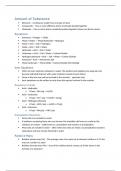
Amount of Substance
Elements – A substance made from one type of atom
Compounds – Two or more different atoms chemically bonded together
Molecules – Two or more atoms covalently bonded together (atoms can be the same)
Equations
Substance + Oxygen -> Oxide
Metal + Water -> Metal Hydroxide + Hydrogen
Metal + Acid -> Salt + Hydrogen
Oxide + Acid -> Salt + Water
Hydroxide + Acid -> Salt + Water
Carbonate + Acid -> Salt + Water + Carbon Dioxide
Hydrogencarbonate + Acid -> Salt + Water + Carbon Dioxide
Ammonia + Acid -> Ammonium Salt
Metal Carbonate -> Metal Oxide + Carbon Dioxide (On Heating)
Ionic Equations
When an ionic substance dissolves in water, the positive and negative ions separate and
become hydrated (interact with water molecles instead of each other)
Some of the ions may not be involved in the reaction – spectator ions
Ionic equations can be written to only show the species involved in the reaction
Reactions of Acids
Acid + Hydroxide
o H+(aq) + OH–(aq) → H2O(l)
Acid + Carbonate
o H+(aq) + CO32–(aq) → H2O(l) + CO2(g)
Acid + Hydrogencarbonate
o H+(aq) + HCO3–(aq) → H2O(l) + CO2(g)
Acid + Ammonia
o H+(aq) + NH3(aq) → NH4+(aq)
Precipitation Reactions
Some salts are insoluble in water
If solutions containing these ions are formed, the insoluble salt forms as a solid as the
solutions are mixed – solid known as a precipitate and reaction as precipitation
Most salts are soluble in water – often when two salts are mixed, no precipitation reactions
takes place and ions remain dissolved in water
Relative Mass
Relative atomic mass (Ar) – The average mass of an atom of an element relative to 1/12 the
mass of a carbon-12 atom
Relative formula mass (Mr) – Sum of the relative atomic masses of all the atoms in the
formula of a substance
, Moles
One mole of anything contains 6.022x10 23 of those things – this number is known as the
Avogadro constant
The mass of one mole of particles of a substance equals the Mr in grams
1 ton = 1,000,000 g
1 kg = 1,000 g
1 mg = 0.001 g
Reacting Mass
You can used balanced chemical equations to find out what mass of chemicals react or are
produced in a chemical reaction
Calculate moles of substance with mass given in question
Calculate moles of substance with mass/Mr needing to be calculated using balanced
equation
Calculate mass/Mr of substance needed in question
Limiting Reagents
It is rare that the exact right amount of chemicals are reacted together – normally one of the
reactants is in excess (more than needed)
The reactant that is not in excess is called the limiting reagent
Work out moles
Use equation to work out how many moles of each substance are needed to completely
react
See which substance is in excess and does not completely react
If needed, work out change in moles of substances using moles of limiting reagent and
equation to work out mass of product
Percentage Yield
When a new substance is formed by a chemical reaction, the expected amount of product
may not be formed
o The reaction may be reversible
o Some product may be lost when seperated from reaction mixture
o Some reactants react in other reactants
% yield = (mass of product obtained/maximum theoretical mass of product) x 100
Atom Economy
Measure of what proportion of the products of a reaction are the desired product and how
much is waste – higher the atom economy, the less waste produced
% yield = ((mass/Mr of desired product)/(Total mass/Mr of products)) x 100
Empirical & Molecular Formulae
Empirical formula – Simplest whole number ratio of stoms of each element in a substance
Molecular formula – Number of atoms of each element in one molecule
Elements – A substance made from one type of atom
Compounds – Two or more different atoms chemically bonded together
Molecules – Two or more atoms covalently bonded together (atoms can be the same)
Equations
Substance + Oxygen -> Oxide
Metal + Water -> Metal Hydroxide + Hydrogen
Metal + Acid -> Salt + Hydrogen
Oxide + Acid -> Salt + Water
Hydroxide + Acid -> Salt + Water
Carbonate + Acid -> Salt + Water + Carbon Dioxide
Hydrogencarbonate + Acid -> Salt + Water + Carbon Dioxide
Ammonia + Acid -> Ammonium Salt
Metal Carbonate -> Metal Oxide + Carbon Dioxide (On Heating)
Ionic Equations
When an ionic substance dissolves in water, the positive and negative ions separate and
become hydrated (interact with water molecles instead of each other)
Some of the ions may not be involved in the reaction – spectator ions
Ionic equations can be written to only show the species involved in the reaction
Reactions of Acids
Acid + Hydroxide
o H+(aq) + OH–(aq) → H2O(l)
Acid + Carbonate
o H+(aq) + CO32–(aq) → H2O(l) + CO2(g)
Acid + Hydrogencarbonate
o H+(aq) + HCO3–(aq) → H2O(l) + CO2(g)
Acid + Ammonia
o H+(aq) + NH3(aq) → NH4+(aq)
Precipitation Reactions
Some salts are insoluble in water
If solutions containing these ions are formed, the insoluble salt forms as a solid as the
solutions are mixed – solid known as a precipitate and reaction as precipitation
Most salts are soluble in water – often when two salts are mixed, no precipitation reactions
takes place and ions remain dissolved in water
Relative Mass
Relative atomic mass (Ar) – The average mass of an atom of an element relative to 1/12 the
mass of a carbon-12 atom
Relative formula mass (Mr) – Sum of the relative atomic masses of all the atoms in the
formula of a substance
, Moles
One mole of anything contains 6.022x10 23 of those things – this number is known as the
Avogadro constant
The mass of one mole of particles of a substance equals the Mr in grams
1 ton = 1,000,000 g
1 kg = 1,000 g
1 mg = 0.001 g
Reacting Mass
You can used balanced chemical equations to find out what mass of chemicals react or are
produced in a chemical reaction
Calculate moles of substance with mass given in question
Calculate moles of substance with mass/Mr needing to be calculated using balanced
equation
Calculate mass/Mr of substance needed in question
Limiting Reagents
It is rare that the exact right amount of chemicals are reacted together – normally one of the
reactants is in excess (more than needed)
The reactant that is not in excess is called the limiting reagent
Work out moles
Use equation to work out how many moles of each substance are needed to completely
react
See which substance is in excess and does not completely react
If needed, work out change in moles of substances using moles of limiting reagent and
equation to work out mass of product
Percentage Yield
When a new substance is formed by a chemical reaction, the expected amount of product
may not be formed
o The reaction may be reversible
o Some product may be lost when seperated from reaction mixture
o Some reactants react in other reactants
% yield = (mass of product obtained/maximum theoretical mass of product) x 100
Atom Economy
Measure of what proportion of the products of a reaction are the desired product and how
much is waste – higher the atom economy, the less waste produced
% yield = ((mass/Mr of desired product)/(Total mass/Mr of products)) x 100
Empirical & Molecular Formulae
Empirical formula – Simplest whole number ratio of stoms of each element in a substance
Molecular formula – Number of atoms of each element in one molecule