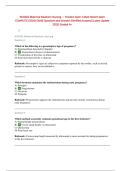
NUR 3123
Pathophysiology & Pharmacology
Final Test Review
(Questions & Solutions)
2025
1
,1. A 68-year-old with type 2 diabetes presents with confusion,
polyuria, and a plasma glucose of 800 mg/dL, serum osmolality 350
mOsm/kg, pH 7.38, and negligible ketones. Which mechanism
primarily accounts for his altered mental status?
A. Dehydration-induced cerebral hypoperfusion
B. Ketone-mediated neuronal dysfunction
C. Hyperosmolar-induced neuronal cell dehydration
D. Lactic acidosis effects
ANS: C
Rationale: In hyperosmolar hyperglycemic state, elevated plasma
osmolality draws water out of neurons, causing cellular dehydration
and altered consciousness.
2. A 45-year-old in septic shock develops diffuse pulmonary infiltrates
and a PaO₂/FiO₂ ratio of 120 mmHg. Which process best describes
the lung injury?
A. Increased hydrostatic pressure in pulmonary capillaries
B. Neutrophil-mediated endothelial damage and alveolar leak
C. Surfactant overproduction
D. Lymphatic obstruction
ANS: B
Rationale: Sepsis triggers neutrophil activation and release of
proteases and cytokines, disrupting alveolar–capillary membranes
and causing noncardiogenic pulmonary edema.
3. A 55-year-old with creatinine clearance of 25 mL/min is prescribed
ceftazidime. What adjustment is most appropriate?
A. Increase dose
B. Decrease dose
C. Shorten dosing interval
2
, D. Eliminate dose adjustment
ANS: B
Rationale: Ceftazidime is renally excreted and accumulates in
renal impairment; reducing individual doses prevents toxicity.
4. A patient with heart failure is switched from enalapril to
sacubitril/valsartan. Which best describes sacubitril’s mechanism?
A. Angiotensin II receptor blockade
B. Neprilysin inhibition, increasing natriuretic peptides
C. Direct renin inhibition
D. Aldosterone receptor antagonism
ANS: B
Rationale: Sacubitril inhibits neprilysin, preventing breakdown of
natriuretic peptides and promoting vasodilation and natriuresis.
5. A febrile ICU patient’s vancomycin regimen is adjusted to achieve
an AUC₀–₂₄/MIC ≥ 400. Which monitoring strategy is ideal?
A. Trough level only
B. Peak level only
C. Paired peak/trough with dosing software
D. Random level after third dose
ANS: C
Rationale: Calculating AUC requires both peak and trough
concentrations, integrated by Bayesian or first-order
pharmacokinetic models.
6. A COPD patient on chronic β₂-agonist inhalers has worsening
wheezing despite increased dose. Which explains this phenomenon?
A. Receptor up-regulation
B. Tachyphylaxis from receptor desensitization
C. Enhanced drug metabolism
D. Improved pulmonary clearance
3
Pathophysiology & Pharmacology
Final Test Review
(Questions & Solutions)
2025
1
,1. A 68-year-old with type 2 diabetes presents with confusion,
polyuria, and a plasma glucose of 800 mg/dL, serum osmolality 350
mOsm/kg, pH 7.38, and negligible ketones. Which mechanism
primarily accounts for his altered mental status?
A. Dehydration-induced cerebral hypoperfusion
B. Ketone-mediated neuronal dysfunction
C. Hyperosmolar-induced neuronal cell dehydration
D. Lactic acidosis effects
ANS: C
Rationale: In hyperosmolar hyperglycemic state, elevated plasma
osmolality draws water out of neurons, causing cellular dehydration
and altered consciousness.
2. A 45-year-old in septic shock develops diffuse pulmonary infiltrates
and a PaO₂/FiO₂ ratio of 120 mmHg. Which process best describes
the lung injury?
A. Increased hydrostatic pressure in pulmonary capillaries
B. Neutrophil-mediated endothelial damage and alveolar leak
C. Surfactant overproduction
D. Lymphatic obstruction
ANS: B
Rationale: Sepsis triggers neutrophil activation and release of
proteases and cytokines, disrupting alveolar–capillary membranes
and causing noncardiogenic pulmonary edema.
3. A 55-year-old with creatinine clearance of 25 mL/min is prescribed
ceftazidime. What adjustment is most appropriate?
A. Increase dose
B. Decrease dose
C. Shorten dosing interval
2
, D. Eliminate dose adjustment
ANS: B
Rationale: Ceftazidime is renally excreted and accumulates in
renal impairment; reducing individual doses prevents toxicity.
4. A patient with heart failure is switched from enalapril to
sacubitril/valsartan. Which best describes sacubitril’s mechanism?
A. Angiotensin II receptor blockade
B. Neprilysin inhibition, increasing natriuretic peptides
C. Direct renin inhibition
D. Aldosterone receptor antagonism
ANS: B
Rationale: Sacubitril inhibits neprilysin, preventing breakdown of
natriuretic peptides and promoting vasodilation and natriuresis.
5. A febrile ICU patient’s vancomycin regimen is adjusted to achieve
an AUC₀–₂₄/MIC ≥ 400. Which monitoring strategy is ideal?
A. Trough level only
B. Peak level only
C. Paired peak/trough with dosing software
D. Random level after third dose
ANS: C
Rationale: Calculating AUC requires both peak and trough
concentrations, integrated by Bayesian or first-order
pharmacokinetic models.
6. A COPD patient on chronic β₂-agonist inhalers has worsening
wheezing despite increased dose. Which explains this phenomenon?
A. Receptor up-regulation
B. Tachyphylaxis from receptor desensitization
C. Enhanced drug metabolism
D. Improved pulmonary clearance
3