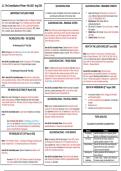
Into The 21st Century
Musical language Musical features of the
Additive rhythm
O
period (1980 - Present Day)
A repeated rhythm, ‘displaced’ either by adding notes to
·Style
↳
or subtracting notes from it There is a wide variety of different musical styles of
This is a well-known technique + can be found in
↳
composition, with no 1 style predominating
Stravinsky This is usually called ‘Pluralism’
-
O
Aleatoric O
Influences
Music in which some element is left to chance or to the
↳
↳
Many composers draw on other music as a basis for
performers to determine their own compositions
Cluster chords
O
These might range from medieval to present day
-
Chords containing 3 or more adjacent notes separated
↳
music + across popular, jazz + world music
by a semitone O
Tonality
These are dissonant chords without resolutions + are
↳
↳
Composers use a wide variety of different tonal +
not found in functional harmony harmonic styles, ranging from serial + atonal through
O
Golden section to very simple modal idioms
A geometrical proportion that divides a line with a
↳
O
Harmony
longer side + a shorter one ↳
No 2 composers will have the same approach to
Many contemporary composers have used the
↳
harmony, which might range from dissonant 12 note
proportion to mark climactic points or moments of chords or microtones to simple triadic harmony
significance in their music O
Metre + rhythm
It can be applied using Fibonacci numbers
↳
↳
Much music since 1980 explores changing time
So, in a piece 34 bars long, the Golden Section falls
-
signatures, unusual metres, polyrhythms, additive
either at the end of bar 21 or bar 13 rhythm, free + aleatoric rhythm + unconventionally
O
Microtones notated rhythm
These are intervals smaller than a semitone,
↳
O
Texture + sonority
frequently used by contemporary composers ↳
The use of texture + sonority is a very important
They are often divided into quarter tones, but may also
↳
element of music since 1980 + is sometimes more
be divided in other ways important to composers than even melody, harmony +
O
Multiphonics rhythm
This is a technique on an instrument that can only
↳
O
Notation
play 1 note at a time in which several notes are ↳
Although many composers continue to use
produced simultaneously conventional traditional notation, many have
They are usually found in music for woodwind using
↳
abandoned or modified this in favour of new ways of
new fingerings or different embouchures notating music
On brass instruments they usually consist of
↳
This might include graphic notation, aleatoric
-
simultaneously playing the instrument + singing into notation, time-based notation + other new systems
it O
Writing for instruments
O
Pluralism ↳
Many new scores feature new techniques of writing for
Pluralism suggests a number of different approaches or
↳
instruments ranging thorough glissandi, multiphonics,
styles, both in music generally + within a musical piece, microtones, key clicks, air tones + many other devices
rather than just 1 kind of style O
Forms
It is a particular feature of the musical world since
↳
↳
Although traditional forms continue to be used,
1980 composers have invented many new types of form for
O
Polyrhythms their music such as chain form, moment form,
A polyrhythm is where 2 different metres or musical
↳
narrative forms + so forth
pulses are played simultaneously
Time-based notation
· Music in which normal rhythmic values are dispensed
with + measured in seconds instead
Musical language Musical features of the
Additive rhythm
O
period (1980 - Present Day)
A repeated rhythm, ‘displaced’ either by adding notes to
·Style
↳
or subtracting notes from it There is a wide variety of different musical styles of
This is a well-known technique + can be found in
↳
composition, with no 1 style predominating
Stravinsky This is usually called ‘Pluralism’
-
O
Aleatoric O
Influences
Music in which some element is left to chance or to the
↳
↳
Many composers draw on other music as a basis for
performers to determine their own compositions
Cluster chords
O
These might range from medieval to present day
-
Chords containing 3 or more adjacent notes separated
↳
music + across popular, jazz + world music
by a semitone O
Tonality
These are dissonant chords without resolutions + are
↳
↳
Composers use a wide variety of different tonal +
not found in functional harmony harmonic styles, ranging from serial + atonal through
O
Golden section to very simple modal idioms
A geometrical proportion that divides a line with a
↳
O
Harmony
longer side + a shorter one ↳
No 2 composers will have the same approach to
Many contemporary composers have used the
↳
harmony, which might range from dissonant 12 note
proportion to mark climactic points or moments of chords or microtones to simple triadic harmony
significance in their music O
Metre + rhythm
It can be applied using Fibonacci numbers
↳
↳
Much music since 1980 explores changing time
So, in a piece 34 bars long, the Golden Section falls
-
signatures, unusual metres, polyrhythms, additive
either at the end of bar 21 or bar 13 rhythm, free + aleatoric rhythm + unconventionally
O
Microtones notated rhythm
These are intervals smaller than a semitone,
↳
O
Texture + sonority
frequently used by contemporary composers ↳
The use of texture + sonority is a very important
They are often divided into quarter tones, but may also
↳
element of music since 1980 + is sometimes more
be divided in other ways important to composers than even melody, harmony +
O
Multiphonics rhythm
This is a technique on an instrument that can only
↳
O
Notation
play 1 note at a time in which several notes are ↳
Although many composers continue to use
produced simultaneously conventional traditional notation, many have
They are usually found in music for woodwind using
↳
abandoned or modified this in favour of new ways of
new fingerings or different embouchures notating music
On brass instruments they usually consist of
↳
This might include graphic notation, aleatoric
-
simultaneously playing the instrument + singing into notation, time-based notation + other new systems
it O
Writing for instruments
O
Pluralism ↳
Many new scores feature new techniques of writing for
Pluralism suggests a number of different approaches or
↳
instruments ranging thorough glissandi, multiphonics,
styles, both in music generally + within a musical piece, microtones, key clicks, air tones + many other devices
rather than just 1 kind of style O
Forms
It is a particular feature of the musical world since
↳
↳
Although traditional forms continue to be used,
1980 composers have invented many new types of form for
O
Polyrhythms their music such as chain form, moment form,
A polyrhythm is where 2 different metres or musical
↳
narrative forms + so forth
pulses are played simultaneously
Time-based notation
· Music in which normal rhythmic values are dispensed
with + measured in seconds instead