Vaughan Williams's
Three songs from On Wenlock Edge:
All Songs.
BACKGROUND
- English composer of symphonies, operas and vocal music amongst other
forms.
- Sought to break away from German Romantic style and looked to other
important influences in his life:
↪ English folk song: Travelled around countryside and transcribed songs, modality
influenced his style
↪ The English choral tradition: Modal Tudor church music particularly.
↪ French Impressionist influence: Had studied in Paris with Ravel: Tremolo strings and
parallel harmonies.
- On Wenlock Edge: A song cycle.
↪ A group of 6 songs setting poems from A Shropshire Lad by A.E. Housman, written in 1896.
↪ Poems describe rural life and convey a nostalgic sense of lost innocence.
POINTS OF INTEREST
- English folk song
- The English choral tradition
- French Impressionist influence
- The Song Cycle
- 20th Century techniques
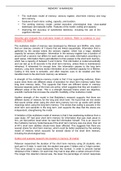
, 1. On Wenlock Edge
STRUCTURE (& TONALITY)
Point Explanation Reference(s)
5 Verses in Houman’s text
Overall structure = A, A, B, B, A/B Structured as a blending of Schubert’s ‘Der Fischer’
- Last verse combines both A + B strophic + through-composed:
elements
- Strophic English
art-song has its origins
in the strophic lieder of
19th century Germany
- Williams betrays
influence of German lied
on the English art-song
genre
BARS 1-16:
- Instrumental introduction then
tenor voice
- Diatonic modal over pentatonic
style ostinato accompaniment
- More dissonance
- Descending chromatic melody for
last line of verse
BARS 16-31: Recalling previous material in a ‘Das Wienen’ Lieder, Schubert
- Modified repeat of music for first summatory way in final section - Piano end postlude recalls
verse of a song: material from previous
- Instrumental introduction now - Not original to Vaughan contrasting sections from
starts in middle of bar
Williams earlier in the section
BARS 32-43:
- New music introduction to the 3rd
verse
- Extended trills
- Mysterious chromatic phrases
highlight words ‘heaving hill’
- Agitated music is all to highlight
the ‘hurtful thoughts’
,BARS 43-55:
- Modified repeat of 3rd verse music
BARS 55-End:
- Combines elements of music from
both 1st + 3rd verses
- Instrumental music from
beginning of 1st verse heard at
beginning of section
- Vocal melody from beginning of
verse 1 heard at low pitch in left
hand piano
- New tremolo accompaniment
above left hand
- Sliding chromatic harmonies of
middle verses are heard next
, MELODY
Point Explanation Reference(s)
Modal style of folk-song influenced Folk-song inspired modal Rhapsody No.1, Norfolk Rhapsodies,
melodic writing writing: Vaughan Williams (1905-1906)
- Emphasizes pastoral setting of - Opens exclusively with a viola
text (COMMON TO ALL 3 SONGS) solo pentatonic melody on E
- Very restricted note range - Modal writing highlights
- Pentatonic outline - Important part of pastoral setting of the text
Vaughan Williams
compositional style Three Elizabethan Songs, No.1, (1891)
- Which set the pastoral - Transposed dorian mode
scene of the poems
------------------------------------ --------------------------------------------
Modal writing is also a feature ‘Sarabande’, from ‘Pour le Piano’,
of French Impressionistic Debussy (1894)
composition: - Written using Aeolian mode on
- Seen in many of the C#
works of Debussy and
Ravel
Style changes dramatically after forte
climax
- Voice descends chromatically
- Sextuplets in piano trills in 2nd
violin + dramatic swells +
waning in dynamics
- Sudden change adds to drama
of storm
Repeated notes + chromaticism
- Creating unrest and unease
Degree of motivic development Symbolic musical integration ‘Das Wienen’, Schubert
- Further acts to represent through motivic development: - Piano‘s opening descending
meaning of text - Very much rooted in motif is developed into 4 parts
- Opening motivic idea portrayed Germanic composition to resemble falling tear
in voice - Vaughan Williams
- Doubled by cello adopted the practice in
- Adding ominous quality to the much of his song
music writing as a means of
- Characterised by interval of achieving compositional
perfect 4th + rhythmic idea of unity, but also depicting
crotchet tied to quaver, followed the evolution of a
by 3 quavers character or theme
within a song
Three songs from On Wenlock Edge:
All Songs.
BACKGROUND
- English composer of symphonies, operas and vocal music amongst other
forms.
- Sought to break away from German Romantic style and looked to other
important influences in his life:
↪ English folk song: Travelled around countryside and transcribed songs, modality
influenced his style
↪ The English choral tradition: Modal Tudor church music particularly.
↪ French Impressionist influence: Had studied in Paris with Ravel: Tremolo strings and
parallel harmonies.
- On Wenlock Edge: A song cycle.
↪ A group of 6 songs setting poems from A Shropshire Lad by A.E. Housman, written in 1896.
↪ Poems describe rural life and convey a nostalgic sense of lost innocence.
POINTS OF INTEREST
- English folk song
- The English choral tradition
- French Impressionist influence
- The Song Cycle
- 20th Century techniques
, 1. On Wenlock Edge
STRUCTURE (& TONALITY)
Point Explanation Reference(s)
5 Verses in Houman’s text
Overall structure = A, A, B, B, A/B Structured as a blending of Schubert’s ‘Der Fischer’
- Last verse combines both A + B strophic + through-composed:
elements
- Strophic English
art-song has its origins
in the strophic lieder of
19th century Germany
- Williams betrays
influence of German lied
on the English art-song
genre
BARS 1-16:
- Instrumental introduction then
tenor voice
- Diatonic modal over pentatonic
style ostinato accompaniment
- More dissonance
- Descending chromatic melody for
last line of verse
BARS 16-31: Recalling previous material in a ‘Das Wienen’ Lieder, Schubert
- Modified repeat of music for first summatory way in final section - Piano end postlude recalls
verse of a song: material from previous
- Instrumental introduction now - Not original to Vaughan contrasting sections from
starts in middle of bar
Williams earlier in the section
BARS 32-43:
- New music introduction to the 3rd
verse
- Extended trills
- Mysterious chromatic phrases
highlight words ‘heaving hill’
- Agitated music is all to highlight
the ‘hurtful thoughts’
,BARS 43-55:
- Modified repeat of 3rd verse music
BARS 55-End:
- Combines elements of music from
both 1st + 3rd verses
- Instrumental music from
beginning of 1st verse heard at
beginning of section
- Vocal melody from beginning of
verse 1 heard at low pitch in left
hand piano
- New tremolo accompaniment
above left hand
- Sliding chromatic harmonies of
middle verses are heard next
, MELODY
Point Explanation Reference(s)
Modal style of folk-song influenced Folk-song inspired modal Rhapsody No.1, Norfolk Rhapsodies,
melodic writing writing: Vaughan Williams (1905-1906)
- Emphasizes pastoral setting of - Opens exclusively with a viola
text (COMMON TO ALL 3 SONGS) solo pentatonic melody on E
- Very restricted note range - Modal writing highlights
- Pentatonic outline - Important part of pastoral setting of the text
Vaughan Williams
compositional style Three Elizabethan Songs, No.1, (1891)
- Which set the pastoral - Transposed dorian mode
scene of the poems
------------------------------------ --------------------------------------------
Modal writing is also a feature ‘Sarabande’, from ‘Pour le Piano’,
of French Impressionistic Debussy (1894)
composition: - Written using Aeolian mode on
- Seen in many of the C#
works of Debussy and
Ravel
Style changes dramatically after forte
climax
- Voice descends chromatically
- Sextuplets in piano trills in 2nd
violin + dramatic swells +
waning in dynamics
- Sudden change adds to drama
of storm
Repeated notes + chromaticism
- Creating unrest and unease
Degree of motivic development Symbolic musical integration ‘Das Wienen’, Schubert
- Further acts to represent through motivic development: - Piano‘s opening descending
meaning of text - Very much rooted in motif is developed into 4 parts
- Opening motivic idea portrayed Germanic composition to resemble falling tear
in voice - Vaughan Williams
- Doubled by cello adopted the practice in
- Adding ominous quality to the much of his song
music writing as a means of
- Characterised by interval of achieving compositional
perfect 4th + rhythmic idea of unity, but also depicting
crotchet tied to quaver, followed the evolution of a
by 3 quavers character or theme
within a song