100% tevredenheidsgarantie Direct beschikbaar na je betaling Lees online óf als PDF Geen vaste maandelijkse kosten 4.2 TrustPilot
logo-home
Tentamen (uitwerkingen)

BIOD 171 Microbiology Module 1 – 6 Exam Questions and Answers2025/2026

Beoordeling
-
Verkocht
-
Pagina's
368
Cijfer
A+
Geüpload op
01-07-2025
Geschreven in
2024/2025

BIOD 171 Microbiology Module 1 – 6 Exam Questions and Answers BIOD 171 Microbiology Module 1 – 6 Exam Questions and Answers Microbiology -Answer-The study of microbes and their biological processes at the micro (microscopic) level. Microbes -Answer-1. A general term that includes microorganisms and viruses; an organism or virus too small to be seen without a microscope 2. Beneficial when aiding in food digestion to protecting us when we are exposed to potentially harmful foreign invaders to helping crops grow 3. Detrimental when harmful strains of bacteria, fungi, protozoa, and viruses kill millions of people each year and sicken even more Microorganisms -Answer-1. Usually consist of a single cell 2. Examples: bacteria, archaeons, fungi, protozoa, and algae Prokaryotic or eukaryotic -Answer-1. The most common distinction between living organisms 2. Prokaryotic cells (before kernel) lack a nucleus, whereas eukaryotic cells (true kernel) have a defined nuclear region 3. Difference: size, complexity, unicellular or multicellular, abundance, examples, nucleus & DNA, and membrane-bound organelles 4. Similarity: macromolecules, plasma membrane, cytosol, chromosomes, and ribosomes 3 classifications of life -Answer-1. Bacteria, Archaea, and Eukarya 2. The first two categories are prokaryotic microorganisms that are different in cellular composition Bacteria (Prokaryotes) -Answer-1. Morphologies: coccus (round/spherical), bacillus (rod), vibrio (curved rod), or spirillum (spiral/corkscrew). 2. Cellular organization: isolated (individual) cells, in chains, or in clusters 3. Examples: Streptococcus (round chains); E. coli (rod); Mycobacterium tuberculosis (a unicellular bacterium) Archaea (Prokaryotes) -Answer-1. Also referred to as extremophiles 2. Survive in extremely harsh environmental conditions, such as high salt levels, acid conditions, high temperatures, and oxygen-poor conditions Eukarya -Answer-Animalia, Plantae, Fungi, and Protista Animalia -Answer-1. Multicellular eukaryotic organisms includes animals and humans 2. Heterotrophic and the general characteristic of motility Heterotrophic -Answer-Incapable of producing one's own energy, must absorb (consume) nutrients from the environment Plantae -Answer-1. Multicellular eukaryotes with cell walls made of cellulose 2. Obtain most energy from sunlight via photosynthesis - autotrophic Photosynthesis -Answer-A process that converts light energy (sunlight) into chemical energy (sugars) within the organism and fuels its activities. The process of capturing sunlight and converting it into the usable energy sources ATP and NADPH. Fungi -Answer-1. Either multicellular or unicellular microorganisms 2. Heterotrophic and the presence of chitin (a derivative of glucose) in cell walls 3. Examples of multicellular fungi are molds and mushrooms; the most common unicellular fungus is yeast Protista -Answer-1. Unicellular microorganisms 2. May form as colonies (seemingly multicellular but do not form tissue layers and thus retain the unicellular classification) 3. Examples: amoeba (motility); algae (plant-like characteristics); mold (fungi-like properties). Viruses -Answer-1. Neither prokaryotic nor eukaryotic 2. Not considered living and do not replicate on their own (only within a host) 3. Contain a capsid, a membrane-like structure that contains genetic material, similar to the nucleus Cell membrane/plasma membrane/cytoplasmic membrane -Answer-1. A semi- permeable barrier surrounding the cytoplasmic space of a cell acts as a barrier to the outside environment while also retaining and preventing the intra (within) cellular components from being lost to the surrounding environment 2. A bilayer composed primarily of amphipathic phospholipids that contain a polar hydrophilic (water loving) head group and a non-polar hydrophobic (water fearing) tail region 3. A relatively high degree of fluidity dependent on the types of lipids, the temperature, and additional molecules (proteins) 4. Sterol lipids (such as cholesterol), which play a major role in eukaryotic membrane composition Cell walls/outer membrane -Answer-1. Found in bacteria, plants, fungi, and algae and help to form the shape of the cell, providing support, structure, and protection 2. Peptidoglycan for bacterial wall: a peptide-polysaccharide matrix; vary in thickness to protect the cell from potentially damaging environmental stresses 3. Surface-layer proteins (S-layer) for archaea cell: physical and chemical protective barrier to the harsh surrounding environments 4. Cellulose and chitin for fungi 5. Mannoproteins (highly glycosylated polypeptides called mannan and mannose) and chitin for yeasts 6. Silica (main component in glass) for Diatoms (algae) : very rigid 7. Some eukaryotic cell walls may contain polysaccharides, like cellulose and pectin Cell envelope -Answer-The combination of the cell membrane and the outer membrane (cell wall) Cytoplasm -Answer-1. Constitutes the open volume within a cell; 2. Comprised mostly of water containing dissolved substances important to the functioning of the cell. Organelles -Answer-Membrane-enclosed structures within the cytoplasm that perform specific functions. Nucleus -Answer-1. A porous double lipid bilayer that contains the genomic content of the cell (DNA) 2. The command center of the cell 3. The defining organelle of all eukaryotic cells Nucleolus -Answer-Within the nucleus, the site of ribosome synthesis Ribosomes -Answer-1. Responsible for protein synthesis. 2. Located in the cytoplasm of prokaryotic cells and attached to the endoplasmic reticulum in eukaryotic cells Endoplasmic Reticulum (ER) -Answer-1. A series of membrane-enclosed sacs and interconnected tubes (lumen) 2. Composed of the smooth endoplasmic reticulum (SER) and the rough endoplasmic reticulum (RER with ribosomes stud the surfac

Meer zien Lees minder
Instelling
BIOD 171
Vak
BIOD 171


Oeps! We kunnen je document nu niet laden. Probeer het nog eens of neem contact op met support.

Geschreven voor

Instelling
BIOD 171
Vak
BIOD 171

Documentinformatie

Geüpload op
1 juli 2025
Aantal pagina's
368
Geschreven in
2024/2025
Type
Tentamen (uitwerkingen)
Bevat
Vragen en antwoorden

Onderwerpen

Voorbeeld van de inhoud

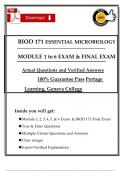
BIOD 171 ESSENTIAL MICROBIOLOGY

MODULE 1 to 6 EXAM & FINAL EXAM

Actual Questions and Verified Answers

100% Guarantee Pass Portage

Learning, Geneva College


Inside you will get:
Module 1, 2, 3, 4, 5, & 6 Exam. & BIOD 171 Final Exam
True & False Questions
Multiple Choice Questions and Answers
Clear images
Expert-Verified Explanations

, Table of Contents
BIOD 171 Module 1 Exam ..............................................................2

BIOD 171 Module 2 Exam ............................................................19

BIOD 171 Module 3 Exam ............................................................41

BIOD 171 Module 4 Exam ............................................................76

BIOD 171 Module 5 Exam ..........................................................103

BIOD 171 Module 6 Exam ..........................................................144

BIOD 171 Final Exam .................................................................. 175


BIOD 171 Module 1 Exam
1. At a generalized level, all cells are comprised of what?

Answer choices:
A. Macromolecules
B. Organelles
C. Organisms
D. Tissues
ANSWER: A. Macromolecules
Expert Rationale: Cells are constructed primarily from

macromolecules][— proteins, lipids, nucleic acids, and polysaccharides—

,that collectively perform structural and catalytic functions. Partial answers

listing only some macromolecule classes are incomplete.
---


2. True/False. A virus is classified as a microbe:
ANSWER: True
Expert Rationale: While viruses are not living organisms and do not meet

the criteria of microorganisms, they are included within the broad

category of microbes. Microbes encompass all microscopic entities

including bacteria, archaea, protists, fungi, and viruses, the latter due to

their biological relevance and impact.


---


3. True or False: The smallest biological unit of life is the molecule:

ANSWER: False

Expert Rationale: Molecules, such as proteins and nucleic acids, are
chemical structures but do not independently exhibit characteristics of life.

The cell is the smallest unit capable of sustaining life processes like

metabolism, growth, and reproduction.


---


4. What is the smallest biological unit of life?

Answer choices:
A. Atom

, B. Molecule

€15,78
Krijg toegang tot het volledige document:

100% tevredenheidsgarantie
Direct beschikbaar na je betaling
Lees online óf als PDF
Geen vaste maandelijkse kosten


Ook beschikbaar in voordeelbundel

Maak kennis met de verkoper

Seller avatar
De reputatie van een verkoper is gebaseerd op het aantal documenten dat iemand tegen betaling verkocht heeft en de beoordelingen die voor die items ontvangen zijn. Er zijn drie niveau’s te onderscheiden: brons, zilver en goud. Hoe beter de reputatie, hoe meer de kwaliteit van zijn of haar werk te vertrouwen is.
ScholarsCorner Princeton University
Volgen Je moet ingelogd zijn om studenten of vakken te kunnen volgen
Verkocht
47
Lid sinds
10 maanden
Aantal volgers
11
Documenten
1787
Laatst verkocht
1 week geleden
Scholar's Corner - Your go-to hub for academic excellence.

Welcome to Scholar's Corners Your trusted source for high-quality, -based test banks, flashcards, and study bundles designed to help you excel in Nursing, NCLEX, Medicine, Business, and Law. We write accurate, exam-focused materials sourced from top Global. colleges, ensuring you study efficiently and pass with confidence. ✅ NCLEX & Nursing Exam Prep ✅ Medical & Business Study Guides ✅ Flashcards for Fast Revision ✅ Verified Answers with Rationales ✅ Easy-to-use, downloadable files

Lees meer Lees minder
4,6

9 beoordelingen

5
7
4
0
3
2
2
0
1
0

Recent door jou bekeken

Waarom studenten kiezen voor Stuvia

Gemaakt door medestudenten, geverifieerd door reviews

Kwaliteit die je kunt vertrouwen: geschreven door studenten die slaagden en beoordeeld door anderen die dit document gebruikten.

Niet tevreden? Kies een ander document

Geen zorgen! Je kunt voor hetzelfde geld direct een ander document kiezen dat beter past bij wat je zoekt.

Betaal zoals je wilt, start meteen met leren

Geen abonnement, geen verplichtingen. Betaal zoals je gewend bent via Bancontact, iDeal of creditcard en download je PDF-document meteen.

Student with book image

“Gekocht, gedownload en geslaagd. Zo eenvoudig kan het zijn.”

Alisha Student

Veelgestelde vragen