Skip to Main Content
Online Residential Athletics Alumni Request Info Apply Now Visit Us Create Guest Account Sign In
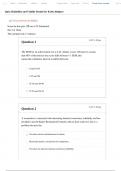
Quiz: Reliability and Validity Results for Krista Rodgers
Correct answers are hidden.
Score for this quiz: 25 out of 25 Submitted
Jun 2 at 10am
This attempt took 17 minutes.
1..25 pts
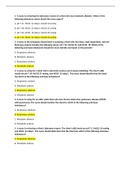
Question 1
The SEM for an achievement test is 2.45. Johnny scores 100 and we assume
that 68% of the time his true score falls between + 1 SEM; this
means the confidence interval would be between:
0 and 102.45
2.45 and 100
95.10 and 104.90
97.55 and 102.45
1..25 pts
Question 2
A researcher is concerned with measuring internal consistency reliability and has
decided to use the Kuder-Richardson Formulas with a Likert scale test; this is a
problem because the:
Test does not have dichotomous test items.
Researcher needs a second test for comparison.
Test does not measure internal consistency reliability.
, Researcher is concerned with content sampling error.
1..25 pts
Question 3
If the reliability coefficient of a test is determined to be .27, what
percentage is attributed to random chance or error?
27%
73%
2.7%
Unknown percentage
1..25 pts
Question 4
You are attempting to account for a time sampling error and decide to
administer the test a second time. In discussing reliability, you report this as what
method of estimating reliability?
Alternate forms
Split-half reliability
Internal consistency reliability
1..25 pts
Question 5
The test manual reports a reliability coefficient (r) of .92, which means:
Online Residential Athletics Alumni Request Info Apply Now Visit Us Create Guest Account Sign In
Quiz: Reliability and Validity Results for Krista Rodgers
Correct answers are hidden.
Score for this quiz: 25 out of 25 Submitted
Jun 2 at 10am
This attempt took 17 minutes.
1..25 pts
Question 1
The SEM for an achievement test is 2.45. Johnny scores 100 and we assume
that 68% of the time his true score falls between + 1 SEM; this
means the confidence interval would be between:
0 and 102.45
2.45 and 100
95.10 and 104.90
97.55 and 102.45
1..25 pts
Question 2
A researcher is concerned with measuring internal consistency reliability and has
decided to use the Kuder-Richardson Formulas with a Likert scale test; this is a
problem because the:
Test does not have dichotomous test items.
Researcher needs a second test for comparison.
Test does not measure internal consistency reliability.
, Researcher is concerned with content sampling error.
1..25 pts
Question 3
If the reliability coefficient of a test is determined to be .27, what
percentage is attributed to random chance or error?
27%
73%
2.7%
Unknown percentage
1..25 pts
Question 4
You are attempting to account for a time sampling error and decide to
administer the test a second time. In discussing reliability, you report this as what
method of estimating reliability?
Alternate forms
Split-half reliability
Internal consistency reliability
1..25 pts
Question 5
The test manual reports a reliability coefficient (r) of .92, which means: