100% tevredenheidsgarantie Direct beschikbaar na je betaling Lees online óf als PDF Geen vaste maandelijkse kosten 4.2 TrustPilot
logo-home
Tentamen (uitwerkingen)

LRM4801 Assignment 2 (100% ANSWERS) 2025 - DUE 7 July 2025

Beoordeling
4,3
(3)
Verkocht
8
Pagina's
16
Cijfer
A+
Geüpload op
27-06-2025
Geschreven in
2024/2025

LRM4801 Assignment 2 (100% ANSWERS) 2025 - DUE 7 July 2025 Ubuntu AutoTech South Africa (UASA) Ubuntu AutoTech South Africa (UASA) is a Gauteng-based automotive manufacturing company with a workforce of just over 2000 employees. As part of its strategic vision for long-term competitiveness and alignment with global manufacturing trends, the company is rolling out a large-scale automation and digital transformation initiative. This move is directly inspired by the World Economic Forum’s Future of Jobs Report 2025, which emphasises the need for agility, lifelong learning, and alignment between technology and human capital. The transformation project includes the integration of robotics on the assembly line, advanced data analytics systems, and predictive maintenance technologies. The executive team sees these changes as an opportunity to boost productivity, reduce operational costs, and modernise the company’s processes. To support this strategic shift, UASA management has adopted an internal communication approach that emphasises unity and shared purpose. Slogans such as “One Team, One Future” and “Together Towards Tomorrow” feature prominently in CEO webinars and staff newsletters. Training academies have been launched to facilitate reskilling and upskilling, although participation is based on management-driven skills forecasting rather than negotiated development pathways. Despite recognising multiple trade unions in the workplace, UASA tends to favour consultative engagement over formal collective bargaining processes. Management believes that conflict can be minimised through transparent leadership and ongoing communication. However, union representatives have expressed dissatisfaction with the limited scope of their involvement, particularly regarding restructuring processes. Executives have downplayed these concerns, framing transformation as a “strategic business imperative, not a negotiation.” In line with this philosophy, middle managers have been trained to manage employee resistance proactively and to align departmental practices with overarching transformation goals. While formal grievance channels remain, employees are encouraged to resolve issues informally to “preserve harmony and focus.” UASA's internal approach to labour relations is occurring within a broader context of a highly unionised automotive sector in South Africa—one historically marked by adversarial labour relations. Three major trade unions are active at UASA, including one affiliated with COSATU. Tensions have grown due to concerns over unilateral decision-making, automation-driven job displacement, and unequal access to new skills development opportunities. LRM4801 Assessment 02 13 © UNISA 2025 At an industry level, UASA participates in the Automotive Industry Employers Association of South Africa (AIEASA), a key body in sectoral bargaining and policy coordination. Sectoral matters affecting wages, working conditions, and employment standards are negotiated through the Automotive Industry Bargaining Council (AIBC), which plays a central role in stabilising labour relations in the automotive sector. While AIEASA promotes proactive investment in workforce digital readiness and diversity, it also cautions employers to anticipate resistance if transformation is not approached collaboratively. These concerns are proving valid. Several disputes related to redeployment, job grading, and severance packages have been referred to the Commission for Conciliation, Mediation and Arbitration (CCMA). Although UASA previously resolved most conflicts internally, the rising number of referrals points to waning employee trust and growing perceptions of procedural unfairness. To address these challenges, UASA has established a Joint Labour-Management Transformation Forum comprising HR executives, shop stewards, and employee-elected representatives. However, union delegates have voiced frustration that the forum serves a symbolic rather than substantive role, with limited influence on final decisions. These organisational tensions are further compounded by national labour market challenges, including high youth unemployment, limited skills transformation, and rising pressure for socially just workplace reforms. UASA’s experience highlights the complex interplay between internal strategies, sectoral dynamics, and broader socio-economic realities shaping labour relations in South Africa today. Compounding these dynamics is the introduction of the Employment Equity Amendment Act, 4 of 2022, which requires designated employers like UASA to comply with new sectoral targets and reporting obligations. UASA’s HR team must now evaluate how its transformation plans align not only with economic and technological imperatives, but also with legal compliance, employment equity goals, and stakeholder expectations in a highly regulated labour environment. Question 1: Labour relations perspective Labour relations theory offers different perspectives for understanding the nature of the employment relationship – most notably the unitarist, pluralist and radical perspectives. UASA appears to adopt a specific labour relations perspective in its approach to managing workplace change and stakeholder engagement. 1.1 Critically compare how UASA’s current labour relations approach, as described in the scenario, would be interpreted through a pluralist and a radical frame of reference. In your response, reflect on how each perspective would shape the understanding of conflict, perspective on trade union involvement, goals and values of employers and employees, and strikes. (10) 1.2 Based on your comparative analysis above, infer which labour relations perspective (unitarist, pluralist or radical) appears most dominant in UASA’s current approach. Justify your conclusion with specific examples from the scenario. (5) In your answer, reflect on how each perspective would shape the understanding of conflict, perspective on trade union involvement, goals and values of employers and employees, and strikes in the transformation process. [15] Question 2: Role-players in employment relations Examine the roles of the key employment relations actors involved in UASA’s transformation process. Discuss the importance and efficacy of each of these role-players at the organisational, industry, and national levels. In your analysis, consider the specific dynamics of the automotive manufacturing sector in South Africa LRM4801 Assessment 02 14 © UNISA 2025 and how each role-player contributes to or hinders efforts to navigate change, promote fair labour practices, and maintain employment stability. [15] Question 3: External environmental analysis As part of the transformation at UASA, several trade unions, including the majority union affiliated with COSATU, have submitted a formal list of demands to the employer. These include: • A moratorium on retrenchments linked to automation • Guaranteed retraining and redeployment opportunities for affected employees • Enhanced worker participation in technology implementation decisions • A wage adjustment aligned with increased productivity from automation • Inclusion of a digital literacy allowance in the next round of wage negotiations We can assume that the union(s) conducted an environmental analysis to formulate these demands in response to both organisational changes and broader labour market shifts. As the representative of the Automative Industry Employers Association of South Africa (AIEASA), conduct an external environmental analysis using information from the Future of Jobs Report 2025, the South African economic context, and trends in the automative sector. Write a formal memorandum to the Automotive Industry Bargaining Council (AIBC) in which you: • Acknowledge the demands made by the union(s) representing UASA employees. • Summarise key external environmental factors influencing the automotive manufacturing industry. • State whether you agree or disagree with the demands, providing a clear justification based on your environmental analysis. • Draw conclusions about the feasibility and implications of the union’s demands for employers in the sector. • Present a reasoned argument that balances the interests of the business, workers, and the broader economic context. [20] Question 4: Application of labour legislation: Employment Equity Act (EEA) Amendments The Employment Equity Amendment Act, 4 of 2022, introduces significant changes to South Africa’s employment equity framework. Among the key amendments are sector-specific numerical targets, expanded enforcement powers for the Department of Employment and Labour, and a renewed emphasis on transformation as a condition for doing business with the state. UASA, as a designated employer in the manufacturing sector, is currently reviewing its employment equity practices to ensure compliance with the amended Act. Management is concerned about balancing the demands of compliance, transformation, and technological disruption brought on by the Fourth Industrial Revolution. Write a legal advisory report to UASA’s HR Executive Team that addresses the following: 4.1 Summarise the key amendments introduced by the 2022 changes to the Employment Equity Act and explain their implications for designated employers. (5) 4.2 Analyse how these amendments intersect with UASA’s current transformation and digital reskilling initiatives. (5) LRM4801 Assessment 02 15 © UNISA 2025 4.3 Propose strategic recommendations to align UASA’s employment equity planning and labour relations strategy with both the amended EEA and the demands of a 4IR-driven environment. (5) [15] Question 5: Labour relations policy and strategic alignment UASA is undergoing a major transformation driven by automation and digital innovation. While management emphasises transparency, internal cohesion, and skills development, tensions with organised labour have revealed gaps in how employment relations are managed, particularly during times of change. Currently, UASA does not have a formalised labour relations policy aligned with its digital transformation strategy, and decisions regarding union engagement, dispute resolution, and change management have been handled inconsistently across departments. As a labour relations consultant, you have been asked to draft a strategic advisory brief for UASA’s Executive Committee. In your brief, address the following: 5.1 Discuss the strategic importance of implementing a formal labour relations policy at UASA in the context of its digital transformation. Explain how such a policy can contribute to organisational stability, employee trust, and fair employment relations, while enabling UASA to navigate the challenges of the Fourth Industrial Revolution. (10) 5.2 Propose key components that should be included in UASA’s labour relations policy, ensuring alignment with both legislative requirements and strategic business goals. (10) 5.3 Provide recommendations on how to embed the labour relations strategy into the broader employment relations and organisational strategies. (5) [25]

Meer zien Lees minder
Instelling
Vak


Oeps! We kunnen je document nu niet laden. Probeer het nog eens of neem contact op met support.

Gekoppeld boek

Geschreven voor

Instelling
Vak

Documentinformatie

Geüpload op
27 juni 2025
Aantal pagina's
16
Geschreven in
2024/2025
Type
Tentamen (uitwerkingen)
Bevat
Vragen en antwoorden

Onderwerpen

Voorbeeld van de inhoud

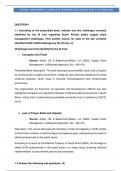
LRM4801 Assignment 2 2025
Unique Number:
Due date: 7 July 2025
LABOUR RELATIONS PERSPECTIVE

1.1. Pluralist and a radical frame of reference

From a pluralist perspective, UASA’s actions reflect a disregard for the reality that the
workplace includes multiple interest groups with different goals and values (Swanepoel &
Slabbert, 2012:27). In pluralism, conflict is seen as normal and inevitable due to these
differing interests. Trade unions are viewed as legitimate and essential actors who represent
the views of employees and help balance power between employers and workers. In the
case of UASA, however, the preference for consultation over formal collective bargaining
limits meaningful union involvement. For instance, the “Joint Labour-Management
Transformation Forum” seems to exist more for appearances than for real negotiation. From
a pluralist point of view, this undermines effective conflict resolution and can weaken trust
between the parties involved (Swanepoel & Slabbert, 2012:28).

In terms of goals and values, the pluralist lens would interpret UASA's focus on unity and
shared slogans like “One Team, One Future” as overly simplistic. Pluralism


DISCLAIMER & TERMS OF USE
 Educational Aid: These study notes are intended to be used as educational resources and should not be seen as a
replacement for individual research, critical analysis, or professional consultation. Students are encouraged to perform
their own research and seek advice from their instructors or academic advisors for specific assignment guidelines.
 Personal Responsibility: While every effort has been made to ensure the accuracy and reliability of the information in
these study notes, the seller does not guarantee the completeness or correctness of all content. The buyer is
responsible for verifying the accuracy of the information and exercising their own judgment when applying it to their
assignments.
 Academic Integrity: It is essential for students to maintain academic integrity and follow their institution's policies
regarding plagiarism, citation, and referencing. These study notes should be used as learning tools and sources of
inspiration. Any direct reproduction of the content without proper citation and acknowledgment may be considered
academic misconduct.
 Limited Liability: The seller shall not be liable for any direct or indirect damages, losses, or consequences arising from
the use of these notes. This includes, but is not limited to, poor academic performance, penalties, or any other negative
consequences resulting from the application or misuse of the information provided.

€2,66
Krijg toegang tot het volledige document:
Gekocht door 8 studenten

100% tevredenheidsgarantie
Direct beschikbaar na je betaling
Lees online óf als PDF
Geen vaste maandelijkse kosten

Beoordelingen van geverifieerde kopers

Alle 3 reviews worden weergegeven
2 weken geleden

5 maanden geleden

6 maanden geleden

4,3

3 beoordelingen

5
2
4
0
3
1
2
0
1
0
Betrouwbare reviews op Stuvia

Alle beoordelingen zijn geschreven door echte Stuvia-gebruikers na geverifieerde aankopen.

Maak kennis met de verkoper

Seller avatar
De reputatie van een verkoper is gebaseerd op het aantal documenten dat iemand tegen betaling verkocht heeft en de beoordelingen die voor die items ontvangen zijn. Er zijn drie niveau’s te onderscheiden: brons, zilver en goud. Hoe beter de reputatie, hoe meer de kwaliteit van zijn of haar werk te vertrouwen is.
EdithNcobgo AAA School of Advertising
Volgen Je moet ingelogd zijn om studenten of vakken te kunnen volgen
Verkocht
167
Lid sinds
5 jaar
Aantal volgers
1
Documenten
157
Laatst verkocht
2 weken geleden

4,6

24 beoordelingen

5
18
4
2
3
4
2
0
1
0

Recent door jou bekeken

Waarom studenten kiezen voor Stuvia

Gemaakt door medestudenten, geverifieerd door reviews

Kwaliteit die je kunt vertrouwen: geschreven door studenten die slaagden en beoordeeld door anderen die dit document gebruikten.

Niet tevreden? Kies een ander document

Geen zorgen! Je kunt voor hetzelfde geld direct een ander document kiezen dat beter past bij wat je zoekt.

Betaal zoals je wilt, start meteen met leren

Geen abonnement, geen verplichtingen. Betaal zoals je gewend bent via Bancontact, iDeal of creditcard en download je PDF-document meteen.

Student with book image

“Gekocht, gedownload en geslaagd. Zo eenvoudig kan het zijn.”

Alisha Student

Veelgestelde vragen