

NEUROGENETICS SAMENVATTING
CHAPTER 1 : INTELLECTUAL DISABILITY
Intellectual disability: <70
Interaction of many genes and environmental factors: monogenic / chromosomal abnormalities or
catastrophic events like prenatal infections
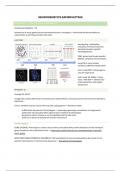
HISTORY
karyotyping : prebanding
(visualize chromosomes) and
banding (visualize specific
banding pattern)
FISH: detect and locate specific
DNA by using fluorescent probes
arrayCGH: copy number
variations (deletion/duplication)
short-read WES: coding regions
only 2% of genome
short-read: 50-300bp long-
read: >100.000 => identify very
small aberations and repeat
expansions
TRISOMY 21
Average IQ: 40-50
Congenital cardiac defects (bv atrioventricular septal defect), structural and functions GI tract disorders,
hypotonia…
Chr21: smallest human chrom with only 233 coding genes => therefore viable
- 5,4Mb Down Syndrome Critical Region => phenotype genotype correlations of a segmental
duplication (but actually other regions also contribute to phenotype)
- No gene for which trisomy is not compatible with life after birth
- Extra chr21 does not disturb the mitotic mechanism
HYPOTHESES
GENE DOSAGE: Phenotype is a direct result of the cumulative effect of the imbalance of the individual
genes located on the triplicated chrom => phenotype results directly from overexpression of specific
chr21 genes
AMPLIFIED DEVELOPMENTAL INSTABILITY: DS manifestations can be interpreted as the result of non-
specific disturbances of chromosome balances => disruption of homeostasis
,HOW DID THEY STUDY
1) Ts65Dn : carries a partial trisomy of mouse chromosome 16, mimicking human chromosome 21
(140 duplicated genes). Serves as model for understanding the underlying pathophysiology, but it
also includes non HSA21 genes
2) Tc1 : contains copy of human HSA21 chrom to study phenotypic consequences and Alzheimer,
but mutations in this model because of different human-mouse arrangements (human
centromeres do not fully function in mice) => mosaic mice with trisomic and euploid cells
3) Other models, but these have all duplications of specific orthologue genes, without an extra
chromosome or centromere (and only 168 of the 233 are well conserved in mice)
4) In vitro trisomy 21 IPSCs to investigate the impact in neural, hematopoetic and cardiac
development; but not reproducible. Not generalizable for the diversity of DS people
FROM GENOTYPE TO PHENOTYPE
(non) dosage sensitive: 3 copies of a dosage sensitive gene contribute to the phenotype (applies
codingRNA and non-codingRNA like microRNA).
Allele specific: the specific combination of alleles of a gene determine the phenotypic effect. The effect of
the combination of alleles can be qualitive (AA variation) or quantitative (expression level differences
between alleles)
Threshold effect: only phenotype when total transcript or protein level from the combination of the 3
alleles reaches a crucial amount
Direct effects: higher expression of dosage-sensitive genes on chr21 directly leads to phenotype
indirect effects: disturbed interactions with non-HSA21 genes (also these interactions can be allele-
specific; only specific interactions lead to a phenotype
Conserved non-genic sequences (CNGs): regulatory functions (gene enhancer/silencer) => duplication of
these can contribute to phenotype via up or downregulation of genes
All this declares the high variability between DS patients!
, DEREGULATED PATHWAYS
Early cortical development: neural progenitor cells (NPCs) undergo symmetrical divisions => expansion ;
at certain point they differentiate into neurons, asymmetrical divisions => neurogenesis ; then neurons
become gliogenic and produce astrocytes and oligodendrocytes
DS: shift in timing of these events (= heterochrony) => fewer NPCs produced before transition to
neurogenesis + premature transition from neurogenic to gliogenic
DYRK1A (dosage sensitive gene) is active in subventricular zone with neural progenitors =>
overexpression leads to no migration from subventricular to cortical plate => too early differentiation and
higher gliogenesis so a higher astrocyte neuron ratio!
ALZHEIMER
Increased gene dosage of APP (amyloid precursor protein) and DYRK1A (dual specificity tyrosine
phosphorylation regulated kinase 1A)
Production of toxic Abeta42 peptide by amyloidogenic processing by beta and gamma secretase +
phosphorylation by DYRK1A increases the amyloidogenic processing of APP. DYRK also phosphorylates
tau => neurofibrillary tangle formation because of lower binding affinity of 3R tau. APOEe4 alters the
clearance and deposition of Abeta
Pharmacotherapy under investigation of normalization of gene dosage of DYRK1A ; but haploinsufficiency
of DYRK1A leads to brain atrophy and neurodevelopmental delays, so determine the most optimal dose
for each neurogenesis stage
KARYOTYPING (1970)
Banding techniques: harvest chromosomes in mitosis (tubulin inhibitors)
G banding: staining with Giemsa dye => dark bands contain AT-rich regions (heterochromatin, gene poor)
which replicate late in the S-phase light bands are GC-rich and replicate early (euchromatin,
transcriptionally active)
Structural variations: abnormalities in structure of chrom: balanced (=no net gain or loss of chromosomal
material, such as inversions and translocations, normally no abnormal phenotype; except when genes
end up in heterochromatin or separated from regulatory units ) unbalanced
CRI-DU-CHAT SYNDROME
Terminal deletion of short arm of chr5
Contiguous gene deletion syndrome: removes several genes lying in close proximity => unrelated clinical
features where each individual gene within a contiguous regions gives rise to a specific feature
Genotype-phenotype correlation: compare individuals with different deletion sizes and correlate a
specific clinical phenotype: severity ≈ size of deletion
KLEEFSTRA SYNDROME
Microdeletion in EHMT1 gene on chr9 = monogenic! In all deletions, this gene is missing
Deletion too small to be picked up with karyotyping (<3Mb)
CHAPTER 1 : INTELLECTUAL DISABILITY
Intellectual disability: <70
Interaction of many genes and environmental factors: monogenic / chromosomal abnormalities or
catastrophic events like prenatal infections
HISTORY
karyotyping : prebanding
(visualize chromosomes) and
banding (visualize specific
banding pattern)
FISH: detect and locate specific
DNA by using fluorescent probes
arrayCGH: copy number
variations (deletion/duplication)
short-read WES: coding regions
only 2% of genome
short-read: 50-300bp long-
read: >100.000 => identify very
small aberations and repeat
expansions
TRISOMY 21
Average IQ: 40-50
Congenital cardiac defects (bv atrioventricular septal defect), structural and functions GI tract disorders,
hypotonia…
Chr21: smallest human chrom with only 233 coding genes => therefore viable
- 5,4Mb Down Syndrome Critical Region => phenotype genotype correlations of a segmental
duplication (but actually other regions also contribute to phenotype)
- No gene for which trisomy is not compatible with life after birth
- Extra chr21 does not disturb the mitotic mechanism
HYPOTHESES
GENE DOSAGE: Phenotype is a direct result of the cumulative effect of the imbalance of the individual
genes located on the triplicated chrom => phenotype results directly from overexpression of specific
chr21 genes
AMPLIFIED DEVELOPMENTAL INSTABILITY: DS manifestations can be interpreted as the result of non-
specific disturbances of chromosome balances => disruption of homeostasis
,HOW DID THEY STUDY
1) Ts65Dn : carries a partial trisomy of mouse chromosome 16, mimicking human chromosome 21
(140 duplicated genes). Serves as model for understanding the underlying pathophysiology, but it
also includes non HSA21 genes
2) Tc1 : contains copy of human HSA21 chrom to study phenotypic consequences and Alzheimer,
but mutations in this model because of different human-mouse arrangements (human
centromeres do not fully function in mice) => mosaic mice with trisomic and euploid cells
3) Other models, but these have all duplications of specific orthologue genes, without an extra
chromosome or centromere (and only 168 of the 233 are well conserved in mice)
4) In vitro trisomy 21 IPSCs to investigate the impact in neural, hematopoetic and cardiac
development; but not reproducible. Not generalizable for the diversity of DS people
FROM GENOTYPE TO PHENOTYPE
(non) dosage sensitive: 3 copies of a dosage sensitive gene contribute to the phenotype (applies
codingRNA and non-codingRNA like microRNA).
Allele specific: the specific combination of alleles of a gene determine the phenotypic effect. The effect of
the combination of alleles can be qualitive (AA variation) or quantitative (expression level differences
between alleles)
Threshold effect: only phenotype when total transcript or protein level from the combination of the 3
alleles reaches a crucial amount
Direct effects: higher expression of dosage-sensitive genes on chr21 directly leads to phenotype
indirect effects: disturbed interactions with non-HSA21 genes (also these interactions can be allele-
specific; only specific interactions lead to a phenotype
Conserved non-genic sequences (CNGs): regulatory functions (gene enhancer/silencer) => duplication of
these can contribute to phenotype via up or downregulation of genes
All this declares the high variability between DS patients!
, DEREGULATED PATHWAYS
Early cortical development: neural progenitor cells (NPCs) undergo symmetrical divisions => expansion ;
at certain point they differentiate into neurons, asymmetrical divisions => neurogenesis ; then neurons
become gliogenic and produce astrocytes and oligodendrocytes
DS: shift in timing of these events (= heterochrony) => fewer NPCs produced before transition to
neurogenesis + premature transition from neurogenic to gliogenic
DYRK1A (dosage sensitive gene) is active in subventricular zone with neural progenitors =>
overexpression leads to no migration from subventricular to cortical plate => too early differentiation and
higher gliogenesis so a higher astrocyte neuron ratio!
ALZHEIMER
Increased gene dosage of APP (amyloid precursor protein) and DYRK1A (dual specificity tyrosine
phosphorylation regulated kinase 1A)
Production of toxic Abeta42 peptide by amyloidogenic processing by beta and gamma secretase +
phosphorylation by DYRK1A increases the amyloidogenic processing of APP. DYRK also phosphorylates
tau => neurofibrillary tangle formation because of lower binding affinity of 3R tau. APOEe4 alters the
clearance and deposition of Abeta
Pharmacotherapy under investigation of normalization of gene dosage of DYRK1A ; but haploinsufficiency
of DYRK1A leads to brain atrophy and neurodevelopmental delays, so determine the most optimal dose
for each neurogenesis stage
KARYOTYPING (1970)
Banding techniques: harvest chromosomes in mitosis (tubulin inhibitors)
G banding: staining with Giemsa dye => dark bands contain AT-rich regions (heterochromatin, gene poor)
which replicate late in the S-phase light bands are GC-rich and replicate early (euchromatin,
transcriptionally active)
Structural variations: abnormalities in structure of chrom: balanced (=no net gain or loss of chromosomal
material, such as inversions and translocations, normally no abnormal phenotype; except when genes
end up in heterochromatin or separated from regulatory units ) unbalanced
CRI-DU-CHAT SYNDROME
Terminal deletion of short arm of chr5
Contiguous gene deletion syndrome: removes several genes lying in close proximity => unrelated clinical
features where each individual gene within a contiguous regions gives rise to a specific feature
Genotype-phenotype correlation: compare individuals with different deletion sizes and correlate a
specific clinical phenotype: severity ≈ size of deletion
KLEEFSTRA SYNDROME
Microdeletion in EHMT1 gene on chr9 = monogenic! In all deletions, this gene is missing
Deletion too small to be picked up with karyotyping (<3Mb)


