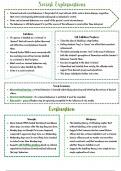
Social Explanations
Criminal and anti-social behaviour is the product of some internal state, such as brain damage, suggesting
that crime is biologically determined and beyond an individual’s control.
Crime can be learned behaviour as a result of the person’s social circumstances.
The behaviour is still determined it is just the source of the influence is social rather than biological.
Labelling:
If a person is labelled as a ‘criminal’ or Self-fulfilling Prophecy:
‘deviant’ that will come to define them and Takes the idea of labelling a step further.
will affect how society behaves towards Calling students ‘lazy’ or ‘clever’ can affect their eventual
them. achievement.
Howard Becker 1963 is more concerned with The label eventually becomes ‘real’ in the way it influences
how and why some actions become labelled both the student’s perception of themselves and the teacher’s
as a criminal in the first place. behaviour towards them.
What counts as criminal behaviour only Can also be applied to the label ‘criminal’.
becomes so when labelled by others. Stigmatised and isolated from society, the offender seeks
Crime is a social construct. support from deviant groups and subcultures.
This draws individuals further into crime.
Social Learning:
Observational learning - criminal behaviour is learned indirectly by observing and imitating the actions of deviant
others.
Vicarious reinforcement - if a criminal behaviour is imitated, it must be rewarded.
Role models - young offenders may be especially susceptible to the influence of role models.
Evaluation
Strength: Weakness:
Marie Jahoda 1954 studied the Ashanti and Ghana The labelling theory of offending implies that
where boys are names after the day they were born. without labelling, crime would not exist,
Monday boys are thought to be even tempered Suggests that someone who has committed an
compared to aggressive boys born on a Wednesday. offence but has not been labelled is not a criminal.
Wednesday boys were 3x more likely to be involved Serious offences such as murder are more than
in violent crime than Monday boys. social constructs, and that murderers are criminals
Suggests self-fulfilling prophecy based on cultural whether they are labelled or not.
expectations had been formed and had influenced Suggests the labelling theory is too simple to be a
the boys’ behaviour. single explanation of crime.
Criminal and anti-social behaviour is the product of some internal state, such as brain damage, suggesting
that crime is biologically determined and beyond an individual’s control.
Crime can be learned behaviour as a result of the person’s social circumstances.
The behaviour is still determined it is just the source of the influence is social rather than biological.
Labelling:
If a person is labelled as a ‘criminal’ or Self-fulfilling Prophecy:
‘deviant’ that will come to define them and Takes the idea of labelling a step further.
will affect how society behaves towards Calling students ‘lazy’ or ‘clever’ can affect their eventual
them. achievement.
Howard Becker 1963 is more concerned with The label eventually becomes ‘real’ in the way it influences
how and why some actions become labelled both the student’s perception of themselves and the teacher’s
as a criminal in the first place. behaviour towards them.
What counts as criminal behaviour only Can also be applied to the label ‘criminal’.
becomes so when labelled by others. Stigmatised and isolated from society, the offender seeks
Crime is a social construct. support from deviant groups and subcultures.
This draws individuals further into crime.
Social Learning:
Observational learning - criminal behaviour is learned indirectly by observing and imitating the actions of deviant
others.
Vicarious reinforcement - if a criminal behaviour is imitated, it must be rewarded.
Role models - young offenders may be especially susceptible to the influence of role models.
Evaluation
Strength: Weakness:
Marie Jahoda 1954 studied the Ashanti and Ghana The labelling theory of offending implies that
where boys are names after the day they were born. without labelling, crime would not exist,
Monday boys are thought to be even tempered Suggests that someone who has committed an
compared to aggressive boys born on a Wednesday. offence but has not been labelled is not a criminal.
Wednesday boys were 3x more likely to be involved Serious offences such as murder are more than
in violent crime than Monday boys. social constructs, and that murderers are criminals
Suggests self-fulfilling prophecy based on cultural whether they are labelled or not.
expectations had been formed and had influenced Suggests the labelling theory is too simple to be a
the boys’ behaviour. single explanation of crime.