Explanation of crime and anti-social
behaviour: Biological
Brain injury:
Huw Williams et al 2010 analysed data from
196 inmates from a single UK prison.
60% of the sample recalled a history of one or
more head injuries in their youth.
This group tended to be younger at the time of
their first offence, recorded higher rates of
reoffending, and had spent more time in prison in
the last 5 years than the rest of the sample.
Connection between brain injury and offending.
ABIs - acquired brain injuries which cause the
developing brain to misfire.
The brain is not fully mature until someone is in
amygdala and aggression: their mid 20s.
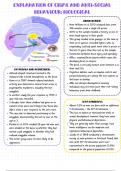
Almond-shaped structure located in the Cognitive abilities such as impulse control and
temporal lobe in both hemispheres of the brain. forward planning are among the last aspects of
Raine et al 1997 showed reduced metabolic the brain to develop.
activity was observed in several brain areas of ABIs can disrupt development meaning
psychopathic murderers, including the left individuals may not move past their risk-taking
amygdala. behaviour from their childhood.
In another study the fear response of 1795 3
year olds was recorded.
2 decades later those children had gone on to xyy syndrome:
commit crime were more likely to be those who About 0.2% of men are born with an additional
didn’t show a fear response to the first tone. Y chromosome - the XYY chromosome.
This was due to abnormal functioning of the This has no effect on testosterone levels or
amygdala, illustrated by the lack of fear at the sexual development, however they have some
age of 3. physical and behavioural differences.
Pardini et al 2014 studied 26 year old men and They are generally taller than average, have
were divided on the basis of whether they had lower intelligence, can be impulsive and
normal sized amygdala or whether they had experience behavioural difficulties.
reduced amygdala volume. Jacobs et al 1968 conducted a chromosome
The latter group were 3x more likely to be survey of male patients in Scotland. Found that
aggressive. men with XYY chromosomes were over-
represented in the prison population (2.9%)
compared to the general population (0.2%).
behaviour: Biological
Brain injury:
Huw Williams et al 2010 analysed data from
196 inmates from a single UK prison.
60% of the sample recalled a history of one or
more head injuries in their youth.
This group tended to be younger at the time of
their first offence, recorded higher rates of
reoffending, and had spent more time in prison in
the last 5 years than the rest of the sample.
Connection between brain injury and offending.
ABIs - acquired brain injuries which cause the
developing brain to misfire.
The brain is not fully mature until someone is in
amygdala and aggression: their mid 20s.
Almond-shaped structure located in the Cognitive abilities such as impulse control and
temporal lobe in both hemispheres of the brain. forward planning are among the last aspects of
Raine et al 1997 showed reduced metabolic the brain to develop.
activity was observed in several brain areas of ABIs can disrupt development meaning
psychopathic murderers, including the left individuals may not move past their risk-taking
amygdala. behaviour from their childhood.
In another study the fear response of 1795 3
year olds was recorded.
2 decades later those children had gone on to xyy syndrome:
commit crime were more likely to be those who About 0.2% of men are born with an additional
didn’t show a fear response to the first tone. Y chromosome - the XYY chromosome.
This was due to abnormal functioning of the This has no effect on testosterone levels or
amygdala, illustrated by the lack of fear at the sexual development, however they have some
age of 3. physical and behavioural differences.
Pardini et al 2014 studied 26 year old men and They are generally taller than average, have
were divided on the basis of whether they had lower intelligence, can be impulsive and
normal sized amygdala or whether they had experience behavioural difficulties.
reduced amygdala volume. Jacobs et al 1968 conducted a chromosome
The latter group were 3x more likely to be survey of male patients in Scotland. Found that
aggressive. men with XYY chromosomes were over-
represented in the prison population (2.9%)
compared to the general population (0.2%).