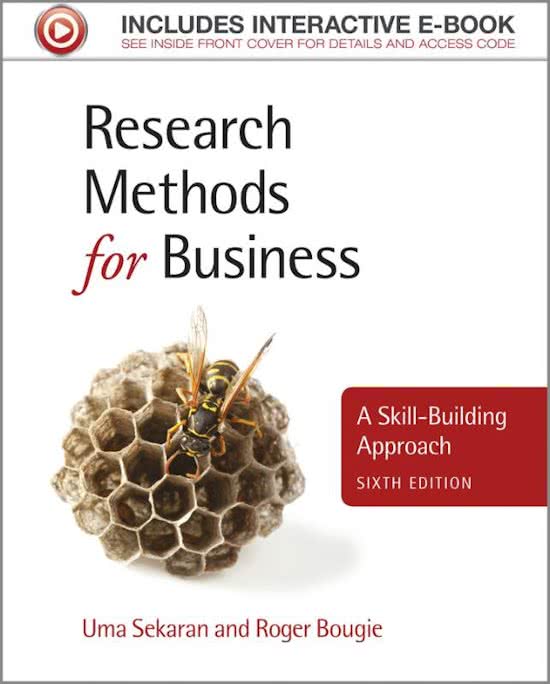
Research Methods for Business: A Skill-Building Approach
● Authors: Uma Sekaran and Roger Bougie
● Latest Edition: 8th Edition (2019)
● Publisher: Wiley
● ISBN: 9781119561224
Summary:
This book guides readers through the process of conducting business research,
emphasizing a practical, skill-building approach. It covers the entire research process, from
identifying a problem to collecting and analyzing data, and finally presenting findings. The
authors focus on developing critical thinking and analytical skills, essential for effective
decision-making in business contexts. The 8th edition includes updated examples and
exercises to enhance learning outcomes
✅ Chapter 1: Introduction to Research
🔹 Summary
This chapter introduces the fundamental concept of business research and its importance
in decision-making. Research is defined as a systematic and organized effort to investigate a
specific problem that needs a solution. The primary goal is to identify, analyze, and solve
problems using empirical data.
The chapter explains how businesses operate in increasingly complex environments and
face challenges that require evidence-based decisions. Research offers tools and
methodologies to collect relevant information, analyze it rigorously, and draw valid
conclusions.
Key characteristics of good research include:
● Purposefulness
● Rigor
● Testability
● Replicability
● Precision and confidence
● Objectivity
● Generalizability
● Parsimony (simplicity)
The chapter also distinguishes between basic and applied research:
● Basic research enhances theoretical understanding without immediate commercial
benefit.
, ● Applied research addresses specific business problems for practical application.
It highlights that successful managers must understand the value of research in gaining
competitive advantage and reducing uncertainty in business decisions.
🔑 Key Concepts and Terms
● Business Research: A systematic inquiry aimed at providing information to guide
managerial decisions.
● Scientific Method: An approach involving observation, hypothesis formation, data
collection, and analysis to answer questions logically.
● Applied Research: Research conducted to solve specific, practical questions; often
tied to decision-making in organizations.
● Basic Research: Research that seeks to expand existing knowledge or theories
without a direct practical application in mind.
● Manager–Researcher Relationship: The collaboration between decision-makers
and researchers that ensures the research addresses real business needs.
● Characteristics of Scientific Research:
○ Purposefulness: Clearly defined objectives.
○ Rigor: Careful and disciplined methodology.
○ Testability: Hypotheses should be verifiable.
○ Replicability: Results should be reproducible.
○ Precision: Accuracy in results.
○ Confidence: Reliability of findings.
○ Objectivity: Unbiased and logical reasoning.
○ Generalizability: Applicability of findings to wider contexts.
○ Parsimony: Simplicity in explanations without losing essence.
✅ Chapter 2: Scientific Investigation
🔹 Summary
This chapter explains the scientific investigation process as a disciplined method of
solving business problems. It emphasizes how a structured and methodical approach leads
to reliable conclusions that managers can act upon.
A scientific investigation involves the following eight-step model:
1. Observation: Identifying a problem or phenomenon.
2. Preliminary Data Gathering: Collecting background information through interviews,
documents, etc.
3. Theory Formulation: Building a logical explanation or conceptual framework.
4. Hypothesizing: Formulating testable propositions.
, 5. Further Data Collection: Designing tools (surveys, interviews, etc.) to collect
primary data.
6. Data Analysis: Using statistical methods to examine relationships and trends.
7. Deduction: Drawing conclusions from data to accept/reject hypotheses.
8. Report Writing: Presenting findings with clarity and recommendations.
The chapter stresses that the hallmarks of scientific research—objectivity, replicability,
and systematic observation—make this process superior to intuition or guesswork in
business.
Additionally, it distinguishes between inductive and deductive reasoning:
● Inductive: Moving from observations to theory.
● Deductive: Starting with theory and testing it with data.
Also, the importance of theory is highlighted—it helps to organize knowledge, explain
phenomena, and predict outcomes.
🔑 Key Concepts and Terms
● Scientific Investigation: A logical, systematic process used to solve business
problems through empirical research and theoretical analysis.
● Inductive Reasoning: Deriving general theories from specific observations
(bottom-up approach).
● Deductive Reasoning: Testing hypotheses derived from theory through data
collection (top-down approach).
● Conceptual Framework: A structure that shows the variables relevant to the study
and the relationships among them.
● Hypothesis: A specific, testable prediction about the relationship between variables.
● Data Collection: The process of gathering information from primary or secondary
sources to test hypotheses.
● Theory: A set of interrelated concepts that explain or predict phenomena.
● Empirical Data: Information based on observation or experimentation rather than
theory alone.
● Causality: The relationship between a cause and its effect, often tested in research
to identify how one variable influences another.
✅ Chapter 3: The Research Process – Steps and
Proposals
🔹 Summary
, This chapter provides a comprehensive overview of the entire research process, outlining
each stage involved in conducting effective business research—from identifying a problem to
presenting the final report.
The process typically involves the following key steps:
1. Identifying the broad problem area: Triggered by changes in environment,
competition, operations, or internal inefficiencies.
2. Defining the problem statement: Narrowing down to a specific, researchable issue
that guides the study.
3. Developing theoretical framework: Linking the problem to existing theories and
identifying variables and relationships.
4. Generating hypotheses: Testable statements based on theoretical background and
problem definition.
5. Determining the research design: Deciding how to collect and analyze data (e.g.,
survey, experiment, case study).
6. Collecting data: Using methods such as interviews, observations, or questionnaires.
7. Analyzing data: Employing qualitative or quantitative techniques to interpret the
findings.
8. Interpreting results and drawing conclusions: Relating results back to the
hypotheses and theory.
9. Report writing and presentation: Documenting findings, methodology, and
recommendations in a professional format.
Additionally, this chapter discusses research proposals, which are crucial at the early
stages of a project. A proposal outlines the problem, objectives, literature review,
methodology, and expected outcomes. It helps gain approval from supervisors or funding
bodies and ensures clarity and direction.
🔑 Key Concepts and Terms
● Problem Definition: A clear, concise statement that specifies the issue to be studied
in the research.
● Theoretical Framework: A logically developed, described, and elaborated network
of associations among variables considered relevant to the problem.
● Hypotheses: Assumptions or predictions to be tested through empirical data
collection and analysis.
● Research Design: The overall strategy chosen to integrate the different components
of the study in a coherent and logical way.
● Primary Data: Data collected directly from original sources through interviews,
surveys, or observations.
● Secondary Data: Existing information that has been collected by someone else for
another purpose but is relevant to the current research.
● Feasibility Study: A preliminary analysis to determine whether a proposed research
project is viable given the time, budget, and resources.
● Authors: Uma Sekaran and Roger Bougie
● Latest Edition: 8th Edition (2019)
● Publisher: Wiley
● ISBN: 9781119561224
Summary:
This book guides readers through the process of conducting business research,
emphasizing a practical, skill-building approach. It covers the entire research process, from
identifying a problem to collecting and analyzing data, and finally presenting findings. The
authors focus on developing critical thinking and analytical skills, essential for effective
decision-making in business contexts. The 8th edition includes updated examples and
exercises to enhance learning outcomes
✅ Chapter 1: Introduction to Research
🔹 Summary
This chapter introduces the fundamental concept of business research and its importance
in decision-making. Research is defined as a systematic and organized effort to investigate a
specific problem that needs a solution. The primary goal is to identify, analyze, and solve
problems using empirical data.
The chapter explains how businesses operate in increasingly complex environments and
face challenges that require evidence-based decisions. Research offers tools and
methodologies to collect relevant information, analyze it rigorously, and draw valid
conclusions.
Key characteristics of good research include:
● Purposefulness
● Rigor
● Testability
● Replicability
● Precision and confidence
● Objectivity
● Generalizability
● Parsimony (simplicity)
The chapter also distinguishes between basic and applied research:
● Basic research enhances theoretical understanding without immediate commercial
benefit.
, ● Applied research addresses specific business problems for practical application.
It highlights that successful managers must understand the value of research in gaining
competitive advantage and reducing uncertainty in business decisions.
🔑 Key Concepts and Terms
● Business Research: A systematic inquiry aimed at providing information to guide
managerial decisions.
● Scientific Method: An approach involving observation, hypothesis formation, data
collection, and analysis to answer questions logically.
● Applied Research: Research conducted to solve specific, practical questions; often
tied to decision-making in organizations.
● Basic Research: Research that seeks to expand existing knowledge or theories
without a direct practical application in mind.
● Manager–Researcher Relationship: The collaboration between decision-makers
and researchers that ensures the research addresses real business needs.
● Characteristics of Scientific Research:
○ Purposefulness: Clearly defined objectives.
○ Rigor: Careful and disciplined methodology.
○ Testability: Hypotheses should be verifiable.
○ Replicability: Results should be reproducible.
○ Precision: Accuracy in results.
○ Confidence: Reliability of findings.
○ Objectivity: Unbiased and logical reasoning.
○ Generalizability: Applicability of findings to wider contexts.
○ Parsimony: Simplicity in explanations without losing essence.
✅ Chapter 2: Scientific Investigation
🔹 Summary
This chapter explains the scientific investigation process as a disciplined method of
solving business problems. It emphasizes how a structured and methodical approach leads
to reliable conclusions that managers can act upon.
A scientific investigation involves the following eight-step model:
1. Observation: Identifying a problem or phenomenon.
2. Preliminary Data Gathering: Collecting background information through interviews,
documents, etc.
3. Theory Formulation: Building a logical explanation or conceptual framework.
4. Hypothesizing: Formulating testable propositions.
, 5. Further Data Collection: Designing tools (surveys, interviews, etc.) to collect
primary data.
6. Data Analysis: Using statistical methods to examine relationships and trends.
7. Deduction: Drawing conclusions from data to accept/reject hypotheses.
8. Report Writing: Presenting findings with clarity and recommendations.
The chapter stresses that the hallmarks of scientific research—objectivity, replicability,
and systematic observation—make this process superior to intuition or guesswork in
business.
Additionally, it distinguishes between inductive and deductive reasoning:
● Inductive: Moving from observations to theory.
● Deductive: Starting with theory and testing it with data.
Also, the importance of theory is highlighted—it helps to organize knowledge, explain
phenomena, and predict outcomes.
🔑 Key Concepts and Terms
● Scientific Investigation: A logical, systematic process used to solve business
problems through empirical research and theoretical analysis.
● Inductive Reasoning: Deriving general theories from specific observations
(bottom-up approach).
● Deductive Reasoning: Testing hypotheses derived from theory through data
collection (top-down approach).
● Conceptual Framework: A structure that shows the variables relevant to the study
and the relationships among them.
● Hypothesis: A specific, testable prediction about the relationship between variables.
● Data Collection: The process of gathering information from primary or secondary
sources to test hypotheses.
● Theory: A set of interrelated concepts that explain or predict phenomena.
● Empirical Data: Information based on observation or experimentation rather than
theory alone.
● Causality: The relationship between a cause and its effect, often tested in research
to identify how one variable influences another.
✅ Chapter 3: The Research Process – Steps and
Proposals
🔹 Summary
, This chapter provides a comprehensive overview of the entire research process, outlining
each stage involved in conducting effective business research—from identifying a problem to
presenting the final report.
The process typically involves the following key steps:
1. Identifying the broad problem area: Triggered by changes in environment,
competition, operations, or internal inefficiencies.
2. Defining the problem statement: Narrowing down to a specific, researchable issue
that guides the study.
3. Developing theoretical framework: Linking the problem to existing theories and
identifying variables and relationships.
4. Generating hypotheses: Testable statements based on theoretical background and
problem definition.
5. Determining the research design: Deciding how to collect and analyze data (e.g.,
survey, experiment, case study).
6. Collecting data: Using methods such as interviews, observations, or questionnaires.
7. Analyzing data: Employing qualitative or quantitative techniques to interpret the
findings.
8. Interpreting results and drawing conclusions: Relating results back to the
hypotheses and theory.
9. Report writing and presentation: Documenting findings, methodology, and
recommendations in a professional format.
Additionally, this chapter discusses research proposals, which are crucial at the early
stages of a project. A proposal outlines the problem, objectives, literature review,
methodology, and expected outcomes. It helps gain approval from supervisors or funding
bodies and ensures clarity and direction.
🔑 Key Concepts and Terms
● Problem Definition: A clear, concise statement that specifies the issue to be studied
in the research.
● Theoretical Framework: A logically developed, described, and elaborated network
of associations among variables considered relevant to the problem.
● Hypotheses: Assumptions or predictions to be tested through empirical data
collection and analysis.
● Research Design: The overall strategy chosen to integrate the different components
of the study in a coherent and logical way.
● Primary Data: Data collected directly from original sources through interviews,
surveys, or observations.
● Secondary Data: Existing information that has been collected by someone else for
another purpose but is relevant to the current research.
● Feasibility Study: A preliminary analysis to determine whether a proposed research
project is viable given the time, budget, and resources.