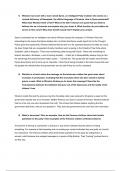
How do the Writers Present Passion?
In both Keat’s poem ‘La Belle Dame Sans Merci’, Dowson’s ‘Non Sum Qualis’, and
Bronte’s novel ‘Wuthering Heights’, passion is presented as an intense obsession
culminating in an inability to think of anything other than the object of your
feelings. An intense uncontrollable emotion that often transcends into spiritual
longing and the thought that life without your love is meaningless.
In ‘La Belle Dame Sans Merci’, Keats tells the narrative of the male speaker, who
meets a nameless woman, who he shares a passionate relationship with, yet she
eventually abandons him. Keats presents passion as a singular focused
obsession. The speaker describes how he ‘nothing else saw all day long’, this
suggests due to passion, he has become absorbed in the woman, perhaps it
could also suggest that the speaker, in his passion, has become detached from
reality. Possibly, Keats could be exploring Romantic ideas on spiritual
connections, however, in ‘La Belle Dame Sans Merci’, Keats also associates
passion with physicality. Perhaps also suggesting intense emotion is caused by
physical sensation. For example, this is shown with ‘she made sweet moan’ and
‘I set her on my pacing steed’, Keats frequent use of sexual euphemisms links
passion as a feeling heavily associated with our physical senses. Uncontrollable
wild emotion is something Keats also explores as an aspect of passion, he
repeats ‘her wild eyes’, ‘I shut her wild, wild eyes’ suggesting passion is
something beyond the rules and laws of our human world. This is again
emphasised when the woman is described as a ‘faery’ and speaking a ‘strange
language’, these quotes have mythical connotations, and Keats could be further
associating passion with feelings that cannot be understood or controlled. Finally,
Keats presents an important aspect of passion as life without one partner being
meaningless and painful. He repeats ‘and no birds sing’ in the first stanza, and as
the last line of the poem – suggesting when the woman leaves the speaker, any
joy and life around him leaves. ‘No’ has a definite finality that suggests the
speaker cannot recover from this passionate relationship. The cyclical structure
of the poem could be a suggestion of the inevitability of a painful end to an
intense, passionate relationship. Possibly, Keat’s intention could be to warn the
reader that relationships of this nature are unsustainable.
In Dowson’s poem ‘Non Sum Qualis’ the speaker describes how he tries to fill the
void in his life left by a woman, yet he cannot stop thinking about her. Like Keats,
Dowson presents passion as an intense obsession. The repetition of ‘Cynara!’
suggests the speaker feels so passionately he is unable to forget her, this is
further emphasised by the constant use of exclamation which shows the strength
of his longing. The word ‘Cynara’ is so entrenched into the structure of the poem
that it forces the reader to feel the same inability to think of anything else, and it
visually mirrors the speaker’s obsessive thoughts. Unlike the physical sensations
Keat’s associates with passion, in ‘Non Sum Qualis’ the physical ‘kisses’ and
‘bought red mouth’ of a prostitute cannot compare to the spiritual longing he
feels for ‘Cynara’. Here, Dowson could be exploring Romantic ideas that true
passion transcends physical boundaries, and is a deeper, spiritual longing for
another. At the end of the poem the speaker is ‘desolate and sick with an old
In both Keat’s poem ‘La Belle Dame Sans Merci’, Dowson’s ‘Non Sum Qualis’, and
Bronte’s novel ‘Wuthering Heights’, passion is presented as an intense obsession
culminating in an inability to think of anything other than the object of your
feelings. An intense uncontrollable emotion that often transcends into spiritual
longing and the thought that life without your love is meaningless.
In ‘La Belle Dame Sans Merci’, Keats tells the narrative of the male speaker, who
meets a nameless woman, who he shares a passionate relationship with, yet she
eventually abandons him. Keats presents passion as a singular focused
obsession. The speaker describes how he ‘nothing else saw all day long’, this
suggests due to passion, he has become absorbed in the woman, perhaps it
could also suggest that the speaker, in his passion, has become detached from
reality. Possibly, Keats could be exploring Romantic ideas on spiritual
connections, however, in ‘La Belle Dame Sans Merci’, Keats also associates
passion with physicality. Perhaps also suggesting intense emotion is caused by
physical sensation. For example, this is shown with ‘she made sweet moan’ and
‘I set her on my pacing steed’, Keats frequent use of sexual euphemisms links
passion as a feeling heavily associated with our physical senses. Uncontrollable
wild emotion is something Keats also explores as an aspect of passion, he
repeats ‘her wild eyes’, ‘I shut her wild, wild eyes’ suggesting passion is
something beyond the rules and laws of our human world. This is again
emphasised when the woman is described as a ‘faery’ and speaking a ‘strange
language’, these quotes have mythical connotations, and Keats could be further
associating passion with feelings that cannot be understood or controlled. Finally,
Keats presents an important aspect of passion as life without one partner being
meaningless and painful. He repeats ‘and no birds sing’ in the first stanza, and as
the last line of the poem – suggesting when the woman leaves the speaker, any
joy and life around him leaves. ‘No’ has a definite finality that suggests the
speaker cannot recover from this passionate relationship. The cyclical structure
of the poem could be a suggestion of the inevitability of a painful end to an
intense, passionate relationship. Possibly, Keat’s intention could be to warn the
reader that relationships of this nature are unsustainable.
In Dowson’s poem ‘Non Sum Qualis’ the speaker describes how he tries to fill the
void in his life left by a woman, yet he cannot stop thinking about her. Like Keats,
Dowson presents passion as an intense obsession. The repetition of ‘Cynara!’
suggests the speaker feels so passionately he is unable to forget her, this is
further emphasised by the constant use of exclamation which shows the strength
of his longing. The word ‘Cynara’ is so entrenched into the structure of the poem
that it forces the reader to feel the same inability to think of anything else, and it
visually mirrors the speaker’s obsessive thoughts. Unlike the physical sensations
Keat’s associates with passion, in ‘Non Sum Qualis’ the physical ‘kisses’ and
‘bought red mouth’ of a prostitute cannot compare to the spiritual longing he
feels for ‘Cynara’. Here, Dowson could be exploring Romantic ideas that true
passion transcends physical boundaries, and is a deeper, spiritual longing for
another. At the end of the poem the speaker is ‘desolate and sick with an old