Sofie De Korte 2024-2025
Session 1: Introduction - Foundations, philosophy, outline
Bandwagons
2 questions for this class:
1. What is wrong with our financial/banking system today?
➔ Bad press / no trust
➔ Paradox of finance
2. What can we do about it now that we could not before?
Paradox of finance
- Bad press, examples:
o Bernie Madoff, infamous for running the largest Ponzi scheme (pyramid) in history.
o Sam Bankman-Fried, founder of FTX, charged with fraud in a major cryptocurrency collapse.
o The Occupy Wall Street movement, protesting financial corruption and corporate greed.
o Markus Braun, former CEO of Wirecard, involved in a massive fintech fraud (just taking payment
transactions) – Netflix: Skandel
- Pop culture – Fight Club (1999)
o Story of movie: guy struggling in life, makes up alterego (guy on right), group of guys beating each
other doing this bcs of society, so they want to change society from evil stuff by destroying banks
o Link with class: if you want to get better in society, you need to change things, first things to change:
fin system
o Problem with movie: how to make a world without banks
- Historical inheritance
o Grand mirror of Folly (John Law 1720)
o Finance as being evil is not recent, has existed for long time
- … Yet: also enjoying the system e.g. insurance, mortgages, bank account, health care,…
2 questions for this class:
1. What is wrong with our financial/banking system today?
➔ Can we get the good without the bad?
2. What can we do about it now that we could not before?
➔ Technology
➔ Policy
Modernity – Technology & Policy
- Information Technology
- Global policy (regulations become very complex)
- EU Policy
1
,Sofie De Korte 2024-2025
One step back
“This is water” ~ David Foster Wallace
➔ If you are going to change smth in the system, you need to know what the waters are (what the fin
system is about and what it serves)
Finance from first principles:
- Embryonic society: people with stuff and needs -> organize transfers -> population grows
- Finance to manage those transfers
- Technology to reduce the cost
Strong feedback loop
- In essence, financial technology is a time machine we have built ourselves. It can’t move people through time,
but it can move their money.”
- Book ‘Sapiens’
- Book ‘Debt’
- Dunbar number: 150 (we can only really maintain about 150 connections at once, if more, we need
technology)
A bit of history – Finance x Technology x Society
- Uruk, located in Irak: first metropolis in history (first big population; 40 000 people), where writing is invented
- When people started living in large communities like Uruk, they shared their lives with strangers as well as
friends. It may have been possible to know everyone in a large farming village, but not in a vast city, such as
Uruk. What were once implicit agreements among neighbors now became explicit contractual agreements
among strangers.
The connection between the tablets and the tokens helps explain the function of each. Virtually all of the
earliest tablets from Uruk were accounting documents recording the transfer of goods and commodities.
Writing was invented in the ancient Near East specifically for recording financial contracts.
- Finance is often regarded as an abstract, mathematical subject that occasionally calls attention to itself by
dramatic crises or as a symbol of excess.
In fact, finance has been an integral part of the development of human society over the past 5,000 years.
Finance played a key role in the development of the first cities, the emergence of classical empires, and the
exploration of the world.
- Finance was integral to the first complex models of time and risk.
o The golden age of Athens owes as much to financial litigation as it does to Socrates.
o Rome’s legendary wealth could not have sustained itself over the centuries without complex financial
organization.
o Ancient Chinese civilization developed its own financial tradition that enabled rulers to hold together a
vast empire.
o In modern Europe, finance stimulated a novel mathematical tradition that quantified and analyzed
risk and made possible an unprecedented era of exploration and discovery.
o A new financial structure—the corporation—emerged as a means to aggregate capital for trade with
Asia and the Americas.
o Finance was an important cofactor in the Industrial Revolution.
o In the twentieth century, capital markets democratized investing and stimulated novel solutions to
major social problems: social security, sovereign funds, and personal savings accounts are all
mechanisms intended to reduce household economic risk.
They have deep roots in the history of finance.
2
,Sofie De Korte 2024-2025
Dark side of Finance – Finance x Technology x Society
- Along with these important contributions to humankind, finance has also created problems:
- debt,
- market bubbles,
- devastating crises and crashes,
- exploitative corporations,
- imperialism, income inequality
- etc.
The story of finance is the story of a technology: a way of doing things.
Financial technology also created serious problems. The invention of debt was connected to slavery,
reparations payments, imperialism, and financial crises. A long-term historical perspective on this
duality in the nature of finance is important. At a minimum, it can guide our thinking about the
design of financial institutions in the future.
Like other technologies, it developed through innovations that improved efficiency. It is not
intrinsically good or bad.
- As the world moves toward a collective global civilization with a greater proportion of its population
participating in complex society, financial tools need to keep up.
The lessons from our collective financial past take on more relevance. History has shown us financial
mechanisms for risk sharing and intertemporal transfers and how variations in these tools can be
adapted to different kinds of societies.
We are free to repurpose past successes and learn from past failures about what to avoid. The
experience of five millennia of financial innovation, however, suggests that finance and civilization
will forever be intertwined.
Hidden lessons – The value of art and myth
Daedalus and Icarus – Fall of Icarus
➔ Daedalus: father, engineer that created the labyrinth, enprisoned in it and he came up with wax wings
(rules: not to high (sun), not to low (sea), Icarus: flies to high, dies
➔ We do crazy stuff with finance but when we dont respect the rules, bad things can happen. Tech always
requires humility (even Icarus gets the manuel, there is hubris)
o Bad story: Icarus dying
o Good story: daedalus IS flying
Fast-forward – What does modern banking look like?
Only thing that matters in finance is information:
Perfect information world vs. Imperfect information world
3
, Sofie De Korte 2024-2025
Information
- Markets require sophisticated information to work (flow) well. If cost to acquire and process
information is to high: markets may cease to function.
Information cost makes financial markets - while being among the most important markets - among
the worst functioning of all markets.
Sources of information cost: information asymmetry, incompleteness & privacy
Solving this problem → Key issue
- Imperfect information world: sources of information friction:
- Screening → adverse selection
- Monitoring → moral hazard
- Privacy → Trust
- Nobel price winners: all about information frictions
Solving information breakdowns – Enters intermediation
- Origins of intermediation:
“In an ideal world, investors and borrowers are able to obtain optimal trading and risk sharing
allocations. However, once financial interactions exhibit frictions in their transaction technology,
the optimal outcome is no longer feasible.” (Freixas and Rochet, 2008)
- The main source of transaction cost in finance
↧
Information friction
↧
Financial intermediation
- Social purpose: address transaction costs and generate welfare gains
- Economics of financial intermediation
- Economic development is based on the premise that the best investment opportunities and
highest quality borrowers are funded
- Wealthy countries have high levels of financial development
- The financial system improves the efficient operation of the economy
- Helping to channel resources to their most productive use
- Financial intermediaries play a key role in lending and investment finance and its
infrastructure
- Information and transaction costs are the primary source of friction of optimal
allocation
- Financial intermediaries main contribution is to reduce such cost
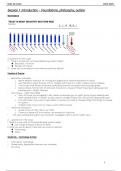
- Graph: Better system at uncovering frictions → better growth (GDP)
4
Session 1: Introduction - Foundations, philosophy, outline
Bandwagons
2 questions for this class:
1. What is wrong with our financial/banking system today?
➔ Bad press / no trust
➔ Paradox of finance
2. What can we do about it now that we could not before?
Paradox of finance
- Bad press, examples:
o Bernie Madoff, infamous for running the largest Ponzi scheme (pyramid) in history.
o Sam Bankman-Fried, founder of FTX, charged with fraud in a major cryptocurrency collapse.
o The Occupy Wall Street movement, protesting financial corruption and corporate greed.
o Markus Braun, former CEO of Wirecard, involved in a massive fintech fraud (just taking payment
transactions) – Netflix: Skandel
- Pop culture – Fight Club (1999)
o Story of movie: guy struggling in life, makes up alterego (guy on right), group of guys beating each
other doing this bcs of society, so they want to change society from evil stuff by destroying banks
o Link with class: if you want to get better in society, you need to change things, first things to change:
fin system
o Problem with movie: how to make a world without banks
- Historical inheritance
o Grand mirror of Folly (John Law 1720)
o Finance as being evil is not recent, has existed for long time
- … Yet: also enjoying the system e.g. insurance, mortgages, bank account, health care,…
2 questions for this class:
1. What is wrong with our financial/banking system today?
➔ Can we get the good without the bad?
2. What can we do about it now that we could not before?
➔ Technology
➔ Policy
Modernity – Technology & Policy
- Information Technology
- Global policy (regulations become very complex)
- EU Policy
1
,Sofie De Korte 2024-2025
One step back
“This is water” ~ David Foster Wallace
➔ If you are going to change smth in the system, you need to know what the waters are (what the fin
system is about and what it serves)
Finance from first principles:
- Embryonic society: people with stuff and needs -> organize transfers -> population grows
- Finance to manage those transfers
- Technology to reduce the cost
Strong feedback loop
- In essence, financial technology is a time machine we have built ourselves. It can’t move people through time,
but it can move their money.”
- Book ‘Sapiens’
- Book ‘Debt’
- Dunbar number: 150 (we can only really maintain about 150 connections at once, if more, we need
technology)
A bit of history – Finance x Technology x Society
- Uruk, located in Irak: first metropolis in history (first big population; 40 000 people), where writing is invented
- When people started living in large communities like Uruk, they shared their lives with strangers as well as
friends. It may have been possible to know everyone in a large farming village, but not in a vast city, such as
Uruk. What were once implicit agreements among neighbors now became explicit contractual agreements
among strangers.
The connection between the tablets and the tokens helps explain the function of each. Virtually all of the
earliest tablets from Uruk were accounting documents recording the transfer of goods and commodities.
Writing was invented in the ancient Near East specifically for recording financial contracts.
- Finance is often regarded as an abstract, mathematical subject that occasionally calls attention to itself by
dramatic crises or as a symbol of excess.
In fact, finance has been an integral part of the development of human society over the past 5,000 years.
Finance played a key role in the development of the first cities, the emergence of classical empires, and the
exploration of the world.
- Finance was integral to the first complex models of time and risk.
o The golden age of Athens owes as much to financial litigation as it does to Socrates.
o Rome’s legendary wealth could not have sustained itself over the centuries without complex financial
organization.
o Ancient Chinese civilization developed its own financial tradition that enabled rulers to hold together a
vast empire.
o In modern Europe, finance stimulated a novel mathematical tradition that quantified and analyzed
risk and made possible an unprecedented era of exploration and discovery.
o A new financial structure—the corporation—emerged as a means to aggregate capital for trade with
Asia and the Americas.
o Finance was an important cofactor in the Industrial Revolution.
o In the twentieth century, capital markets democratized investing and stimulated novel solutions to
major social problems: social security, sovereign funds, and personal savings accounts are all
mechanisms intended to reduce household economic risk.
They have deep roots in the history of finance.
2
,Sofie De Korte 2024-2025
Dark side of Finance – Finance x Technology x Society
- Along with these important contributions to humankind, finance has also created problems:
- debt,
- market bubbles,
- devastating crises and crashes,
- exploitative corporations,
- imperialism, income inequality
- etc.
The story of finance is the story of a technology: a way of doing things.
Financial technology also created serious problems. The invention of debt was connected to slavery,
reparations payments, imperialism, and financial crises. A long-term historical perspective on this
duality in the nature of finance is important. At a minimum, it can guide our thinking about the
design of financial institutions in the future.
Like other technologies, it developed through innovations that improved efficiency. It is not
intrinsically good or bad.
- As the world moves toward a collective global civilization with a greater proportion of its population
participating in complex society, financial tools need to keep up.
The lessons from our collective financial past take on more relevance. History has shown us financial
mechanisms for risk sharing and intertemporal transfers and how variations in these tools can be
adapted to different kinds of societies.
We are free to repurpose past successes and learn from past failures about what to avoid. The
experience of five millennia of financial innovation, however, suggests that finance and civilization
will forever be intertwined.
Hidden lessons – The value of art and myth
Daedalus and Icarus – Fall of Icarus
➔ Daedalus: father, engineer that created the labyrinth, enprisoned in it and he came up with wax wings
(rules: not to high (sun), not to low (sea), Icarus: flies to high, dies
➔ We do crazy stuff with finance but when we dont respect the rules, bad things can happen. Tech always
requires humility (even Icarus gets the manuel, there is hubris)
o Bad story: Icarus dying
o Good story: daedalus IS flying
Fast-forward – What does modern banking look like?
Only thing that matters in finance is information:
Perfect information world vs. Imperfect information world
3
, Sofie De Korte 2024-2025
Information
- Markets require sophisticated information to work (flow) well. If cost to acquire and process
information is to high: markets may cease to function.
Information cost makes financial markets - while being among the most important markets - among
the worst functioning of all markets.
Sources of information cost: information asymmetry, incompleteness & privacy
Solving this problem → Key issue
- Imperfect information world: sources of information friction:
- Screening → adverse selection
- Monitoring → moral hazard
- Privacy → Trust
- Nobel price winners: all about information frictions
Solving information breakdowns – Enters intermediation
- Origins of intermediation:
“In an ideal world, investors and borrowers are able to obtain optimal trading and risk sharing
allocations. However, once financial interactions exhibit frictions in their transaction technology,
the optimal outcome is no longer feasible.” (Freixas and Rochet, 2008)
- The main source of transaction cost in finance
↧
Information friction
↧
Financial intermediation
- Social purpose: address transaction costs and generate welfare gains
- Economics of financial intermediation
- Economic development is based on the premise that the best investment opportunities and
highest quality borrowers are funded
- Wealthy countries have high levels of financial development
- The financial system improves the efficient operation of the economy
- Helping to channel resources to their most productive use
- Financial intermediaries play a key role in lending and investment finance and its
infrastructure
- Information and transaction costs are the primary source of friction of optimal
allocation
- Financial intermediaries main contribution is to reduce such cost
- Graph: Better system at uncovering frictions → better growth (GDP)
4