NRA Note cards
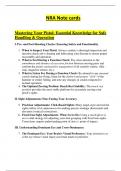
Mastering Your Pistol: Essential Knowledge for Safe
Handling & Operation
I. Pre- and Post-Shooting Checks: Ensuring Safety and Functionality
1. When to Inspect Your Pistol: Always conduct a thorough inspection and
function check after cleaning and lubricating your firearm to ensure proper
reassembly and operation.
2. What to Feel During a Function Check: Pay close attention to the
smoothness and absence of excessive friction between moving parts and
confirm the proper and positive engagement of all controls (safety, slide
stop, magazine release, etc.).
3. What to Listen For During a Function Check: Be attuned to any unusual
sounds during dry-firing, listen for the distinct and proper "click" of the
hammer or striker falling, and note any changes in sound compared to
normal operation.
4. The Optimal Zeroing Position: Bench Rest Stability: The bench rest
position provides the most stable platform for accurately zeroing your
pistol's sights.
II. Sight Adjustments: Fine-Tuning Your Accuracy
5. Precision Adjustments: Click-Based Sights: Many target-style and red dot
sights utilize click adjustments for making precise windage (horizontal) and
elevation (vertical) corrections.
6. Fixed Iron Sight Adjustments: What Not to Do: Using a recoil glove is
not a valid strategy for adjusting your shot grouping with fixed iron sights.
Corrections require understanding point of aim vs. point of impact.
III. Understanding Dominant Eye and Cross-Dominance:
7. The Dominant Eye: Your Brain's Visual Preference: Your dominant eye
is the eye whose visual input your brain tends to prioritize.
, 8. Matching Dominance: The Natural Alignment: Optimal shooting often
occurs when hand and eye dominance align (e.g., left eye/left hand or right
eye/right hand).
9. Compensating for Cross-Dominance: Adapting Your Technique:
Strategies for shooters with cross-dominance include tilting the pistol, tilting
your head to align the dominant eye with the sights, or even using your
support hand for shooting.
IV. Essential Gun Handling Safety Rules:
10.The Eight Additional Rules: Going Beyond the Basics: The statement
"Remove the Garner plate from the muzzle before loading the gun" is NOT
one of the generally recognized eight additional rules of gun handling.
11.The Three Primary Rules: Cornerstones of Firearm Safety: The
statement "ALWAYS keep your eye on the trigger" is NOT one of the
universally accepted Three Rules for Safe Gun Handling. The correct rule is
"ALWAYS keep your finger off the trigger until your sights are on the target
and you have made the decision to shoot."
V. Ammunition Safety and Handling:
12.Dangers of Ammunition Exposed to Fire: If ammunition is exposed to
fire, the cartridge can burst, and while not a major explosion, small, high-
velocity fragments of the case can pose a significant danger to eyes at close
range.
13.Rimfire vs. Centerfire: Primer Location Matters: Centerfire ammunition
has the primer located in the center of the case head, while rimfire
ammunition has the primer contained within the rim of the case head.
14.Safe Ammunition Disposal: Responsibility First: The safest way to
dispose of unserviceable ammunition is to take it to a hazardous material
facility or return it to the manufacturer for proper handling.
15.Manual Ejection: Single-Action Revolvers: On single-action revolvers,
cartridges must be manually ejected one at a time.
VI. Revolver Operation: Single and Double Action:
16.Double-Action Modes: Versatile Firing: A double-action revolver can be
fired in two modes: single-action mode (hammer manually cocked) and
double-action mode (trigger pull cocks and releases the hammer).
VII. Safe Pistol Loading Practices:
Mastering Your Pistol: Essential Knowledge for Safe
Handling & Operation
I. Pre- and Post-Shooting Checks: Ensuring Safety and Functionality
1. When to Inspect Your Pistol: Always conduct a thorough inspection and
function check after cleaning and lubricating your firearm to ensure proper
reassembly and operation.
2. What to Feel During a Function Check: Pay close attention to the
smoothness and absence of excessive friction between moving parts and
confirm the proper and positive engagement of all controls (safety, slide
stop, magazine release, etc.).
3. What to Listen For During a Function Check: Be attuned to any unusual
sounds during dry-firing, listen for the distinct and proper "click" of the
hammer or striker falling, and note any changes in sound compared to
normal operation.
4. The Optimal Zeroing Position: Bench Rest Stability: The bench rest
position provides the most stable platform for accurately zeroing your
pistol's sights.
II. Sight Adjustments: Fine-Tuning Your Accuracy
5. Precision Adjustments: Click-Based Sights: Many target-style and red dot
sights utilize click adjustments for making precise windage (horizontal) and
elevation (vertical) corrections.
6. Fixed Iron Sight Adjustments: What Not to Do: Using a recoil glove is
not a valid strategy for adjusting your shot grouping with fixed iron sights.
Corrections require understanding point of aim vs. point of impact.
III. Understanding Dominant Eye and Cross-Dominance:
7. The Dominant Eye: Your Brain's Visual Preference: Your dominant eye
is the eye whose visual input your brain tends to prioritize.
, 8. Matching Dominance: The Natural Alignment: Optimal shooting often
occurs when hand and eye dominance align (e.g., left eye/left hand or right
eye/right hand).
9. Compensating for Cross-Dominance: Adapting Your Technique:
Strategies for shooters with cross-dominance include tilting the pistol, tilting
your head to align the dominant eye with the sights, or even using your
support hand for shooting.
IV. Essential Gun Handling Safety Rules:
10.The Eight Additional Rules: Going Beyond the Basics: The statement
"Remove the Garner plate from the muzzle before loading the gun" is NOT
one of the generally recognized eight additional rules of gun handling.
11.The Three Primary Rules: Cornerstones of Firearm Safety: The
statement "ALWAYS keep your eye on the trigger" is NOT one of the
universally accepted Three Rules for Safe Gun Handling. The correct rule is
"ALWAYS keep your finger off the trigger until your sights are on the target
and you have made the decision to shoot."
V. Ammunition Safety and Handling:
12.Dangers of Ammunition Exposed to Fire: If ammunition is exposed to
fire, the cartridge can burst, and while not a major explosion, small, high-
velocity fragments of the case can pose a significant danger to eyes at close
range.
13.Rimfire vs. Centerfire: Primer Location Matters: Centerfire ammunition
has the primer located in the center of the case head, while rimfire
ammunition has the primer contained within the rim of the case head.
14.Safe Ammunition Disposal: Responsibility First: The safest way to
dispose of unserviceable ammunition is to take it to a hazardous material
facility or return it to the manufacturer for proper handling.
15.Manual Ejection: Single-Action Revolvers: On single-action revolvers,
cartridges must be manually ejected one at a time.
VI. Revolver Operation: Single and Double Action:
16.Double-Action Modes: Versatile Firing: A double-action revolver can be
fired in two modes: single-action mode (hammer manually cocked) and
double-action mode (trigger pull cocks and releases the hammer).
VII. Safe Pistol Loading Practices: