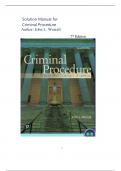
Solution Manual for
Criminal Procedure
Author: John L. Worrall
7th Edition
iii
,Contents
To The Instructor Iv
Syllabi V
Syllabus For 16-Week Term (Semester) Viii
Chapter 1 1
Introduction To Criminal Procedure 1
Chapter 2 19
Remedies 19
Chapter 3 31
Introduction To Search And Seizure 31
Chapter 4 45
Searches And Arrests With Warrants 45
Chapter 5 59
Searches And Arrests Without Warrants 59
Chapter 6 74
Actions Based On Reasonable Suspicion 74
Chapter 7 87
Actions Based On Administrative Justification And Consent 87
Chapter 8 101
Interrogations And Confessions 101
Chapter 9 114
Identification Procedures And The Role Of Witnesses 114
Chapter 10 126
The Pretrial Process 126
Chapter 11 140
Prosecutors, Grand Juries, And Defense Attorneys 140
Chapter 12 156
Plea Bargaining And Guilty Pleas 156
Chapter 13 170
Rights At Trial 170
Chapter 14 184
More Rights At Trial 184
Chapter 15 199
Sentencing, Appeals, And Habeas Corpus 199
Test Bank 215
iv
, To The Instructor
The Instructor’s Manual Is A Comprehensive Document That Includes A Chapter Overview, Chapter
Objectives, A Lecture Outline With Teaching Tips, Answers To The Decision-Making Exercises In The
Main Text, Additional Assignments, Suggested Answers To The End-Of-Chapter Assignments (Review
Questions).
Criminal Procedure Continues To Be Divided Into Five Parts: (1) Introduction; (2) Search And Seizure;
(3) Interrogations, Confessions, And Identification Procedures; (4) The Beginnings Of Formal
Proceedings; And (5) Trial, Conviction, And Beyond. Chapter 1 Is Introductory And Provides Readers
With The Information Necessary To Begin Studying Criminal Procedure. In Particular, It Defines
Criminal Procedure; Highlights The Due Process/Crime Control Dilemma, Which Is At The Heart Of All
Controversies In Criminal Procedure; Discusses The Relationship Among The Courts, Including A Brief
Section On How To Do Legal Research; And Introduces Several Issues And Trends In Criminal
Procedure. Chapter 1 Ends With A Detailed Overview Of The Text. Chapter 2 Begins By Discussing The
Exclusionary Rule, And Then Considers Criminal, Civil, And Nonjudicial Remedies. Remedies Are
Presented Early In The Text So Readers Will Become Aware Of How People’s Rights Can Be Enforced
In The U.S. Courts.
Chapter 3 Provides A Framework For Studying The Fourth Amendment; Specifically, It Defines
Fourth Amendment Terminology And Specifies When Searches And Seizures Occur. This Chapter Also
Covers The Doctrine Of Justification, Focusing On The Definitions Of Probable Cause, Reasonable
Suspicion, And Administrative Justification. Chapters 4 And 5 Go On To Cover Searches And Seizures
With Warrants And Without Warrants, Respectively. Chapter 6 Covers Actions Based On Reasonable
Suspicion, Including Stops And Frisks And Investigative Detentions, And Chapter 7 Covers Actions
Based On Administrative Justification And Consent, Including Inventories, Inspections, Checkpoints,
School And Office Searches, Drug And Alcohol Testing, And The Like.
Chapter 8 Focuses Heavily On The Fifth Amendment’s Self-Incrimination Clause And Then
Summarizes The Proper Procedures For Conducting Interrogations And Obtaining Valid Confessions.
Further, It Also Examines How The Sixth And Fourteenth Amendments Govern Interrogations And
Confessions. Chapter 9 Discusses Identification Procedures, Including The Guidelines For Proper
Pretrial Identifications, And Also Introduces Identification Procedures Used During Trial, Including The
Proper Questioning Of Witnesses To Assist In Valid In-Court Identifications.
Chapter 10 Begins By Discussing Booking, The Initial Appearance, The Probable Cause Hearing,
Pretrial Release, The Preliminary Hearing, And The Arraignment. This Chapter Also Introduces The
Rules Surrounding Discovery. While Discovery Can Occur Well Into A Trial, Most Often Discovery Is
Pretrial In Nature; Thus, It Is Appropriate To Discuss Discovery In This Context. Chapter 11 Covers
Prosecutors, Grand Juries, And Defense Attorneys, Including The Constitutional Guidelines By Which
Each Must Abide. Of Course, The Actions Of Prosecutors, Defense Attorneys, And Even Grand Juries
Matter Outside The Pretrial Context, But Readers Should Be Familiar With These Important Actors
Before Moving Into The Adjudication Section. Finally, Chapter 12 Covers Plea Bargaining And Guilty
Pleas. Again, Both Can Occur Well Into A Trial, But Most Plea Bargains And Guilty Pleas Are
Undertaken In An Effort To Avoid Trial.
Chapter 13, The First Of Two Chapters About The Defendant’s Rights At Trial, Examines The Right
To A Speedy Trial And The Right To An Impartial Judge And Jury. Chapter 14 Continues The Focus On
Rights At Trial, Discussing Openness, Confrontation, Compulsory Process, Double Jeopardy, And
Entrapment. Lastly, Chapter 15 Covers Important Topics In Sentencing As Well As Appeals And
Habeas Corpus.
v
, Syllabi
Syllabus For 10-Week Term (Quarter)
Course Number: Criminal Procedure: From First Contact To Appeal
Section Number
Room Number
Semester
Professor: Office Hours:
Name
E-Mail Address
Office Address
Office Phone
Number
Required Text:
Worrall, J.L. (2024) Criminal Procedure: From First Contact To Appeal (7th Ed.). New
Jersey: Pearson Education, Inc.
Exams (50%)
There Are Three (3) Multiple-Choice Exams. The Exams Are Not Cumulative But Will Be Based On The
Information Presented Immediately Preceding Each Exam.
Final Exam (20%)
There Will Be Final Exam For This Class. The Format For The Exam May Consist Of Some Type Of
Multiple Choices, Fill-Ins The Blanks, And/Or Essay Questions That Pertain To All Of The Information
Presented.
Instructor Assignments (20%)
Assignments Will Be Given Out Throughout The Semester. Students Are Expected To Complete Each
Assignment And Submit Them On The Due Date. Assignments Should Include The Student’s Opinion
Backed Up Facts, When Appropriate, And Be Submitted In A Typed Format With 12 Times New Roman
Font With 1” Margins, Unless Instructed Otherwise.
Classroom Participation/Attendance (10%)
The Course Is Not Intended To Be Solely A Lecture Format. Every Student Is Expected To Actively
Participate In Classroom Discussions. Therefore, Each Student Should Be Prepared To Discuss The
Topics Scheduled To Be Covered.
Extra Credit
With Prior Instructor Permission, A Student May Receive Points Towards Their Overall Course Average
By Submitting An Extra Assignment Assigned By The Instructor.
vi
Criminal Procedure
Author: John L. Worrall
7th Edition
iii
,Contents
To The Instructor Iv
Syllabi V
Syllabus For 16-Week Term (Semester) Viii
Chapter 1 1
Introduction To Criminal Procedure 1
Chapter 2 19
Remedies 19
Chapter 3 31
Introduction To Search And Seizure 31
Chapter 4 45
Searches And Arrests With Warrants 45
Chapter 5 59
Searches And Arrests Without Warrants 59
Chapter 6 74
Actions Based On Reasonable Suspicion 74
Chapter 7 87
Actions Based On Administrative Justification And Consent 87
Chapter 8 101
Interrogations And Confessions 101
Chapter 9 114
Identification Procedures And The Role Of Witnesses 114
Chapter 10 126
The Pretrial Process 126
Chapter 11 140
Prosecutors, Grand Juries, And Defense Attorneys 140
Chapter 12 156
Plea Bargaining And Guilty Pleas 156
Chapter 13 170
Rights At Trial 170
Chapter 14 184
More Rights At Trial 184
Chapter 15 199
Sentencing, Appeals, And Habeas Corpus 199
Test Bank 215
iv
, To The Instructor
The Instructor’s Manual Is A Comprehensive Document That Includes A Chapter Overview, Chapter
Objectives, A Lecture Outline With Teaching Tips, Answers To The Decision-Making Exercises In The
Main Text, Additional Assignments, Suggested Answers To The End-Of-Chapter Assignments (Review
Questions).
Criminal Procedure Continues To Be Divided Into Five Parts: (1) Introduction; (2) Search And Seizure;
(3) Interrogations, Confessions, And Identification Procedures; (4) The Beginnings Of Formal
Proceedings; And (5) Trial, Conviction, And Beyond. Chapter 1 Is Introductory And Provides Readers
With The Information Necessary To Begin Studying Criminal Procedure. In Particular, It Defines
Criminal Procedure; Highlights The Due Process/Crime Control Dilemma, Which Is At The Heart Of All
Controversies In Criminal Procedure; Discusses The Relationship Among The Courts, Including A Brief
Section On How To Do Legal Research; And Introduces Several Issues And Trends In Criminal
Procedure. Chapter 1 Ends With A Detailed Overview Of The Text. Chapter 2 Begins By Discussing The
Exclusionary Rule, And Then Considers Criminal, Civil, And Nonjudicial Remedies. Remedies Are
Presented Early In The Text So Readers Will Become Aware Of How People’s Rights Can Be Enforced
In The U.S. Courts.
Chapter 3 Provides A Framework For Studying The Fourth Amendment; Specifically, It Defines
Fourth Amendment Terminology And Specifies When Searches And Seizures Occur. This Chapter Also
Covers The Doctrine Of Justification, Focusing On The Definitions Of Probable Cause, Reasonable
Suspicion, And Administrative Justification. Chapters 4 And 5 Go On To Cover Searches And Seizures
With Warrants And Without Warrants, Respectively. Chapter 6 Covers Actions Based On Reasonable
Suspicion, Including Stops And Frisks And Investigative Detentions, And Chapter 7 Covers Actions
Based On Administrative Justification And Consent, Including Inventories, Inspections, Checkpoints,
School And Office Searches, Drug And Alcohol Testing, And The Like.
Chapter 8 Focuses Heavily On The Fifth Amendment’s Self-Incrimination Clause And Then
Summarizes The Proper Procedures For Conducting Interrogations And Obtaining Valid Confessions.
Further, It Also Examines How The Sixth And Fourteenth Amendments Govern Interrogations And
Confessions. Chapter 9 Discusses Identification Procedures, Including The Guidelines For Proper
Pretrial Identifications, And Also Introduces Identification Procedures Used During Trial, Including The
Proper Questioning Of Witnesses To Assist In Valid In-Court Identifications.
Chapter 10 Begins By Discussing Booking, The Initial Appearance, The Probable Cause Hearing,
Pretrial Release, The Preliminary Hearing, And The Arraignment. This Chapter Also Introduces The
Rules Surrounding Discovery. While Discovery Can Occur Well Into A Trial, Most Often Discovery Is
Pretrial In Nature; Thus, It Is Appropriate To Discuss Discovery In This Context. Chapter 11 Covers
Prosecutors, Grand Juries, And Defense Attorneys, Including The Constitutional Guidelines By Which
Each Must Abide. Of Course, The Actions Of Prosecutors, Defense Attorneys, And Even Grand Juries
Matter Outside The Pretrial Context, But Readers Should Be Familiar With These Important Actors
Before Moving Into The Adjudication Section. Finally, Chapter 12 Covers Plea Bargaining And Guilty
Pleas. Again, Both Can Occur Well Into A Trial, But Most Plea Bargains And Guilty Pleas Are
Undertaken In An Effort To Avoid Trial.
Chapter 13, The First Of Two Chapters About The Defendant’s Rights At Trial, Examines The Right
To A Speedy Trial And The Right To An Impartial Judge And Jury. Chapter 14 Continues The Focus On
Rights At Trial, Discussing Openness, Confrontation, Compulsory Process, Double Jeopardy, And
Entrapment. Lastly, Chapter 15 Covers Important Topics In Sentencing As Well As Appeals And
Habeas Corpus.
v
, Syllabi
Syllabus For 10-Week Term (Quarter)
Course Number: Criminal Procedure: From First Contact To Appeal
Section Number
Room Number
Semester
Professor: Office Hours:
Name
E-Mail Address
Office Address
Office Phone
Number
Required Text:
Worrall, J.L. (2024) Criminal Procedure: From First Contact To Appeal (7th Ed.). New
Jersey: Pearson Education, Inc.
Exams (50%)
There Are Three (3) Multiple-Choice Exams. The Exams Are Not Cumulative But Will Be Based On The
Information Presented Immediately Preceding Each Exam.
Final Exam (20%)
There Will Be Final Exam For This Class. The Format For The Exam May Consist Of Some Type Of
Multiple Choices, Fill-Ins The Blanks, And/Or Essay Questions That Pertain To All Of The Information
Presented.
Instructor Assignments (20%)
Assignments Will Be Given Out Throughout The Semester. Students Are Expected To Complete Each
Assignment And Submit Them On The Due Date. Assignments Should Include The Student’s Opinion
Backed Up Facts, When Appropriate, And Be Submitted In A Typed Format With 12 Times New Roman
Font With 1” Margins, Unless Instructed Otherwise.
Classroom Participation/Attendance (10%)
The Course Is Not Intended To Be Solely A Lecture Format. Every Student Is Expected To Actively
Participate In Classroom Discussions. Therefore, Each Student Should Be Prepared To Discuss The
Topics Scheduled To Be Covered.
Extra Credit
With Prior Instructor Permission, A Student May Receive Points Towards Their Overall Course Average
By Submitting An Extra Assignment Assigned By The Instructor.
vi