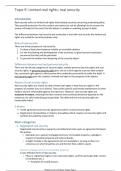
Topic 9: Limited real rights: real security
Introduction
Real security refers to limited real rights that embody security concerning underlying debts.
They provide protection for the creditor and reduce his risk by allowing him to recover the
money still owed in the event that the debtor is unable or unwilling to pay his debt.
The difference between real security and servitudes is that with real security the limited real
rights are vested for security purposes only.
Role of real security
There are three purposes of real security:
1. To draw a distinction between reliable an unreliable debtors.
2. For the functioning and development of the economy, to give financial institutions
assurance that they will be paid back.
3. To prevent the debtor from disposing of the security object.
Difference between real and personal security
There are two broad categories of security rights, namely personal security rights and real
security rights. A personal security right gives rise to a claim against a person (the creditor
has a personal right against a third person who undertakes personally to settle the debt). A
real security right gives the creditor a limited real right in the property of the debtor.
Nature of real security rights
Real security rights are similar to other limited real rights in that they are rights in the
property of another (iura in re aliena). They confer specific and limited entitlements on their
holders and are enforceable against third persons. However, real security rights are
accessory in nature, meaning that their creation and continued existence depends on the
existence of a valid underlying principal debt. The debt and the real security right are
inextricably linked.
2 phases
• Credit agreement and security agreement which create personal rights
• Registration (immovables) or delivery (movables) which creates real security rights and
satisfies the publicity requirement
Main categories
1. Negotiated real security
Negotiated real security is expressly concluded and relies upon an agreement between
the parties.
○ Examples are a special mortgage bond over immovable property, a pledge in
respect of movable property and notarial bonds.
○ A slight mistake in the agreement will not invalidate it, as long as there is a
consensus on who the parties are and the fact that a debt is owed.
Special mortgage bond over immovable property
A very effective form of real security.
○ Phase 1: Agreement (gives rise to personal rights, confirms principal debt, record
of conditions etc.)
▪ Examples of invalid clauses:
□ Forfeiture clause (bank automatically becomes owner if principal debt
Property Law 278 Erica Vegter Page 1
, □ Forfeiture clause (bank automatically becomes owner if principal debt
not paid).
□ Immediate sale out of hand (bank can immediately sell property if
debt not paid)
○ Phase 2: Registration (gives rise to real rights, mortgage comes into existence as
a real security right when it is registered in the Deeds Registry)
▪ Multiple properties can part of the same mortgage bond, provided that
each asset is specifically and clearly described. You cannot register a
mortgage bond that refers generally to all the debtor's immovable assets.
○ The mortgagee has a preferential claim to the proceeds from a sale in execution
of the property. The surplus can then be used to settle other creditor's claims.
○ The mortgagee is also entitled to immediate execution (apply for court order to
levy execution immediately against mortgaged property without first following
normal process of first levying execution against mortgager's movable property)
HOWEVER, this is problematic when dealing with residential properties since S26
of the Constitution must be considered (right of access to adequate housing).
Thus the principle of judicial oversight was developed in Japhta v Schoeman.
Judicial oversight means that a presiding official must consider all the relevant
circumstances before a sale in execution of a residential property can take place.
○ Japhta v Schoeman
Mrs Japhta applied for and was granted government housing. When she
defaulted on her debt, the creditor applied for an attachment order for the sale
in execution of her house. The court considered section 26 of the Constitution,
which states that everyone has the right to have access to adequate housing and
the state must take reasonable legislative and other measures, within its
available resources, to achieve the progressive realisation of this right. It held
that section 66(1)(a) of the Magistrate’s Court Act was unconstitutional in that it
permitted an infringement of Mrs Japhta’s right of access to housing merely as a
result of poverty. The MCA was amended so that a presiding official (magistrate
or judge) must consider relevant factors before the sale in execution can take
place. These factors include ‘the circumstances in which the debt was incurred;
any attempts made by the debtor to pay off the debt; the financial situation of
the parties; the amount of the debt; whether the debtor is employed or has a
source of income to pay off the debt and any other factor relevant to the
particular facts of the case before the court,’ as well as possible alternatives to
a sale in execution. The objective of judicial oversight is therefore to ensure
fairness and protect vulnerable homeowners who may lack income and savings
to pay for the necessities of life, and may be at the mercy of conscienceless
persons ready to abuse the law.
○ Gundwana v Steko Development considers the argument against judicial
oversight, saying that the debtor voluntarily risked their home by asking for a
loan and registering a mortgage. However, most people would not be able to
purchase a home without financial assistance. The High Court Rules were also
amended to be in accordance with the principle of judicial oversight.
○ In ABSA Bank v Mokebe, the court confirmed the usual approach:
▪ Look at movables first
▪ Sale in execution is a last resort
▪ Always use judicial oversight
▪ Provide for reserve price to prevent home being sold for far less than it's
worth
Types of mortgage bonds:
Property Law 278 Erica Vegter Page 2
Introduction
Real security refers to limited real rights that embody security concerning underlying debts.
They provide protection for the creditor and reduce his risk by allowing him to recover the
money still owed in the event that the debtor is unable or unwilling to pay his debt.
The difference between real security and servitudes is that with real security the limited real
rights are vested for security purposes only.
Role of real security
There are three purposes of real security:
1. To draw a distinction between reliable an unreliable debtors.
2. For the functioning and development of the economy, to give financial institutions
assurance that they will be paid back.
3. To prevent the debtor from disposing of the security object.
Difference between real and personal security
There are two broad categories of security rights, namely personal security rights and real
security rights. A personal security right gives rise to a claim against a person (the creditor
has a personal right against a third person who undertakes personally to settle the debt). A
real security right gives the creditor a limited real right in the property of the debtor.
Nature of real security rights
Real security rights are similar to other limited real rights in that they are rights in the
property of another (iura in re aliena). They confer specific and limited entitlements on their
holders and are enforceable against third persons. However, real security rights are
accessory in nature, meaning that their creation and continued existence depends on the
existence of a valid underlying principal debt. The debt and the real security right are
inextricably linked.
2 phases
• Credit agreement and security agreement which create personal rights
• Registration (immovables) or delivery (movables) which creates real security rights and
satisfies the publicity requirement
Main categories
1. Negotiated real security
Negotiated real security is expressly concluded and relies upon an agreement between
the parties.
○ Examples are a special mortgage bond over immovable property, a pledge in
respect of movable property and notarial bonds.
○ A slight mistake in the agreement will not invalidate it, as long as there is a
consensus on who the parties are and the fact that a debt is owed.
Special mortgage bond over immovable property
A very effective form of real security.
○ Phase 1: Agreement (gives rise to personal rights, confirms principal debt, record
of conditions etc.)
▪ Examples of invalid clauses:
□ Forfeiture clause (bank automatically becomes owner if principal debt
Property Law 278 Erica Vegter Page 1
, □ Forfeiture clause (bank automatically becomes owner if principal debt
not paid).
□ Immediate sale out of hand (bank can immediately sell property if
debt not paid)
○ Phase 2: Registration (gives rise to real rights, mortgage comes into existence as
a real security right when it is registered in the Deeds Registry)
▪ Multiple properties can part of the same mortgage bond, provided that
each asset is specifically and clearly described. You cannot register a
mortgage bond that refers generally to all the debtor's immovable assets.
○ The mortgagee has a preferential claim to the proceeds from a sale in execution
of the property. The surplus can then be used to settle other creditor's claims.
○ The mortgagee is also entitled to immediate execution (apply for court order to
levy execution immediately against mortgaged property without first following
normal process of first levying execution against mortgager's movable property)
HOWEVER, this is problematic when dealing with residential properties since S26
of the Constitution must be considered (right of access to adequate housing).
Thus the principle of judicial oversight was developed in Japhta v Schoeman.
Judicial oversight means that a presiding official must consider all the relevant
circumstances before a sale in execution of a residential property can take place.
○ Japhta v Schoeman
Mrs Japhta applied for and was granted government housing. When she
defaulted on her debt, the creditor applied for an attachment order for the sale
in execution of her house. The court considered section 26 of the Constitution,
which states that everyone has the right to have access to adequate housing and
the state must take reasonable legislative and other measures, within its
available resources, to achieve the progressive realisation of this right. It held
that section 66(1)(a) of the Magistrate’s Court Act was unconstitutional in that it
permitted an infringement of Mrs Japhta’s right of access to housing merely as a
result of poverty. The MCA was amended so that a presiding official (magistrate
or judge) must consider relevant factors before the sale in execution can take
place. These factors include ‘the circumstances in which the debt was incurred;
any attempts made by the debtor to pay off the debt; the financial situation of
the parties; the amount of the debt; whether the debtor is employed or has a
source of income to pay off the debt and any other factor relevant to the
particular facts of the case before the court,’ as well as possible alternatives to
a sale in execution. The objective of judicial oversight is therefore to ensure
fairness and protect vulnerable homeowners who may lack income and savings
to pay for the necessities of life, and may be at the mercy of conscienceless
persons ready to abuse the law.
○ Gundwana v Steko Development considers the argument against judicial
oversight, saying that the debtor voluntarily risked their home by asking for a
loan and registering a mortgage. However, most people would not be able to
purchase a home without financial assistance. The High Court Rules were also
amended to be in accordance with the principle of judicial oversight.
○ In ABSA Bank v Mokebe, the court confirmed the usual approach:
▪ Look at movables first
▪ Sale in execution is a last resort
▪ Always use judicial oversight
▪ Provide for reserve price to prevent home being sold for far less than it's
worth
Types of mortgage bonds:
Property Law 278 Erica Vegter Page 2