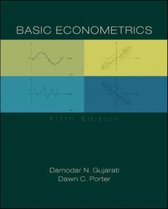
Gujarati: Basic Econometrics, Fourth Edition
Introduction
Part I – Single-Equation Regression Models
1. The Nature of Regression Analysis
2. Two-Variable Regression Analysis: Some Basic Ideas
3. Two Variable Regression Model: The Problem of Estimation
4. Classical Normal Linear Regression Model (CNLRM)
5. Two-Variable Regression: Interval Estimation and Hypothesis Testing
6. Extensions of the Two-Variable Linear Regression Model
7. Multiple Regression Analysis: The Problem of Estimation
8. Multiple Regression Analysis: The Problem of Inference
9. Dummy Variable Regression Models
Part 2: Relaxing Assumptions of the Classical Model
10. Multicollinearity: What Happens if the Regressions are Correlated?
11. Heteroscedasticity: What Happens if the Error Variance is Nonconstant?
12. Autocorrelation: What Happens if the Error Terms are Correlated?
13. Econometric Modeling I: Model Specification and Diagnostic Testing?
Part 3: Topics in Econometrics
14. Nonlinear Regression Models
15. Qualitative Response Regression Models
16. Panel Data Regression Models
17. Dynamic Econometric Model: Autoregressive and Distributed Lag Models
Part 4: Simultaneous Equation Models
18. Simultaneous-Equation Models
19. The Identification Problem
20. Simultaneous-Equation Methods
Part 5: Time Series Econometrics
21. Time Series Econometrics: Some Basic Concepts
22. Time Series Econometrics: Forecasting
Appendixes
A. A Review of Some Statistical Concepts
B. Rudiments of Matrix Algebra
C. The Matrix Approach to the Linear Regression Model
D. Statistical Tables
Selected Bibliography
Indexes
Name Index
Subject Index
,Gujarati: Basic Front Matter Preface © The McGraw−Hill
Econometrics, Fourth Companies, 2004
Edition
PREFACE
BACKGROUND AND PURPOSE
As in the previous three editions, the primary objective of the fourth edition
of Basic Econometrics is to provide an elementary but comprehensive intro-
duction to econometrics without resorting to matrix algebra, calculus, or
statistics beyond the elementary level.
In this edition I have attempted to incorporate some of the developments
in the theory and practice of econometrics that have taken place since the
publication of the third edition in 1995. With the availability of sophisti-
cated and user-friendly statistical packages, such as Eviews, Limdep,
Microfit, Minitab, PcGive, SAS, Shazam, and Stata, it is now possible to dis-
cuss several econometric techniques that could not be included in the pre-
vious editions of the book. I have taken full advantage of these statistical
packages in illustrating several examples and exercises in this edition.
I was pleasantly surprised to find that my book is used not only by eco-
nomics and business students but also by students and researchers in sev-
eral other disciplines, such as politics, international relations, agriculture,
and health sciences. Students in these disciplines will find the expanded dis-
cussion of several topics very useful.
THE FOURTH EDITION
The major changes in this edition are as follows:
1. In the introductory chapter, after discussing the steps involved in tra-
ditional econometric methodology, I discuss the very important question of
how one chooses among competing econometric models.
2. In Chapter 1, I discuss very briefly the measurement scale of eco-
nomic variables. It is important to know whether the variables are ratio
xxv
, Gujarati: Basic Front Matter Preface © The McGraw−Hill
Econometrics, Fourth Companies, 2004
Edition
xxvi PREFACE
scale, interval scale, ordinal scale, or nominal scale, for that will determine
the econometric technique that is appropriate in a given situation.
3. The appendices to Chapter 3 now include the large-sample properties
of OLS estimators, particularly the property of consistency.
4. The appendix to Chapter 5 now brings into one place the properties
and interrelationships among the four important probability distributions
that are heavily used in this book, namely, the normal, t, chi square, and F.
5. Chapter 6, on functional forms of regression models, now includes a
discussion of regression on standardized variables.
6. To make the book more accessible to the nonspecialist, I have moved
the discussion of the matrix approach to linear regression from old Chapter 9
to Appendix C. Appendix C is slightly expanded to include some advanced
material for the benefit of the more mathematically inclined students. The
new Chapter 9 now discusses dummy variable regression models.
7. Chapter 10, on multicollinearity, includes an extended discussion of
the famous Longley data, which shed considerable light on the nature and
scope of multicollinearity.
8. Chapter 11, on heteroscedasticity, now includes in the appendix an
intuitive discussion of White’s robust standard errors.
9. Chapter 12, on autocorrelation, now includes a discussion of the
Newey–West method of correcting the OLS standard errors to take into ac-
count likely autocorrelation in the error term. The corrected standard errors
are known as HAC standard errors. This chapter also discusses briefly the
topic of forecasting with autocorrelated error terms.
10. Chapter 13, on econometric modeling, replaces old Chapters 13 and
14. This chapter has several new topics that the applied researcher will find
particularly useful. They include a compact discussion of model selection
criteria, such as the Akaike information criterion, the Schwarz information
criterion, Mallows’s Cp criterion, and forecast chi square. The chapter also
discusses topics such as outliers, leverage, influence, recursive least squares,
and Chow’s prediction failure test. This chapter concludes with some cau-
tionary advice to the practitioner about econometric theory and economet-
ric practice.
11. Chapter 14, on nonlinear regression models, is new. Because of the
easy availability of statistical software, it is no longer difficult to estimate
regression models that are nonlinear in the parameters. Some econometric
models are intrinsically nonlinear in the parameters and need to be esti-
mated by iterative methods. This chapter discusses and illustrates some
comparatively simple methods of estimating nonlinear-in-parameter regres-
sion models.
12. Chapter 15, on qualitative response regression models, which re-
places old Chapter 16, on dummy dependent variable regression models,
provides a fairly extensive discussion of regression models that involve a
dependent variable that is qualitative in nature. The main focus is on logit
, Gujarati: Basic Front Matter Preface © The McGraw−Hill
Econometrics, Fourth Companies, 2004
Edition
PREFACE xxvii
and probit models and their variations. The chapter also discusses the
Poisson regression model, which is used for modeling count data, such as the
number of patents received by a firm in a year; the number of telephone
calls received in a span of, say, 5 minutes; etc. This chapter has a brief dis-
cussion of multinomial logit and probit models and duration models.
13. Chapter 16, on panel data regression models, is new. A panel data
combines features of both time series and cross-section data. Because of in-
creasing availability of panel data in the social sciences, panel data regres-
sion models are being increasingly used by researchers in many fields. This
chapter provides a nontechnical discussion of the fixed effects and random
effects models that are commonly used in estimating regression models
based on panel data.
14. Chapter 17, on dynamic econometric models, has now a rather ex-
tended discussion of the Granger causality test, which is routinely used (and
misused) in applied research. The Granger causality test is sensitive to the
number of lagged terms used in the model. It also assumes that the under-
lying time series is stationary.
15. Except for new problems and minor extensions of the existing esti-
mation techniques, Chapters 18, 19, and 20 on simultaneous equation mod-
els are basically unchanged. This reflects the fact that interest in such mod-
els has dwindled over the years for a variety of reasons, including their poor
forecasting performance after the OPEC oil shocks of the 1970s.
16. Chapter 21 is a substantial revision of old Chapter 21. Several concepts
of time series econometrics are developed and illustrated in this chapter. The
main thrust of the chapter is on the nature and importance of stationary
time series. The chapter discusses several methods of finding out if a given
time series is stationary. Stationarity of a time series is crucial for the appli-
cation of various econometric techniques discussed in this book.
17. Chapter 22 is also a substantial revision of old Chapter 22. It discusses
the topic of economic forecasting based on the Box–Jenkins (ARIMA) and
vector autoregression (VAR) methodologies. It also discusses the topic of
measuring volatility in financial time series by the techniques of autoregres-
sive conditional heteroscedasticity (ARCH) and generalized autoregressive con-
ditional heteroscedasticity (GARCH).
18. Appendix A, on statistical concepts, has been slightly expanded. Ap-
pendix C discusses the linear regression model using matrix algebra. This is
for the benefit of the more advanced students.
As in the previous editions, all the econometric techniques discussed in
this book are illustrated by examples, several of which are based on con-
crete data from various disciplines. The end-of-chapter questions and prob-
lems have several new examples and data sets. For the advanced reader,
there are several technical appendices to the various chapters that give
proofs of the various theorems and or formulas developed in the text.
Introduction
Part I – Single-Equation Regression Models
1. The Nature of Regression Analysis
2. Two-Variable Regression Analysis: Some Basic Ideas
3. Two Variable Regression Model: The Problem of Estimation
4. Classical Normal Linear Regression Model (CNLRM)
5. Two-Variable Regression: Interval Estimation and Hypothesis Testing
6. Extensions of the Two-Variable Linear Regression Model
7. Multiple Regression Analysis: The Problem of Estimation
8. Multiple Regression Analysis: The Problem of Inference
9. Dummy Variable Regression Models
Part 2: Relaxing Assumptions of the Classical Model
10. Multicollinearity: What Happens if the Regressions are Correlated?
11. Heteroscedasticity: What Happens if the Error Variance is Nonconstant?
12. Autocorrelation: What Happens if the Error Terms are Correlated?
13. Econometric Modeling I: Model Specification and Diagnostic Testing?
Part 3: Topics in Econometrics
14. Nonlinear Regression Models
15. Qualitative Response Regression Models
16. Panel Data Regression Models
17. Dynamic Econometric Model: Autoregressive and Distributed Lag Models
Part 4: Simultaneous Equation Models
18. Simultaneous-Equation Models
19. The Identification Problem
20. Simultaneous-Equation Methods
Part 5: Time Series Econometrics
21. Time Series Econometrics: Some Basic Concepts
22. Time Series Econometrics: Forecasting
Appendixes
A. A Review of Some Statistical Concepts
B. Rudiments of Matrix Algebra
C. The Matrix Approach to the Linear Regression Model
D. Statistical Tables
Selected Bibliography
Indexes
Name Index
Subject Index
,Gujarati: Basic Front Matter Preface © The McGraw−Hill
Econometrics, Fourth Companies, 2004
Edition
PREFACE
BACKGROUND AND PURPOSE
As in the previous three editions, the primary objective of the fourth edition
of Basic Econometrics is to provide an elementary but comprehensive intro-
duction to econometrics without resorting to matrix algebra, calculus, or
statistics beyond the elementary level.
In this edition I have attempted to incorporate some of the developments
in the theory and practice of econometrics that have taken place since the
publication of the third edition in 1995. With the availability of sophisti-
cated and user-friendly statistical packages, such as Eviews, Limdep,
Microfit, Minitab, PcGive, SAS, Shazam, and Stata, it is now possible to dis-
cuss several econometric techniques that could not be included in the pre-
vious editions of the book. I have taken full advantage of these statistical
packages in illustrating several examples and exercises in this edition.
I was pleasantly surprised to find that my book is used not only by eco-
nomics and business students but also by students and researchers in sev-
eral other disciplines, such as politics, international relations, agriculture,
and health sciences. Students in these disciplines will find the expanded dis-
cussion of several topics very useful.
THE FOURTH EDITION
The major changes in this edition are as follows:
1. In the introductory chapter, after discussing the steps involved in tra-
ditional econometric methodology, I discuss the very important question of
how one chooses among competing econometric models.
2. In Chapter 1, I discuss very briefly the measurement scale of eco-
nomic variables. It is important to know whether the variables are ratio
xxv
, Gujarati: Basic Front Matter Preface © The McGraw−Hill
Econometrics, Fourth Companies, 2004
Edition
xxvi PREFACE
scale, interval scale, ordinal scale, or nominal scale, for that will determine
the econometric technique that is appropriate in a given situation.
3. The appendices to Chapter 3 now include the large-sample properties
of OLS estimators, particularly the property of consistency.
4. The appendix to Chapter 5 now brings into one place the properties
and interrelationships among the four important probability distributions
that are heavily used in this book, namely, the normal, t, chi square, and F.
5. Chapter 6, on functional forms of regression models, now includes a
discussion of regression on standardized variables.
6. To make the book more accessible to the nonspecialist, I have moved
the discussion of the matrix approach to linear regression from old Chapter 9
to Appendix C. Appendix C is slightly expanded to include some advanced
material for the benefit of the more mathematically inclined students. The
new Chapter 9 now discusses dummy variable regression models.
7. Chapter 10, on multicollinearity, includes an extended discussion of
the famous Longley data, which shed considerable light on the nature and
scope of multicollinearity.
8. Chapter 11, on heteroscedasticity, now includes in the appendix an
intuitive discussion of White’s robust standard errors.
9. Chapter 12, on autocorrelation, now includes a discussion of the
Newey–West method of correcting the OLS standard errors to take into ac-
count likely autocorrelation in the error term. The corrected standard errors
are known as HAC standard errors. This chapter also discusses briefly the
topic of forecasting with autocorrelated error terms.
10. Chapter 13, on econometric modeling, replaces old Chapters 13 and
14. This chapter has several new topics that the applied researcher will find
particularly useful. They include a compact discussion of model selection
criteria, such as the Akaike information criterion, the Schwarz information
criterion, Mallows’s Cp criterion, and forecast chi square. The chapter also
discusses topics such as outliers, leverage, influence, recursive least squares,
and Chow’s prediction failure test. This chapter concludes with some cau-
tionary advice to the practitioner about econometric theory and economet-
ric practice.
11. Chapter 14, on nonlinear regression models, is new. Because of the
easy availability of statistical software, it is no longer difficult to estimate
regression models that are nonlinear in the parameters. Some econometric
models are intrinsically nonlinear in the parameters and need to be esti-
mated by iterative methods. This chapter discusses and illustrates some
comparatively simple methods of estimating nonlinear-in-parameter regres-
sion models.
12. Chapter 15, on qualitative response regression models, which re-
places old Chapter 16, on dummy dependent variable regression models,
provides a fairly extensive discussion of regression models that involve a
dependent variable that is qualitative in nature. The main focus is on logit
, Gujarati: Basic Front Matter Preface © The McGraw−Hill
Econometrics, Fourth Companies, 2004
Edition
PREFACE xxvii
and probit models and their variations. The chapter also discusses the
Poisson regression model, which is used for modeling count data, such as the
number of patents received by a firm in a year; the number of telephone
calls received in a span of, say, 5 minutes; etc. This chapter has a brief dis-
cussion of multinomial logit and probit models and duration models.
13. Chapter 16, on panel data regression models, is new. A panel data
combines features of both time series and cross-section data. Because of in-
creasing availability of panel data in the social sciences, panel data regres-
sion models are being increasingly used by researchers in many fields. This
chapter provides a nontechnical discussion of the fixed effects and random
effects models that are commonly used in estimating regression models
based on panel data.
14. Chapter 17, on dynamic econometric models, has now a rather ex-
tended discussion of the Granger causality test, which is routinely used (and
misused) in applied research. The Granger causality test is sensitive to the
number of lagged terms used in the model. It also assumes that the under-
lying time series is stationary.
15. Except for new problems and minor extensions of the existing esti-
mation techniques, Chapters 18, 19, and 20 on simultaneous equation mod-
els are basically unchanged. This reflects the fact that interest in such mod-
els has dwindled over the years for a variety of reasons, including their poor
forecasting performance after the OPEC oil shocks of the 1970s.
16. Chapter 21 is a substantial revision of old Chapter 21. Several concepts
of time series econometrics are developed and illustrated in this chapter. The
main thrust of the chapter is on the nature and importance of stationary
time series. The chapter discusses several methods of finding out if a given
time series is stationary. Stationarity of a time series is crucial for the appli-
cation of various econometric techniques discussed in this book.
17. Chapter 22 is also a substantial revision of old Chapter 22. It discusses
the topic of economic forecasting based on the Box–Jenkins (ARIMA) and
vector autoregression (VAR) methodologies. It also discusses the topic of
measuring volatility in financial time series by the techniques of autoregres-
sive conditional heteroscedasticity (ARCH) and generalized autoregressive con-
ditional heteroscedasticity (GARCH).
18. Appendix A, on statistical concepts, has been slightly expanded. Ap-
pendix C discusses the linear regression model using matrix algebra. This is
for the benefit of the more advanced students.
As in the previous editions, all the econometric techniques discussed in
this book are illustrated by examples, several of which are based on con-
crete data from various disciplines. The end-of-chapter questions and prob-
lems have several new examples and data sets. For the advanced reader,
there are several technical appendices to the various chapters that give
proofs of the various theorems and or formulas developed in the text.