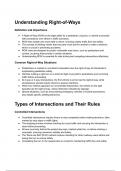
Understanding Right-of-Ways
Definition and Importance
● A Right-of-Way (ROW) is the legal ability for a pedestrian, bicyclist, or vehicle to proceed
with precedence over others in traffic scenarios.
● ROW laws dictate who must yield to whom, ensuring orderly traffic flow and safety.
● The concept of yielding means that one party must wait for another to make a decision,
which is crucial in preventing accidents.
● ROW rules are designed to protect vulnerable road users, such as pedestrians and
cyclists, by giving them priority in certain situations.
● Understanding ROW is essential for safe driving and navigating intersections effectively.
Common Right-of-Way Situations
● Pedestrians in marked or unmarked crosswalks have the right-of-way at intersections,
emphasizing pedestrian safety.
● Vehicles making a right turn on a solid red light must yield to pedestrians and oncoming
traffic before proceeding.
● At 2-way or 4-way intersections, the first vehicle to arrive has the right-of-way, while
simultaneous arrivals require drivers to assess intentions.
● When two vehicles approach an uncontrolled intersection, the vehicle on the right
typically has the right-of-way, unless otherwise indicated by signage.
● Special situations, such as encountering emergency vehicles or funeral processions,
also dictate specific yielding behaviors.
Types of Intersections and Their Rules
Controlled Intersections
● Controlled intersections require drivers to stop completely before making decisions, often
marked by stop signs or traffic lights.
● The stopping process involves checking for cross traffic and ensuring the intersection is
clear before proceeding.
● Drivers must stop behind the posted stop sign, marked white line, or before entering a
crosswalk, ensuring maximum visibility and safety.
● The 'Rock and Roll' (R+R) method involves checking for other roadway users before and
during the turn to ensure safety.
● Completing the turn in the nearest lane is crucial for maintaining traffic flow and safety.
Definition and Importance
● A Right-of-Way (ROW) is the legal ability for a pedestrian, bicyclist, or vehicle to proceed
with precedence over others in traffic scenarios.
● ROW laws dictate who must yield to whom, ensuring orderly traffic flow and safety.
● The concept of yielding means that one party must wait for another to make a decision,
which is crucial in preventing accidents.
● ROW rules are designed to protect vulnerable road users, such as pedestrians and
cyclists, by giving them priority in certain situations.
● Understanding ROW is essential for safe driving and navigating intersections effectively.
Common Right-of-Way Situations
● Pedestrians in marked or unmarked crosswalks have the right-of-way at intersections,
emphasizing pedestrian safety.
● Vehicles making a right turn on a solid red light must yield to pedestrians and oncoming
traffic before proceeding.
● At 2-way or 4-way intersections, the first vehicle to arrive has the right-of-way, while
simultaneous arrivals require drivers to assess intentions.
● When two vehicles approach an uncontrolled intersection, the vehicle on the right
typically has the right-of-way, unless otherwise indicated by signage.
● Special situations, such as encountering emergency vehicles or funeral processions,
also dictate specific yielding behaviors.
Types of Intersections and Their Rules
Controlled Intersections
● Controlled intersections require drivers to stop completely before making decisions, often
marked by stop signs or traffic lights.
● The stopping process involves checking for cross traffic and ensuring the intersection is
clear before proceeding.
● Drivers must stop behind the posted stop sign, marked white line, or before entering a
crosswalk, ensuring maximum visibility and safety.
● The 'Rock and Roll' (R+R) method involves checking for other roadway users before and
during the turn to ensure safety.
● Completing the turn in the nearest lane is crucial for maintaining traffic flow and safety.