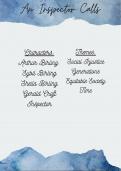
An Inspector Calls
Characters: Themes:
Arthur Birling Social Injustice
Sybil Birling Generations
Sheila Birling Equitable Society
Gerald Croft Time
Inspector
,
Character Analysis and Development Quotes- Analysis and Interpretation
Stage Directions: "a heavy-looking, rather portentous man in his middle fifties with fairly easy manners but rather provincial in his speech"
Mr Birling is the head of the Birling household. Priestley exhibits Mr Birling as the living embodiment of the capitalist ideology
His physical appearance is a reflection of capitalism; he wears formal clothing
He has made himself very wealthy by being a 'hard-headed' "Heavy-looking"- symbolises greed and suggests that he is a powerful and influential figure, may appear to be intimidating
Frequently displays his "portentous" attitude- he tries really hard to impress people, suggests that he is a powerful and influential figure but also may appear to be somewhat intimidating
He has made himself very wealthy by being a 'hard-headed' business man.
business man. He is firmly capitalist, and right-wing in his political views.
He has no concept of value other than wealth or social status, as he himself is a social climber. He believes that he and his wife uphold right values.
He is an active member of the community in Brumley and He is portrayed as a self-important and pompous man who is more concerned about his social status and wealth than the welfare of others.
His easy manners and provincial speech suggests that he is not particularly cultured or well-educated.
thinks that he might be in the running for a Knighthood. Stage directions show that Mr Birling is a complex character with both positive and negative traits.
"Provincial"- Used to show the low-class origins of Mr Birling; he has to compensate for his lower class accent with material possessions
"Portentous"- immediate indication of Mr Birling's self-indulged temperament
At the start of the play he comes across as being arrogant,
Act 1: "It's one of the happiest nights of my life" "You're the type of son-in-law I've always wanted" "lower costs and higher prices"
making long speeches about his predictions for the future. Birling's clearly pompous perspective is evidence d through his immediate reclamation of the spotlight after Sheila and Gerald's engageme
nt is announced.
He also makes assertions about how a man should look out Mr Birling values Sheila on her capacity to further the family company.
"My"- This shows that Mr Birling is quire selfish because he only thinks that it is one of the happiest nights of his life and not of Sheila and Gerald.
Although it is Sheila's engagement , Birling is making it all about himself
for number one and not waste time helping others. It is at this The line is significant because it highlights Mr. Birling's focus on social status and wealth, and his lack of concern for others.
The audience knows that the Birling family's happiness is built on a foundation of exploitation and disregard for the working class, and that their wealth and status will not protect them from the
exact moment that the Inspector arrives. consequences of their actions.
The line is therefore ironic and underscores the theme of hypocrisy in the play.
"Me" "My life"-selfish nature. The emphasis on Mr Birling's own life is due to his own reputation and social status increasing after Sheila's marriage to Gerald. In reality it matters not whether Sheila and Gerald
Sybil, his wife, is his 'social superior' and it is hinted that he is are happily married.
Reveals that Mr Birling sees Gerald as being like himself – a determined man of business.
self-conscious about being from a more working-class The line is significant because it highlights Mr. Birling's focus on social status and wealth, and his desire to maintain the Birling family's privileged position in society.
Mr. Birling sees Gerald as the perfect son-in-law because he is the son of a wealthy businessman and comes from a similar social background to the Birlings.
background. The line is therefore ironic because the audience knows that Gerald has a dark secret and that his engagement to Sheila will not bring happiness to the Birling family.
The line also underscores the theme of hypocrisy in the play, as Mr. Birling's desire for social status and wealth blinds him to the moral failings of those around him.
Birling's selfish nature is reinforced by his wish to see 'lower costs' and 'higher prices'.
He is materialistic and possessive and also has old fashioned He wants to maximise his profit, whilst keeping those in the 'workforce' in their submissive position, further entrenching the class and wealth divide, and
enabling the capitalists to profit at the expense of the majority.
views about women. The line is significant because it highlights Mr. Birling's capitalist and profit-driven worldview.
He is arguing that businesses should focus on lowering costs and raising prices in order to increase profits, rather than worrying about the welfare of their
Arthur Birling supports capitalist views and is firmly employees or the impact of their actions on society.
The line is therefore critical of the capitalist system and underscores the theme of exploitation in the play.
The audience knows that the Birling family's wealth and privilege are built on the exploitation of the working class, and that Mr. Birling's focus on
entrenched within 1912 ante-bellum (before the war) English profit and capitalism has blinded him to the moral failings of his actions.
The line also highlights the conflict between individualism and collective responsibility, as Mr. Birling is arguing that businesses should prioritize their
social elite own profits over the welfare of society as a whole
Act 1: "hard-headed practical man of business" "unsinkable absolutely unsinkable"
Priestley uses the character of Mr Birling, not only as a He doesn't allow sentiment to interfere in his business ventures and he lacks ethics and morals
The tone of pride in the adjectives ‘hard-headed’ and ‘practical’ reveals that he sees these qualities as admirable ones, and the phrase ‘man of business’ shows
method to critique capitalism, but to reveal the cycle of that Priestley is establishing Arthur Birling as a symbol of capitalism.
Mr Birling declares the Titanic to be unsinkable.
oppression caused by social divisions anc classism He repeats this opinion, which he presents as a fact, with the intensifier ‘absolutely’ showing his complete confidence in his judgement.
The line is significant because it highlights Mr. Birling's arrogance and his belief in the invincibility of the Titanic.
Mr. Birling is convinced that the Titanic is unsinkable, and that nothing can go wrong on the ship's maiden voyage.
The line is therefore ironic, as the audience knows that the Titanic will sink and that Mr. Birling's arrogance and blind faith in technology will
be exposed as foolish and dangerous.
The line also underscores the theme of hubris in the play, as Mr. Birling's belief in the invincibility of the Titanic is a metaphor for his belief in the invi
ncibility of his own wealth and status.
The audience knows that Mr. Birling's arrogance and disregard for the working class will ultimately lead to his downfall, just as the Titanic's
arrogance and disregard for safety led to its sinking.
The certainty shown by Mr Birling's repetition demonstrates his poor judgement
Act 1: "mixed up together like bees in a hive" "I can't accept any responsibility" "soon be asking for the earth"
Character Adjectives Arthur Birling uses a simile to convey his dismissal of ideologies surrounding community and social responsibility.
The simile acts as a form of belittlement, as if he finds the concept of socialism comical.
This simile compares the image of a hive of bees with people of all kinds mixed together as part of a community.
1. Ostentatious: Characterised by pretentious or showy display This is Mr Birling being arrogant again but it also gets across Priestley's ideas about class.
The simile is significant because it highlights the theme of collective responsibility and the interconnectedness of society.
2. Condescending: Having or showing an attitude of patronising Mr. Birling is using the image of a beehive to describe the way that society is organized, with each individual playing a role in the larger, collective whole.
The simile is therefore critical of the capitalist system and underscores the theme of exploitation in the play.
superiority Mr. Birling's focus on profit and capitalism has blinded him to the moral failings of his actions, and he
is unable to see the impact of his actions on society as a whole.
3. Belittling: Dismiss (someone or something) as unimportant The simile also highlights the conflict between individualism and collective responsibility, as Mr. Birling is arguing that individuals should prioritize their own interests over the welfare of society as a whole.
The simile is therefore ironic, as the audience knows that Mr. Birling's wealth and status are built on the exploitation of the working class, and that his disregard for the interconnectedness of society will
4. Arrogant: Having or revealing an exaggerated sense of one’s own ultimately lead to his downfall.
The use of the adverb "any" reveals Mr Birling's complete lack of morality, as he believes sacking Eva Smith has no impact on her life which drove her to suicide.
This highlights Mr Birling's arrogant and dismissive nature as he evidently has a narrow minded and simplistic understanding of Eva's death
importance or abilities The hyperbolic metaphor "asking for the Earth" implies that the workers' demands were irrational and unreasonable.
Mr Birling presents them as greedy and unable to control their desires, implying that it is his role to maintain balance within society.
5. Conservative: Averse to change or innovation and holding traditional This is an insult to the classes, as he implies that they "take" the earth, presenting the upper classes' entitlement as selfish and destructive
values Act 2: "Why the devil do you want to go upsetting the child like that?"
The line is significant because it highlights Mr. Birling's desire to protect his family's reputation and social status.
6. Patriarchal: Relating to or denoting a system of society or government Mr. Birling is angry that the Inspector has questioned his daughter Sheila, and he is concerned that the Inspector's investigation will damage his family's reputation.
The line is therefore critical of the capitalist system and underscores the theme of exploitation in the play.
Mr. Birling's focus on profit and capitalism has blinded him to the moral failings of his actions, and he is unable to see the impact of his actions on society as a whole.
controlled by men The line also underscores the theme of individualism versus collective responsibility, as Mr. Birling is more concerned with protecting his family's interests than with the welfare of society as a whole.
The line is therefore ironic, as the audience knows that Mr. Birling's disregard for the working class and his focus on profit will ultimately lead to his downfall, just as his desire to protect his family's reputation
7. Narcissistic: Having or showing an excessive interest in or admiration of will ultimately lead to their exposure and downfall.
"Child"- The massive difference between his attitudes for the two situations shows how he feels that bad things could happen to other classes and people but should not happen to his child.
oneself
Act 3: "The famous younger generation who know it all... can't even take a joke"
8. Rapacious: Aggressively greedy or grasping This ironic quote shows that the younger generation have accepted responsibility while the parents are not taking it at all seriously.
The use of the noun "joke" is significant as it is ironic
9. Covetous: Having or showing a great desire to possess something Trivialising Eva Smith's suffering as a "joke" emphasises the static character of Mr Birling
Birling returns to his complacent and arrogant attitude ,that we saw before the Inspector arrives, when it is discovered that the Inspector was not real.
He mocks Sheila and Eric for accepting responsibility.
belonging to someone else
Act 3: "a police inspector is on his way here- to ask some- questions-"
10. Brazen: Bold and without shame Mr Birling is shocked to receive such news after mocking both Sheila and Eric
The line is significant because it creates a sense of tension and anticipation in the audience.
11. Obstinate: Stubbornly refusing to change one’s opinion or chosen The audience is left wondering who the Inspector is, why he is coming to the house, and what questions he will ask.
The line is also significant because it highlights the theme of responsibility and accountability.
course of action, despite attempts to persuade one to do so Mr. Birling is worried that the Inspector's questions will reveal the family's involvement in the death of Eva Smith, and he is concerned about the consequences that will follow.
The line is therefore critical of the capitalist system and underscores the theme of exploitation in the play.
Mr. Birling's focus on profit and capitalism has blinded him to the moral failings of his actions, and he is unable to see the impact of his actions on society as a whole.
12. Static: Lacking in change, action especially in an undesirable way. The line also underscores the theme of individualism versus collective responsibility, as Mr. Birling is more concerned with protecting his family's interests than with the welfare of society as a whole.
The line is therefore ironic, as the audience knows that Mr. Birling's disregard for the working class and his focus on profit will ultimately lead to his downfall, just as his desire to protect his family's reputation
13. Avaricious: Having or showing an extreme greed for wealth or material will ultimately lead to their exposure and downfall.
Cyclical structure- back to the beginning of the play
gain
Characters: Themes:
Arthur Birling Social Injustice
Sybil Birling Generations
Sheila Birling Equitable Society
Gerald Croft Time
Inspector
,
Character Analysis and Development Quotes- Analysis and Interpretation
Stage Directions: "a heavy-looking, rather portentous man in his middle fifties with fairly easy manners but rather provincial in his speech"
Mr Birling is the head of the Birling household. Priestley exhibits Mr Birling as the living embodiment of the capitalist ideology
His physical appearance is a reflection of capitalism; he wears formal clothing
He has made himself very wealthy by being a 'hard-headed' "Heavy-looking"- symbolises greed and suggests that he is a powerful and influential figure, may appear to be intimidating
Frequently displays his "portentous" attitude- he tries really hard to impress people, suggests that he is a powerful and influential figure but also may appear to be somewhat intimidating
He has made himself very wealthy by being a 'hard-headed' business man.
business man. He is firmly capitalist, and right-wing in his political views.
He has no concept of value other than wealth or social status, as he himself is a social climber. He believes that he and his wife uphold right values.
He is an active member of the community in Brumley and He is portrayed as a self-important and pompous man who is more concerned about his social status and wealth than the welfare of others.
His easy manners and provincial speech suggests that he is not particularly cultured or well-educated.
thinks that he might be in the running for a Knighthood. Stage directions show that Mr Birling is a complex character with both positive and negative traits.
"Provincial"- Used to show the low-class origins of Mr Birling; he has to compensate for his lower class accent with material possessions
"Portentous"- immediate indication of Mr Birling's self-indulged temperament
At the start of the play he comes across as being arrogant,
Act 1: "It's one of the happiest nights of my life" "You're the type of son-in-law I've always wanted" "lower costs and higher prices"
making long speeches about his predictions for the future. Birling's clearly pompous perspective is evidence d through his immediate reclamation of the spotlight after Sheila and Gerald's engageme
nt is announced.
He also makes assertions about how a man should look out Mr Birling values Sheila on her capacity to further the family company.
"My"- This shows that Mr Birling is quire selfish because he only thinks that it is one of the happiest nights of his life and not of Sheila and Gerald.
Although it is Sheila's engagement , Birling is making it all about himself
for number one and not waste time helping others. It is at this The line is significant because it highlights Mr. Birling's focus on social status and wealth, and his lack of concern for others.
The audience knows that the Birling family's happiness is built on a foundation of exploitation and disregard for the working class, and that their wealth and status will not protect them from the
exact moment that the Inspector arrives. consequences of their actions.
The line is therefore ironic and underscores the theme of hypocrisy in the play.
"Me" "My life"-selfish nature. The emphasis on Mr Birling's own life is due to his own reputation and social status increasing after Sheila's marriage to Gerald. In reality it matters not whether Sheila and Gerald
Sybil, his wife, is his 'social superior' and it is hinted that he is are happily married.
Reveals that Mr Birling sees Gerald as being like himself – a determined man of business.
self-conscious about being from a more working-class The line is significant because it highlights Mr. Birling's focus on social status and wealth, and his desire to maintain the Birling family's privileged position in society.
Mr. Birling sees Gerald as the perfect son-in-law because he is the son of a wealthy businessman and comes from a similar social background to the Birlings.
background. The line is therefore ironic because the audience knows that Gerald has a dark secret and that his engagement to Sheila will not bring happiness to the Birling family.
The line also underscores the theme of hypocrisy in the play, as Mr. Birling's desire for social status and wealth blinds him to the moral failings of those around him.
Birling's selfish nature is reinforced by his wish to see 'lower costs' and 'higher prices'.
He is materialistic and possessive and also has old fashioned He wants to maximise his profit, whilst keeping those in the 'workforce' in their submissive position, further entrenching the class and wealth divide, and
enabling the capitalists to profit at the expense of the majority.
views about women. The line is significant because it highlights Mr. Birling's capitalist and profit-driven worldview.
He is arguing that businesses should focus on lowering costs and raising prices in order to increase profits, rather than worrying about the welfare of their
Arthur Birling supports capitalist views and is firmly employees or the impact of their actions on society.
The line is therefore critical of the capitalist system and underscores the theme of exploitation in the play.
The audience knows that the Birling family's wealth and privilege are built on the exploitation of the working class, and that Mr. Birling's focus on
entrenched within 1912 ante-bellum (before the war) English profit and capitalism has blinded him to the moral failings of his actions.
The line also highlights the conflict between individualism and collective responsibility, as Mr. Birling is arguing that businesses should prioritize their
social elite own profits over the welfare of society as a whole
Act 1: "hard-headed practical man of business" "unsinkable absolutely unsinkable"
Priestley uses the character of Mr Birling, not only as a He doesn't allow sentiment to interfere in his business ventures and he lacks ethics and morals
The tone of pride in the adjectives ‘hard-headed’ and ‘practical’ reveals that he sees these qualities as admirable ones, and the phrase ‘man of business’ shows
method to critique capitalism, but to reveal the cycle of that Priestley is establishing Arthur Birling as a symbol of capitalism.
Mr Birling declares the Titanic to be unsinkable.
oppression caused by social divisions anc classism He repeats this opinion, which he presents as a fact, with the intensifier ‘absolutely’ showing his complete confidence in his judgement.
The line is significant because it highlights Mr. Birling's arrogance and his belief in the invincibility of the Titanic.
Mr. Birling is convinced that the Titanic is unsinkable, and that nothing can go wrong on the ship's maiden voyage.
The line is therefore ironic, as the audience knows that the Titanic will sink and that Mr. Birling's arrogance and blind faith in technology will
be exposed as foolish and dangerous.
The line also underscores the theme of hubris in the play, as Mr. Birling's belief in the invincibility of the Titanic is a metaphor for his belief in the invi
ncibility of his own wealth and status.
The audience knows that Mr. Birling's arrogance and disregard for the working class will ultimately lead to his downfall, just as the Titanic's
arrogance and disregard for safety led to its sinking.
The certainty shown by Mr Birling's repetition demonstrates his poor judgement
Act 1: "mixed up together like bees in a hive" "I can't accept any responsibility" "soon be asking for the earth"
Character Adjectives Arthur Birling uses a simile to convey his dismissal of ideologies surrounding community and social responsibility.
The simile acts as a form of belittlement, as if he finds the concept of socialism comical.
This simile compares the image of a hive of bees with people of all kinds mixed together as part of a community.
1. Ostentatious: Characterised by pretentious or showy display This is Mr Birling being arrogant again but it also gets across Priestley's ideas about class.
The simile is significant because it highlights the theme of collective responsibility and the interconnectedness of society.
2. Condescending: Having or showing an attitude of patronising Mr. Birling is using the image of a beehive to describe the way that society is organized, with each individual playing a role in the larger, collective whole.
The simile is therefore critical of the capitalist system and underscores the theme of exploitation in the play.
superiority Mr. Birling's focus on profit and capitalism has blinded him to the moral failings of his actions, and he
is unable to see the impact of his actions on society as a whole.
3. Belittling: Dismiss (someone or something) as unimportant The simile also highlights the conflict between individualism and collective responsibility, as Mr. Birling is arguing that individuals should prioritize their own interests over the welfare of society as a whole.
The simile is therefore ironic, as the audience knows that Mr. Birling's wealth and status are built on the exploitation of the working class, and that his disregard for the interconnectedness of society will
4. Arrogant: Having or revealing an exaggerated sense of one’s own ultimately lead to his downfall.
The use of the adverb "any" reveals Mr Birling's complete lack of morality, as he believes sacking Eva Smith has no impact on her life which drove her to suicide.
This highlights Mr Birling's arrogant and dismissive nature as he evidently has a narrow minded and simplistic understanding of Eva's death
importance or abilities The hyperbolic metaphor "asking for the Earth" implies that the workers' demands were irrational and unreasonable.
Mr Birling presents them as greedy and unable to control their desires, implying that it is his role to maintain balance within society.
5. Conservative: Averse to change or innovation and holding traditional This is an insult to the classes, as he implies that they "take" the earth, presenting the upper classes' entitlement as selfish and destructive
values Act 2: "Why the devil do you want to go upsetting the child like that?"
The line is significant because it highlights Mr. Birling's desire to protect his family's reputation and social status.
6. Patriarchal: Relating to or denoting a system of society or government Mr. Birling is angry that the Inspector has questioned his daughter Sheila, and he is concerned that the Inspector's investigation will damage his family's reputation.
The line is therefore critical of the capitalist system and underscores the theme of exploitation in the play.
Mr. Birling's focus on profit and capitalism has blinded him to the moral failings of his actions, and he is unable to see the impact of his actions on society as a whole.
controlled by men The line also underscores the theme of individualism versus collective responsibility, as Mr. Birling is more concerned with protecting his family's interests than with the welfare of society as a whole.
The line is therefore ironic, as the audience knows that Mr. Birling's disregard for the working class and his focus on profit will ultimately lead to his downfall, just as his desire to protect his family's reputation
7. Narcissistic: Having or showing an excessive interest in or admiration of will ultimately lead to their exposure and downfall.
"Child"- The massive difference between his attitudes for the two situations shows how he feels that bad things could happen to other classes and people but should not happen to his child.
oneself
Act 3: "The famous younger generation who know it all... can't even take a joke"
8. Rapacious: Aggressively greedy or grasping This ironic quote shows that the younger generation have accepted responsibility while the parents are not taking it at all seriously.
The use of the noun "joke" is significant as it is ironic
9. Covetous: Having or showing a great desire to possess something Trivialising Eva Smith's suffering as a "joke" emphasises the static character of Mr Birling
Birling returns to his complacent and arrogant attitude ,that we saw before the Inspector arrives, when it is discovered that the Inspector was not real.
He mocks Sheila and Eric for accepting responsibility.
belonging to someone else
Act 3: "a police inspector is on his way here- to ask some- questions-"
10. Brazen: Bold and without shame Mr Birling is shocked to receive such news after mocking both Sheila and Eric
The line is significant because it creates a sense of tension and anticipation in the audience.
11. Obstinate: Stubbornly refusing to change one’s opinion or chosen The audience is left wondering who the Inspector is, why he is coming to the house, and what questions he will ask.
The line is also significant because it highlights the theme of responsibility and accountability.
course of action, despite attempts to persuade one to do so Mr. Birling is worried that the Inspector's questions will reveal the family's involvement in the death of Eva Smith, and he is concerned about the consequences that will follow.
The line is therefore critical of the capitalist system and underscores the theme of exploitation in the play.
Mr. Birling's focus on profit and capitalism has blinded him to the moral failings of his actions, and he is unable to see the impact of his actions on society as a whole.
12. Static: Lacking in change, action especially in an undesirable way. The line also underscores the theme of individualism versus collective responsibility, as Mr. Birling is more concerned with protecting his family's interests than with the welfare of society as a whole.
The line is therefore ironic, as the audience knows that Mr. Birling's disregard for the working class and his focus on profit will ultimately lead to his downfall, just as his desire to protect his family's reputation
13. Avaricious: Having or showing an extreme greed for wealth or material will ultimately lead to their exposure and downfall.
Cyclical structure- back to the beginning of the play
gain