1
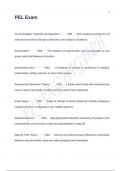
PEL Exam
Accommodation (cognitive development) - ANS when existing schemas do not
R
work and we need to change to deal with a new object or situations.
Acculturation -
HEANS The adoption of cultural traits, such as language, by one
group under the influence of another.
acheivement test -
IG ANS A measure of mastery or proficiency in reading,
H
mathematics, writing, science, or some other subject.
NG
Achievement Motivation Theory - ANS a theory which holds that individuals can
I
have a need to get ahead, to attain success, and to reach objectives
Y
action stage - ANS Stage of change in which people are actively changing a
L
negative behavior or adopting a new, healthy behavior
F
adaptive behavior - ANS Age-appropriate behaviors necessary for people to live
independently and to function safely and appropriately in daily life
Allport's Trait Theory - ANS external and internal forces influence an individuals
behavior and personality. these are called genotype and phenotypes
, 2
ambivalent attachment - ANS insecurely attached; upset when mother leaves and
then angry with mother upon her return
R
anal stage - ANS 1-3 years. libido is focused on the anus. their ego is now
E
developed
H
Applied Behavior Analysis (ABA) - ANS focuses on improving specific behaviors,
G
social skills, communication and learning skills.
aptitude test -
HI ANS a test designed to predict a person's future performance;
G
aptitude is the capacity to learn
N
Assimilation - ANS the social process of absorbing one cultural group into
I
harmony with another
LY
Assimilation (cognitive development) - ANS using existing schemas to deal with
F
new object or situations
auditory learner - ANS listen to lectures and use their voice to reinforce concepts.
ask them to repeat concepts back to you.
, 3
autonmy vs shame - ANS 18 months-3 years. child focused on developing sense
of personal control over physical skills. supported for their independence
avoidant attachment - ANS characterized by child's unresponsiveness to parent,
R
does not use the parent as a secure base, and does not care if parent leaves
Behavioral Theory -
HE ANS
behavior is learned by conditioning
behavior is learned and can be reinforced or modified.
Bias in research -
IG ANS True findings distorted due a factor other than the one
H
studied
G
biopyschosocial model - ANS a model of health that integrates the effects of
N
biological, behavioral, and social factors on health and illness
YI
Boundaries (SFT) - ANS rules that highlight who participate and how much.
L
factors that organize them and separates them.
F
boundary setting sft - ANS A technique...in which the therapist establishes a
functional semi-permeable (clear) boundary where either a rigid or diffuse boundary had
existed previously.
, 4
Broca's aphasia - ANS condition resulting from damage to Broca's area, causing
the affected person to be unable to speak fluently, to mispronounce words, and to speak
haltingly
R
Bully Prevention Program - ANS limiting social rewards for bullying and harmful
E
behavior. bullying occurs to get attention, praise or social status
H
cardinal traits - ANS Traits that are characteristics that direct most of the person's
G
activities (the person's dominant traits that influence all of our behaviors)
central tendency -
HI ANS a measure that represents the typical response or the
G
behavior of a group as a whole
N
central traits - ANS According to trait theory, traits that form the basis of
I
personality.
LY
Child Behavior Checklist (CBCL) - ANS The Child Behavior Checklist (CBCL) is a
F
parent-report questionnaire on child behavioral and emotional problems. It is one of the
most widely-used standardized measures for evaluating maladaptive behavioral and
emotional problems in subjects between the ages of 2 and 18. It assesses internalizing
behaviors (anxious, depressive, and over controlled) and externalizing behaviors
(aggressive, hyperactive, noncompliant and under controlled). (15 min)
PEL Exam
Accommodation (cognitive development) - ANS when existing schemas do not
R
work and we need to change to deal with a new object or situations.
Acculturation -
HEANS The adoption of cultural traits, such as language, by one
group under the influence of another.
acheivement test -
IG ANS A measure of mastery or proficiency in reading,
H
mathematics, writing, science, or some other subject.
NG
Achievement Motivation Theory - ANS a theory which holds that individuals can
I
have a need to get ahead, to attain success, and to reach objectives
Y
action stage - ANS Stage of change in which people are actively changing a
L
negative behavior or adopting a new, healthy behavior
F
adaptive behavior - ANS Age-appropriate behaviors necessary for people to live
independently and to function safely and appropriately in daily life
Allport's Trait Theory - ANS external and internal forces influence an individuals
behavior and personality. these are called genotype and phenotypes
, 2
ambivalent attachment - ANS insecurely attached; upset when mother leaves and
then angry with mother upon her return
R
anal stage - ANS 1-3 years. libido is focused on the anus. their ego is now
E
developed
H
Applied Behavior Analysis (ABA) - ANS focuses on improving specific behaviors,
G
social skills, communication and learning skills.
aptitude test -
HI ANS a test designed to predict a person's future performance;
G
aptitude is the capacity to learn
N
Assimilation - ANS the social process of absorbing one cultural group into
I
harmony with another
LY
Assimilation (cognitive development) - ANS using existing schemas to deal with
F
new object or situations
auditory learner - ANS listen to lectures and use their voice to reinforce concepts.
ask them to repeat concepts back to you.
, 3
autonmy vs shame - ANS 18 months-3 years. child focused on developing sense
of personal control over physical skills. supported for their independence
avoidant attachment - ANS characterized by child's unresponsiveness to parent,
R
does not use the parent as a secure base, and does not care if parent leaves
Behavioral Theory -
HE ANS
behavior is learned by conditioning
behavior is learned and can be reinforced or modified.
Bias in research -
IG ANS True findings distorted due a factor other than the one
H
studied
G
biopyschosocial model - ANS a model of health that integrates the effects of
N
biological, behavioral, and social factors on health and illness
YI
Boundaries (SFT) - ANS rules that highlight who participate and how much.
L
factors that organize them and separates them.
F
boundary setting sft - ANS A technique...in which the therapist establishes a
functional semi-permeable (clear) boundary where either a rigid or diffuse boundary had
existed previously.
, 4
Broca's aphasia - ANS condition resulting from damage to Broca's area, causing
the affected person to be unable to speak fluently, to mispronounce words, and to speak
haltingly
R
Bully Prevention Program - ANS limiting social rewards for bullying and harmful
E
behavior. bullying occurs to get attention, praise or social status
H
cardinal traits - ANS Traits that are characteristics that direct most of the person's
G
activities (the person's dominant traits that influence all of our behaviors)
central tendency -
HI ANS a measure that represents the typical response or the
G
behavior of a group as a whole
N
central traits - ANS According to trait theory, traits that form the basis of
I
personality.
LY
Child Behavior Checklist (CBCL) - ANS The Child Behavior Checklist (CBCL) is a
F
parent-report questionnaire on child behavioral and emotional problems. It is one of the
most widely-used standardized measures for evaluating maladaptive behavioral and
emotional problems in subjects between the ages of 2 and 18. It assesses internalizing
behaviors (anxious, depressive, and over controlled) and externalizing behaviors
(aggressive, hyperactive, noncompliant and under controlled). (15 min)