Lecture 1: Introduction to financial risk management
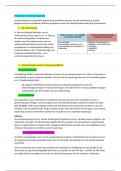
Bank balance sheet
- Deposits are the main liabilities (tegoeden van klanten op hun
rekening)
- Loans are the main assets (uitgeleende bedragen aan klanten)
→ Maturity mismatch between assets and liabilities: Liabilities are
short term, loans are in principle long term.
Banks finance loans with short term debt.
- Increasing role of short-term debt
- Increasing focus on trading assets
- Low equity ratio (5%-8%)
o Non-financial firms this ratio is on average 70/80%
Bank balance sheet: credit risk -->
- Credit risk = the risk that borrowers (counterparties in loan and derivatives
transactions) will default (fail to pay)
o Red arrows is what then happens, to stay in balance equity decreases
- Credit risk can wipe out (parts of) loans and trading assets
- Banks account for possibility of nonperforming loans by setting aside reserves:
Provision for Loan Losses (contra-asset reducing the value of loan assets)
o If insufficient, losses lower equity
Bank balance sheet: market risk -->
- Market risk = possibility that instruments in the bank’s trading book (e.g. securities)
will decline in value
- Depends on the future movements in market variables:
o Inflation
o interest rate, if changed: value of assets linked to fixed interest change
o foreign exchange, (assets denominated in foreign currency)
o stock market performances
o aggregated credit risk
- ‘’Trading and other assets’’ will decrease and these losses will be in net income so then
equity decreases.
Bank balance sheet: liquidity risk -->
- Liquidity risk = the risk that a bank may be unable to meet short-term financial
demands (e.g., depositor withdrawals or maturing short-term debt)
o Due to a lack of readily available cash or marketable assets
- Can withdrawals of deposit or a roll-over freeze of short-term debt be absorbed by
assets?
o Roll-over freeze of short-term debt = when a bank or financial institution
is unable to refinance (or "roll over") its maturing short-term debt because
lenders or creditors refuse to provide new funding
o Question is related to the ability to convert assets into cash (liquidity)
o Loans and trading assets are often long-term and with limited marketability (hard to
convert quickly to cash) --> exposes bank to liquidity risk
Operational risk
- Basel Committee on Banking Supervision: Operational risk = the risk of loss resulting from
inadequate/failed internal processes, people, and systems or from external events
1
, - Pandemic or geopolitical risks fall into this category
Financial risks and insolvency
- Credit, market, and operational risk can wipe out assets and equity, leading to insolvency
- When is a corporation insolvent?
o When is not able to pay its debt
o Test: Do liabilities exceed assets?
o Test: Can it raise new equity (from private investors)?
▪ If no private investor is willing to inject equity at any price, the company is
insolvent.
▪ The test uses private investors because their willingness to invest reflects true
market confidence in the corporation's solvency without relying on
government subsidies.
- As banks have little equity, a 5% loss of assets can lead to insolvency
Overview
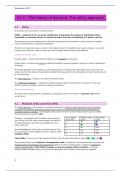
Financial risks, innovations, and regulation are
interconnected, with regulation designed to mitigate risks
arising from innovations and inherent financial
vulnerabilities.
The origins of financial regulation (all steps of circle →)
Why do banks have so little equity?
- Banks operate on a maturity mismatch: they use short-term
liabilities (e.g., deposits) to fund long-term assets (e.g., loans),
which is highly profitable but risky. They keep low equity which
increases fragility
Why are banks so regulated?
- This fragility from low equity and maturity mismatch incentivizes
bank runs, where depositors panic and withdraw funds en masse, fearing insolvency.
Deposit Insurance: The Solution and New Problem
- Governments introduced deposit insurance to prevent bank runs, assuring depositors their
funds are safe.
- New Problem: Deposit insurance makes depositors indifferent to the bank’s riskiness,
enabling banks to raise cheap debt without needing to compensate depositors with higher
interest rates (because no risk)
Incentive to Take Excessive Risk
- With access to cheap debt, banks are incentivized to take on excessive risks, knowing they
can borrow without significantly increasing funding costs, while potential losses are largely
externalized.
→ Next step regulators need to deal with: excessive risk creates systematic risk to financial system
- risk-taking behavior by individual banks aggregates into systemic risk, threatening the
stability of the entire financial system
→ They deal with this by enforcing capital regulation
2
,Capital regulation
- Regulators set minimum levels for the capital a bank is required to keep as a buffer against
losses and remain solvent.
o Note that the usage of “keep” may be misleading: Ensure sufficient equity as a stable
source of financing, not necessarily as cash reserves. While banks don’t keep capital
in the literal sense, they must maintain an adequate equity base to absorb losses and
support lending.
- Tier 1 Capital: High-quality capital like equity.
- Tier 2 Capital: Subordinated debt with lower loss-absorbing capacity.
o Supplementary, offering additional protection but with lower loss-absorbing power
- Long term capital safer than short term → reduces rollover risk (unable to refinance short-
term obligations) & gives more stability in capital structure.
Overview
Financial innovations
- Financial innovations generate new approaches to financial circumstances
- Usually, new products, services, or securities that improve efficiency or transfer risks
o Improve efficiency: same outcome at lower cost or more outcome at same cost
o Transfer risks: Innovations can carve out some risks and transfer them (more
important)
- Risk has different costs and benefits for different investors, depending on:
o risks profiles / inherent preferences
o portfolio composition / how diversified
o financial constraints
o hedging opportunities
o regulation (some institutions under lot of regulation)
Financial innovations: CDSs (credit default swaps)
- Insurance contract protecting against a borrower’s default
- Buyer (long protection, short credit risk): pays premiums (90 bps) and receives a lump sum if
borrower defaults
- Seller (short protection, long credit risk): receives premiums but must pay a a lump sum if a
default occurs
- Could be used for hedging (if the buyer is exposed to the borrower’s credit risk) or
speculation on changes in creditworthiness
- CDS spread: (%premium) is a measure of creditworthiness
3
, Overview
Regulatory arbitrage
The major impulses to successful financial innovations have come from regulations and taxes -
Merton H. Miller, 1986
- Regulatory arbitrage involves entering into a (series of) transaction, without affecting the
risks being taken, in order to reduce regulatory (capital) requirements
- Chat uitleg: regulatory arbitrage exploits differences in rules to minimize compliance costs
without reducing risk.
- Types of regulatory arbitrage:
o Cross-national: Moving operations to countries with less strict regulations (e.g., tax
havens or regulatory "race to the bottom")
o Cross-sector: Bypassing financial regulations by operating outside the formal banking
system (e.g., fintech)
o Single-rule: Using tools like securitization to restructure assets, making them appear
safer to reduce capital requirements (e.g., selling risky loans as asset-backed
securities).
Organization and content of the course
Goals:
- Understand the relations on the triad risk-innovations-regulation
- Learn the tools of risk management
- Understand the connections between various risks and regulations of
financial institutions
The banking stress of 2023
The stress
- In March 2023, Silicon Valley Bank (SVB) faced a depositor run
- On 10 March, SVB was taken over by U.S. regulators
- The second-largest bank failure in the U.S. history
- A similar situation of Signature Bank, a crypto-oriented bank
- Triggered stress for multiple mid-sized banks in the U.S. as well as in several global banks
(Credit Suisse)
- Considered a major risk management failure
Borrowing short…
Bank deposits increased during the pandemic. Reasons?
4
Bank balance sheet
- Deposits are the main liabilities (tegoeden van klanten op hun
rekening)
- Loans are the main assets (uitgeleende bedragen aan klanten)
→ Maturity mismatch between assets and liabilities: Liabilities are
short term, loans are in principle long term.
Banks finance loans with short term debt.
- Increasing role of short-term debt
- Increasing focus on trading assets
- Low equity ratio (5%-8%)
o Non-financial firms this ratio is on average 70/80%
Bank balance sheet: credit risk -->
- Credit risk = the risk that borrowers (counterparties in loan and derivatives
transactions) will default (fail to pay)
o Red arrows is what then happens, to stay in balance equity decreases
- Credit risk can wipe out (parts of) loans and trading assets
- Banks account for possibility of nonperforming loans by setting aside reserves:
Provision for Loan Losses (contra-asset reducing the value of loan assets)
o If insufficient, losses lower equity
Bank balance sheet: market risk -->
- Market risk = possibility that instruments in the bank’s trading book (e.g. securities)
will decline in value
- Depends on the future movements in market variables:
o Inflation
o interest rate, if changed: value of assets linked to fixed interest change
o foreign exchange, (assets denominated in foreign currency)
o stock market performances
o aggregated credit risk
- ‘’Trading and other assets’’ will decrease and these losses will be in net income so then
equity decreases.
Bank balance sheet: liquidity risk -->
- Liquidity risk = the risk that a bank may be unable to meet short-term financial
demands (e.g., depositor withdrawals or maturing short-term debt)
o Due to a lack of readily available cash or marketable assets
- Can withdrawals of deposit or a roll-over freeze of short-term debt be absorbed by
assets?
o Roll-over freeze of short-term debt = when a bank or financial institution
is unable to refinance (or "roll over") its maturing short-term debt because
lenders or creditors refuse to provide new funding
o Question is related to the ability to convert assets into cash (liquidity)
o Loans and trading assets are often long-term and with limited marketability (hard to
convert quickly to cash) --> exposes bank to liquidity risk
Operational risk
- Basel Committee on Banking Supervision: Operational risk = the risk of loss resulting from
inadequate/failed internal processes, people, and systems or from external events
1
, - Pandemic or geopolitical risks fall into this category
Financial risks and insolvency
- Credit, market, and operational risk can wipe out assets and equity, leading to insolvency
- When is a corporation insolvent?
o When is not able to pay its debt
o Test: Do liabilities exceed assets?
o Test: Can it raise new equity (from private investors)?
▪ If no private investor is willing to inject equity at any price, the company is
insolvent.
▪ The test uses private investors because their willingness to invest reflects true
market confidence in the corporation's solvency without relying on
government subsidies.
- As banks have little equity, a 5% loss of assets can lead to insolvency
Overview
Financial risks, innovations, and regulation are
interconnected, with regulation designed to mitigate risks
arising from innovations and inherent financial
vulnerabilities.
The origins of financial regulation (all steps of circle →)
Why do banks have so little equity?
- Banks operate on a maturity mismatch: they use short-term
liabilities (e.g., deposits) to fund long-term assets (e.g., loans),
which is highly profitable but risky. They keep low equity which
increases fragility
Why are banks so regulated?
- This fragility from low equity and maturity mismatch incentivizes
bank runs, where depositors panic and withdraw funds en masse, fearing insolvency.
Deposit Insurance: The Solution and New Problem
- Governments introduced deposit insurance to prevent bank runs, assuring depositors their
funds are safe.
- New Problem: Deposit insurance makes depositors indifferent to the bank’s riskiness,
enabling banks to raise cheap debt without needing to compensate depositors with higher
interest rates (because no risk)
Incentive to Take Excessive Risk
- With access to cheap debt, banks are incentivized to take on excessive risks, knowing they
can borrow without significantly increasing funding costs, while potential losses are largely
externalized.
→ Next step regulators need to deal with: excessive risk creates systematic risk to financial system
- risk-taking behavior by individual banks aggregates into systemic risk, threatening the
stability of the entire financial system
→ They deal with this by enforcing capital regulation
2
,Capital regulation
- Regulators set minimum levels for the capital a bank is required to keep as a buffer against
losses and remain solvent.
o Note that the usage of “keep” may be misleading: Ensure sufficient equity as a stable
source of financing, not necessarily as cash reserves. While banks don’t keep capital
in the literal sense, they must maintain an adequate equity base to absorb losses and
support lending.
- Tier 1 Capital: High-quality capital like equity.
- Tier 2 Capital: Subordinated debt with lower loss-absorbing capacity.
o Supplementary, offering additional protection but with lower loss-absorbing power
- Long term capital safer than short term → reduces rollover risk (unable to refinance short-
term obligations) & gives more stability in capital structure.
Overview
Financial innovations
- Financial innovations generate new approaches to financial circumstances
- Usually, new products, services, or securities that improve efficiency or transfer risks
o Improve efficiency: same outcome at lower cost or more outcome at same cost
o Transfer risks: Innovations can carve out some risks and transfer them (more
important)
- Risk has different costs and benefits for different investors, depending on:
o risks profiles / inherent preferences
o portfolio composition / how diversified
o financial constraints
o hedging opportunities
o regulation (some institutions under lot of regulation)
Financial innovations: CDSs (credit default swaps)
- Insurance contract protecting against a borrower’s default
- Buyer (long protection, short credit risk): pays premiums (90 bps) and receives a lump sum if
borrower defaults
- Seller (short protection, long credit risk): receives premiums but must pay a a lump sum if a
default occurs
- Could be used for hedging (if the buyer is exposed to the borrower’s credit risk) or
speculation on changes in creditworthiness
- CDS spread: (%premium) is a measure of creditworthiness
3
, Overview
Regulatory arbitrage
The major impulses to successful financial innovations have come from regulations and taxes -
Merton H. Miller, 1986
- Regulatory arbitrage involves entering into a (series of) transaction, without affecting the
risks being taken, in order to reduce regulatory (capital) requirements
- Chat uitleg: regulatory arbitrage exploits differences in rules to minimize compliance costs
without reducing risk.
- Types of regulatory arbitrage:
o Cross-national: Moving operations to countries with less strict regulations (e.g., tax
havens or regulatory "race to the bottom")
o Cross-sector: Bypassing financial regulations by operating outside the formal banking
system (e.g., fintech)
o Single-rule: Using tools like securitization to restructure assets, making them appear
safer to reduce capital requirements (e.g., selling risky loans as asset-backed
securities).
Organization and content of the course
Goals:
- Understand the relations on the triad risk-innovations-regulation
- Learn the tools of risk management
- Understand the connections between various risks and regulations of
financial institutions
The banking stress of 2023
The stress
- In March 2023, Silicon Valley Bank (SVB) faced a depositor run
- On 10 March, SVB was taken over by U.S. regulators
- The second-largest bank failure in the U.S. history
- A similar situation of Signature Bank, a crypto-oriented bank
- Triggered stress for multiple mid-sized banks in the U.S. as well as in several global banks
(Credit Suisse)
- Considered a major risk management failure
Borrowing short…
Bank deposits increased during the pandemic. Reasons?
4