100% tevredenheidsgarantie Direct beschikbaar na je betaling Lees online óf als PDF Geen vaste maandelijkse kosten 4.2 TrustPilot
logo-home
Tentamen (uitwerkingen)

APES Unit 2 Review Questions and Answers

Beoordeling
-
Verkocht
-
Pagina's
4
Cijfer
A+
Geüpload op
01-12-2024
Geschreven in
2024/2025

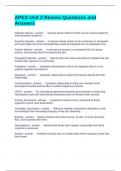
APES Unit 2 Review Questions and Answers Indicator Species Species whose tolerance limits can be used to judge the environmental conditions. Keystone Species A species whose impact on its community or ecosystem are much larger and more influential than would be expected from its population size. Pioneer Species In primary succession on a terrestrial site; the plants lichens, and microbes that first colonize the site. Foundation Species Species that can create and enhance habitats that can benefit other species in a community. Parasitism Symbiotic relationship in which one organism lives in or on another organism and harms it. Mutualism Symbiotic relationship in which both species benefit from the relationship. Commensalism Symbiotic relationship in which one member of the association benefits and the other is neither helped nor harmed. CITES An international agreement between governments to ensure that international trade with wild animals and plants does not threaten their survival. Primary Succession Land that is bared of soil is colonized by living organisms where none lived before. Secondary Succession When an existing community is disturbed, a new one develops from the biological legacy of the old community. Benthos Bottom dwellers that either burrow, anchor, or move along the floor. Some species filter feed. Decomposers bacteria that break down organic compounds and return nutrients to producers. Estuary Partially enclosed area of coastal water where seawater mixes with fresh water. Intertidal Zones The area of the shoreline between low and high tides and have many niches. Biomes A major biotic community characterized by the dominant forms of plant life and prevailing climate. Boreal forest Northern coniferous forest where trees are adapted to harsh winter conditions (between 45-60 degrees). Chaparral Characterized by hot dry summers and cool moist winters, dominated by a dense growth of mostly small-leaved evergreen shrubs and are prone to wildfires. Desert Areas characterized by less than 25 cm of precipitation annually and where evaporation exceeds precipitation. Savannas A plain characterized by coarse grasses and scattered tree growth. Especially on the margins of the tropics where the rainfall is seasonal. Temperate Deciduous Forest Biome with defined seasons and regular precipitation, characterized by the presence of broad-leaf deciduous leaved trees. Tundra A vast treeless plain in the arctic regions between the ice cap and the tree line. Polar desert A desert at the poles with ice but little precipitation. Taiga Just south of the tundra; characterized by a northern coniferous forest, mineral-poor topsoil, boreal forest, and evergreen coniferous forest. Temperate Grassland Found in temperate regions with a semiarid climate, dominated by grass species. Tropical Rain Forest Receives large amounts of precipitation, characterized by high levels of biodiversity, rapid nutrient cycling and nutrient-poor soil Abiotic Factors Non Living components such as water, air nutrients, rocks, heat, and solar energy. Biotic Factors Living and once living biological components such as plants, animals, and microbes. Range of Tolerance Each population has a range of tolerance to variations in its physical and chemical environment. Limiting Factors Too much or too little of any factors can limit the growth of a population in an ecosystem even if all other factors are at the optimum range of tolerance for the species. Producers Autotrophs, make their own food Autotrophs An organism that produces its own food from inorganic compounds and a source of energy. Photosynthesis 6CO2 + 6H2O + Energy --> C6H12O6 + 6O2 Chemosynthesis Synthesis of organic compounds by energy derived from chemical reactions. Consumers Heterotrophs, gain nutrients by feeding on other organisms or their remains. Heterotrophs Organisms that cannot make their own food from inorganic chemicals and therefore live by feeding on other organisms. Detritivores Feeds on the wastes or dead bodies of other organisms, called detritus. Examples include mites, earthworms, catfish, and vultures. Aerobic Respiration/Fermentation Uses oxygen to convert nutrients back to carbon dioxide and water. Anaerobic Respiration Done in absence of oxygen and produces methane, alcohol, vinegar, hydrogen sulfide, etc... Ecological Efficiency The percentage of usable chemical energy transferred as biomass from one trophic level to the next. Gross Primary Productivity The rate at which an ecosystem's producers convert solar energy into chemical energy as biomass found in their tissues. Net Primary Productivity The rate at which producers use photosynthesis to produce and store chemical energy minus the rate at which they use some of this stored chemical energy through aerobic respiration. HIPPO Habitat destruction, invasive species, population growth, pollution, overharvesting Coevolution The process in which a change in the gene pool of one species may lead to the change of the gene pool of another. Ecological Niche Particular area within a habitat occupied by an organism and includes the function of that organism within an ecological community. Fundamental Niche The full potential range of the physical, chemical, and biological factors a species can use if there is no competition from other species. Realized Niche Parts of the fundamental niche of a species that are actually used by that species. Specialist Species Species with a narrow ecological niche; may be able to live only in a certain habitat, and tolerate a narrow range of climatic and other environmental conditions. Generalist Species Species with a broad ecological niche; they can live in many different habitats, eat a variety of foods, and tolerate a wide range of environmental conditions. Speciation Geographic Isolation Separation of populations of a species for long periods of time into different areas. Reproductive Isolation Long-term geographic separation of members of a particular sexually reproducing species. Endemic Species Species that are native to and found only within a limited area.

Meer zien Lees minder
Instelling
APES
Vak
APES


Oeps! We kunnen je document nu niet laden. Probeer het nog eens of neem contact op met support.

Geschreven voor

Instelling
APES
Vak
APES

Documentinformatie

Geüpload op
1 december 2024
Aantal pagina's
4
Geschreven in
2024/2025
Type
Tentamen (uitwerkingen)
Bevat
Vragen en antwoorden

Onderwerpen

Voorbeeld van de inhoud

APES Unit 2 Review Questions and
Answers
Indicator Species - answer Species whose tolerance limits can be used to judge the
environmental conditions.

Keystone Species - answer A species whose impact on its community or ecosystem
are much larger and more influential than would be expected from its population size.

Pioneer Species - answer In primary succession on a terrestrial site; the plants
lichens, and microbes that first colonize the site.

Foundation Species - answer Species that can create and enhance habitats that can
benefit other species in a community.

Parasitism - answer Symbiotic relationship in which one organism lives in or on
another organism and harms it.

Mutualism - answer Symbiotic relationship in which both species benefit from the
relationship.

Commensalism - answer Symbiotic relationship in which one member of the
association benefits and the other is neither helped nor harmed.

CITES - answer An international agreement between governments to ensure that
international trade with wild animals and plants does not threaten their survival.

Primary Succession - answer Land that is bared of soil is colonized by living
organisms where none lived before.

Secondary Succession - answer When an existing community is disturbed, a new
one develops from the biological legacy of the old community.

Benthos - answer Bottom dwellers that either burrow, anchor, or move along the
floor. Some species filter feed.

Decomposers - answer bacteria that break down organic compounds and return
nutrients to producers.

Estuary - answer Partially enclosed area of coastal water where seawater mixes with
fresh water.

€11,41
Krijg toegang tot het volledige document:

100% tevredenheidsgarantie
Direct beschikbaar na je betaling
Lees online óf als PDF
Geen vaste maandelijkse kosten


Ook beschikbaar in voordeelbundel

Maak kennis met de verkoper

Seller avatar
De reputatie van een verkoper is gebaseerd op het aantal documenten dat iemand tegen betaling verkocht heeft en de beoordelingen die voor die items ontvangen zijn. Er zijn drie niveau’s te onderscheiden: brons, zilver en goud. Hoe beter de reputatie, hoe meer de kwaliteit van zijn of haar werk te vertrouwen is.
Pogba119 Harvard University
Volgen Je moet ingelogd zijn om studenten of vakken te kunnen volgen
Verkocht
48
Lid sinds
1 jaar
Aantal volgers
2
Documenten
4956
Laatst verkocht
1 maand geleden
NURSING TEST

BEST EDUCATIONAL RESOURCES FOR STUDENTS

3,9

9 beoordelingen

5
4
4
2
3
2
2
0
1
1

Recent door jou bekeken

Waarom studenten kiezen voor Stuvia

Gemaakt door medestudenten, geverifieerd door reviews

Kwaliteit die je kunt vertrouwen: geschreven door studenten die slaagden en beoordeeld door anderen die dit document gebruikten.

Niet tevreden? Kies een ander document

Geen zorgen! Je kunt voor hetzelfde geld direct een ander document kiezen dat beter past bij wat je zoekt.

Betaal zoals je wilt, start meteen met leren

Geen abonnement, geen verplichtingen. Betaal zoals je gewend bent via Bancontact, iDeal of creditcard en download je PDF-document meteen.

Student with book image

“Gekocht, gedownload en geslaagd. Zo eenvoudig kan het zijn.”

Alisha Student

Veelgestelde vragen