Article 267 TFEU
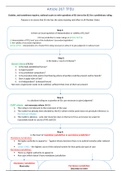
Enables, and sometimes requires, national courts to refer questions of EU law to the ECJ for a preliminary ruling.
Purpose is to ensure that EU law has the same meaning and effect in all Member States
Step 1:
Is there an issue/question of interpretation or validity of EU law?
ECJ has jurisdiction to make rulings on (Article 267(1)):
a) interpretation of TFEU and ‘acts of the institutions’ (secondary legislation)
b) the validity of secondary legislation
Article 267(2) – interpretation of a Treaty if ECJ ruling necessary to allow it to give judgment in national court
Step 2:
Is the body a ‘court or tribunal’?
Dorsch Criteria (EPCIRI):
1. Is the body established by law?
2. Is it permanent?
3. Is its jurisdiction compulsory?
4. Is its procedure inter partes (had hearing where all parties could be present and be heard)?
5. Does it apply rules of law?
6. Is it independent? (unbiased forum)
Not every single factor needs to be satisfied, sufficient that most of them are present
Step 3:
Is a decision/ruling on a question of EU Law necessary to give judgment?
CILFIT criteria – not necessary where (RAO):
1. The ruling is not relevant to the conclusion of the case
2. The matter has already been decided by the ECJ (where similar point does not preclude reference i.e.
Da Costa en Schaake
3. The matter is obvious – acte clair (must be clear on the fact of it so as to leave no scope for
reasonable doubt to courts of MS and ECJ)
Step 4:
Is the Court of mandatory jurisdiction or permissive jurisdiction?
Mandatory Jurisdiction:
No higher authority to appeal to - “against whose decisions there is no judicial remedy under national
law”
Costa v ENEL – the highest court of the national system for that particular type of case
Permissive Jurisdiction:
There is a higher authority to appeal to
Any court which doesn’t have mandatory jurisdiction
Mandatory Jurisdiction
Must refer Permissive Jurisdiction
Discretion to refer
,
, Direct Effect, Indirect Effect and State Liability
Directly applicable
Directly effective legislation = legislation
legislation = legislation Actions based on EU Law before a national court that becomes a part of
that gives rise to rights the legal system in
or obligations which Member States without
individuals may enforce Can EU Legislation be used in a national court? the need for further
before their national enactment by the
courts Member States’
national legislatures
Regulation or Treaty article Directive
Regulation = secondary legislation secondary legislation, not directly applicable
Treaty article = primary legislation
Both directly applicable
Has the directive been correctly implemented?
i.e. via Act of Parliament or delegated legislation (SI)
YES NO
Is the legislation directly effective?
Van Gend criteria: Rely on that Determine whether it is
1. Sufficiently clear and precise; national law being used horizontally or
vertically
2. Unconditional; and
3. Leave no room for exercise of (see Foster v British Gas
discretion in implementation on part guidelines for definition of
of Member State or Community public body or emanation
institutions of state)
Vertical Horizontal
YES NO
No rights
May be applied vertically under EU Is it directly effective?
(Regulation = Leonesio, Treaty law Not directly
= Van Gend) Van Duyn criteria - Terms of
effective –
and horizontally the directive must be clear, Marshall
(Regulation = Atonio Munoz, precise and unconditional – (directive must
Treaty = Defrenne) can make Article 267 not impose
reference if unsure obligations on an
individual –Facini
Foster v British Gas guidelines for the definition of Ratti - time limit for Dori confirmed
a public body/emanation of the State (EOS): implementation must have this)
expired
1. ‘Public service condition’ – responsible for providing a
public service
2. ‘Control condition’ – under the control of the state
3. ‘Special powers condition’ – has special powers which
go beyond those which result from the normal rules Is it indirectly effective?
applicable in relations between individuals
Von Colson – purposive approach - national
Only 2 & 3 need to be satisfied – Farrell legislation should be interpreted in light of the
wording and purpose of the (EU Law) Directive
(Doughty not EOS, no public service or special powers;
Griffin was EOS, public service, special powers, didn’t EU Law has indirect effect where national law can be read
have to be state-controlled for control condition to be purposively
satisfied – statutory provisions and condition of licence
permitted it; NUT was EOS, not all 3 conditions need to
be satisfied)
Enables, and sometimes requires, national courts to refer questions of EU law to the ECJ for a preliminary ruling.
Purpose is to ensure that EU law has the same meaning and effect in all Member States
Step 1:
Is there an issue/question of interpretation or validity of EU law?
ECJ has jurisdiction to make rulings on (Article 267(1)):
a) interpretation of TFEU and ‘acts of the institutions’ (secondary legislation)
b) the validity of secondary legislation
Article 267(2) – interpretation of a Treaty if ECJ ruling necessary to allow it to give judgment in national court
Step 2:
Is the body a ‘court or tribunal’?
Dorsch Criteria (EPCIRI):
1. Is the body established by law?
2. Is it permanent?
3. Is its jurisdiction compulsory?
4. Is its procedure inter partes (had hearing where all parties could be present and be heard)?
5. Does it apply rules of law?
6. Is it independent? (unbiased forum)
Not every single factor needs to be satisfied, sufficient that most of them are present
Step 3:
Is a decision/ruling on a question of EU Law necessary to give judgment?
CILFIT criteria – not necessary where (RAO):
1. The ruling is not relevant to the conclusion of the case
2. The matter has already been decided by the ECJ (where similar point does not preclude reference i.e.
Da Costa en Schaake
3. The matter is obvious – acte clair (must be clear on the fact of it so as to leave no scope for
reasonable doubt to courts of MS and ECJ)
Step 4:
Is the Court of mandatory jurisdiction or permissive jurisdiction?
Mandatory Jurisdiction:
No higher authority to appeal to - “against whose decisions there is no judicial remedy under national
law”
Costa v ENEL – the highest court of the national system for that particular type of case
Permissive Jurisdiction:
There is a higher authority to appeal to
Any court which doesn’t have mandatory jurisdiction
Mandatory Jurisdiction
Must refer Permissive Jurisdiction
Discretion to refer
,
, Direct Effect, Indirect Effect and State Liability
Directly applicable
Directly effective legislation = legislation
legislation = legislation Actions based on EU Law before a national court that becomes a part of
that gives rise to rights the legal system in
or obligations which Member States without
individuals may enforce Can EU Legislation be used in a national court? the need for further
before their national enactment by the
courts Member States’
national legislatures
Regulation or Treaty article Directive
Regulation = secondary legislation secondary legislation, not directly applicable
Treaty article = primary legislation
Both directly applicable
Has the directive been correctly implemented?
i.e. via Act of Parliament or delegated legislation (SI)
YES NO
Is the legislation directly effective?
Van Gend criteria: Rely on that Determine whether it is
1. Sufficiently clear and precise; national law being used horizontally or
vertically
2. Unconditional; and
3. Leave no room for exercise of (see Foster v British Gas
discretion in implementation on part guidelines for definition of
of Member State or Community public body or emanation
institutions of state)
Vertical Horizontal
YES NO
No rights
May be applied vertically under EU Is it directly effective?
(Regulation = Leonesio, Treaty law Not directly
= Van Gend) Van Duyn criteria - Terms of
effective –
and horizontally the directive must be clear, Marshall
(Regulation = Atonio Munoz, precise and unconditional – (directive must
Treaty = Defrenne) can make Article 267 not impose
reference if unsure obligations on an
individual –Facini
Foster v British Gas guidelines for the definition of Ratti - time limit for Dori confirmed
a public body/emanation of the State (EOS): implementation must have this)
expired
1. ‘Public service condition’ – responsible for providing a
public service
2. ‘Control condition’ – under the control of the state
3. ‘Special powers condition’ – has special powers which
go beyond those which result from the normal rules Is it indirectly effective?
applicable in relations between individuals
Von Colson – purposive approach - national
Only 2 & 3 need to be satisfied – Farrell legislation should be interpreted in light of the
wording and purpose of the (EU Law) Directive
(Doughty not EOS, no public service or special powers;
Griffin was EOS, public service, special powers, didn’t EU Law has indirect effect where national law can be read
have to be state-controlled for control condition to be purposively
satisfied – statutory provisions and condition of licence
permitted it; NUT was EOS, not all 3 conditions need to
be satisfied)