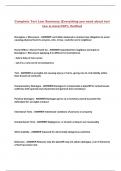
Complete Tort Law Summary (Everything you need about tort
law is here)100% Verified
Donoghue v Stevenson - ANSWER Lord Atkin deduced a common law obligation to avoid
causing physical harm to anyone, who, in law, could be one's neighbour
Home Office v Dorset Yacht Co - ANSWER expanded the neighbour principle in
Donoghue v Stevenson applying it to different circumstances
- held a duty of care arose
- set it to a new set of circumstances
Tort - ANSWER A wrongful act causing injury or harm, giving rise to civil liability (other
than breach of contract)
Compensatory Damages - ANSWER Damages to compensate a plaintiff for actual losses
suffered, both special (out-of-pocket) and general (non-monetary)
Punitive Damages - ANSWER Damages given as a monetary award to punish the
defendant for wrongful conduct
Intentional Torts - ANSWER Intentional violations of persons or property
Unintentional Torts - ANSWER Negligence, or breach of duty to act reasonably
Strict Liability - ANSWER Imposed for abnormally dangerous activities
Defenses - ANSWER Reasons why the plaintiff may not obtain damages, even if elements
of tort have been met
,Tortfeasor - ANSWER One who commits a wrongful act that interferes with another's
interests, must intend to commit the act
Intent - ANSWER Transferred if tortfeasor intended to injure one person but instead
injured another, or made a direct harmful or offensive contact
Battery - ANSWER Application of an act which constitutes assault and causes injury to
plaintiff
False Imprisonment - ANSWER Confinement or restraint of another's activities without
jurisdiction
Intentional Infliction of Emotional Distress - ANSWER An extreme and outrageous act,
intentionally committed, resulting in severe emotional distress to another
Defamation - ANSWER False statements of fact that are published or publicly spoken,
causing injury to another's good reputation
Slander - ANSWER Oral form of defamation
Defamation Damages - ANSWER Compensation for general damages to the plaintiff for
non-specific harms such as disgrace or humiliation
Fraudulent Misrepresentation - ANSWER Deliberate deception of another to gain an
advantage, making a false statement of a known fact
Negligent Misrepresentation - ANSWER When one has a duty to another to provide
accurate information, usually when the maker of the false statement had reason to
believe the statement was true
, Wrongful Interference - ANSWER Interference with a contractual relationship between
two parties
Competitive Methods vs. Predatory Behavior - ANSWER Illegally forcing competitors out
of the market, plaintiff must prove defendant injured consumers and barred defenses to
stand interference
Intentional Torts Against Property - ANSWER Intentional acts that interfere with a
person's legally protected interest in their land or chattels
Trespass - ANSWER To land (no damage to land need occur) or to chattels (taking or
damaging chattel
Conversion - ANSWER Taking personal property and placing it in the service of another
Disparagement of Property - ANSWER At common law a trespasser is liable for any
damage caused to the property
Negligence - ANSWER Failure to exercise the standard of care that a reasonable person
would exercise in similar circumstances
Professional Negligence - ANSWER A professional who "breaches" their duty of care
may be sued for malpractice
Good Samaritan Statutes - ANSWER One who is aided voluntarily by another cannot sue
a 'good samaritan' for negligence
Dram Shop Acts - ANSWER Bar owner or bartender may be held liable for injuries
caused by a person they served or held responsible for continuing to serve an
intoxicated person
law is here)100% Verified
Donoghue v Stevenson - ANSWER Lord Atkin deduced a common law obligation to avoid
causing physical harm to anyone, who, in law, could be one's neighbour
Home Office v Dorset Yacht Co - ANSWER expanded the neighbour principle in
Donoghue v Stevenson applying it to different circumstances
- held a duty of care arose
- set it to a new set of circumstances
Tort - ANSWER A wrongful act causing injury or harm, giving rise to civil liability (other
than breach of contract)
Compensatory Damages - ANSWER Damages to compensate a plaintiff for actual losses
suffered, both special (out-of-pocket) and general (non-monetary)
Punitive Damages - ANSWER Damages given as a monetary award to punish the
defendant for wrongful conduct
Intentional Torts - ANSWER Intentional violations of persons or property
Unintentional Torts - ANSWER Negligence, or breach of duty to act reasonably
Strict Liability - ANSWER Imposed for abnormally dangerous activities
Defenses - ANSWER Reasons why the plaintiff may not obtain damages, even if elements
of tort have been met
,Tortfeasor - ANSWER One who commits a wrongful act that interferes with another's
interests, must intend to commit the act
Intent - ANSWER Transferred if tortfeasor intended to injure one person but instead
injured another, or made a direct harmful or offensive contact
Battery - ANSWER Application of an act which constitutes assault and causes injury to
plaintiff
False Imprisonment - ANSWER Confinement or restraint of another's activities without
jurisdiction
Intentional Infliction of Emotional Distress - ANSWER An extreme and outrageous act,
intentionally committed, resulting in severe emotional distress to another
Defamation - ANSWER False statements of fact that are published or publicly spoken,
causing injury to another's good reputation
Slander - ANSWER Oral form of defamation
Defamation Damages - ANSWER Compensation for general damages to the plaintiff for
non-specific harms such as disgrace or humiliation
Fraudulent Misrepresentation - ANSWER Deliberate deception of another to gain an
advantage, making a false statement of a known fact
Negligent Misrepresentation - ANSWER When one has a duty to another to provide
accurate information, usually when the maker of the false statement had reason to
believe the statement was true
, Wrongful Interference - ANSWER Interference with a contractual relationship between
two parties
Competitive Methods vs. Predatory Behavior - ANSWER Illegally forcing competitors out
of the market, plaintiff must prove defendant injured consumers and barred defenses to
stand interference
Intentional Torts Against Property - ANSWER Intentional acts that interfere with a
person's legally protected interest in their land or chattels
Trespass - ANSWER To land (no damage to land need occur) or to chattels (taking or
damaging chattel
Conversion - ANSWER Taking personal property and placing it in the service of another
Disparagement of Property - ANSWER At common law a trespasser is liable for any
damage caused to the property
Negligence - ANSWER Failure to exercise the standard of care that a reasonable person
would exercise in similar circumstances
Professional Negligence - ANSWER A professional who "breaches" their duty of care
may be sued for malpractice
Good Samaritan Statutes - ANSWER One who is aided voluntarily by another cannot sue
a 'good samaritan' for negligence
Dram Shop Acts - ANSWER Bar owner or bartender may be held liable for injuries
caused by a person they served or held responsible for continuing to serve an
intoxicated person