PSYC 205 TEST BANK QUESTIONS AND ANSWERS WITH SOLUTIONS 2025
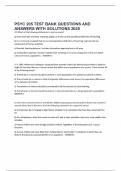
10. Which of the following statements is most accurate? a) Some examples of animal 'teaching' appear to fit the current operational definition of teaching. b) It is commonly accepted that the current operational definition of 'teaching' captures the key components of human teaching. c) Meerkat 'teaching behavior' includes information regarding how to kill prey. d) Comparative cognition research indicates that 'teaching' is not a key component to the cumulative culture of human populations. - ANSWER a 9. In 1999, Whiten and colleagues proposed three essential criteria for determining whether a behavior might be best described as a cultural variant that differs across populations of a species. These include all of the following except a) The behavior of interest should be present in some populations of a species but absent in others. b) There should be no reason to think that genetic differences could account for population differences in the behavior of interest. c) The behavior of interest should be considered to be the outcome of social learning. d) The behavior of interest should be present in only some families (i.e., kin groups) with a population. - ANSWER d 8. Given the research by Horner and Whiten (2005) using opaque and transparent boxes that contained rewards (described in the text), all of the following statements are supported except a) Chimpanzees do not engage in high fidelity imitation in any situations that have been observed thus far. b) For chimpanzees, when the causal structure of a task is clear, emulation may occur more readily than imitation. c) Human children are more strongly biased to imitate, regardless of the transparency of a causal structure. d) Human children are more likely than chimpanzees to 'overimitate' in situations in which they can observe the physical, causal properties of an apparatus. - ANSWER a 7. After observing a member of his group use a stone to crack open a nut, the observing chimpanzee recognizes the end- state of the actions (to obtain nuts) and uses the same actions as the observed chimpanzee. This type of social learning would typically be called a) Imitation b) End-state emulation c) Mim

Geschreven voor
- Instelling
- Research Methods for the Behavioral Sciences
- Vak
- Research Methods for the Behavioral Sciences
Documentinformatie
- Geüpload op
- 10 november 2024
- Aantal pagina's
- 58
- Geschreven in
- 2024/2025
- Type
- Tentamen (uitwerkingen)
- Bevat
- Vragen en antwoorden
Onderwerpen
-
psyc 205 test bank questions and answers with solu

Ook beschikbaar in voordeelbundel