Reflexive Verbs & Pronouns
What are reflexive verbs & pronouns?
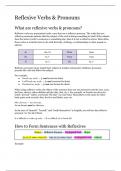
Reflexive verbs are pronominal verbs–ones that use a reflexive pronoun. The verbs that use
reflexive pronouns indicate that the subject of the verb is doing something to itself. If the subject
does the action (verb) to someone or something else, then it is not a reflexive action. Most often,
these verbs or activities have to do with the body, clothing, or relationships to other people or
objects.
Je me, m’ Nous nous
Tu te, t’ Vous vous
Il se, s’ Ils se, s’
Reflexive pronouns must match their subject in number and gender. Reflexive pronouns
precede the verb and follow the subject.
Par exemple:
● I brush my teeth. → Je me brosse les dents.
● I will brush my teeth. → Je me brosserai les dents.
● I brushed my teeth. → Je me suis brossé les dents.
When using reflexive verbs, the object of the sentence does not use possessive articles (my, your,
his/hers, theirs), rather definite articles (the, that, etc.). For example, in French one does not
brush “my hair” rather, you brush “the hair” on your head. This pattern is the same for other
body parts such as teeth, skin, the face and limbs, eyes, etc.
Mes cheveux → Les cheveux.
Je me brosse mes les cheveux.
In the case of “himself,” “herself,” and “itself/themselves” in English, you will use the reflexive
pronoun “se” for all of them.
It is difficult to wake up early. → Il est difficile de se lever tôt.
How to Form Sentences with Reflexives
Subject + Reflexive Pronoun + Conjugated Verb + Object
(je, tu, il, nous, vous, ils) + (me, te, se, nous, vous) + (conjugated verb) + (object)
Exemple:
What are reflexive verbs & pronouns?
Reflexive verbs are pronominal verbs–ones that use a reflexive pronoun. The verbs that use
reflexive pronouns indicate that the subject of the verb is doing something to itself. If the subject
does the action (verb) to someone or something else, then it is not a reflexive action. Most often,
these verbs or activities have to do with the body, clothing, or relationships to other people or
objects.
Je me, m’ Nous nous
Tu te, t’ Vous vous
Il se, s’ Ils se, s’
Reflexive pronouns must match their subject in number and gender. Reflexive pronouns
precede the verb and follow the subject.
Par exemple:
● I brush my teeth. → Je me brosse les dents.
● I will brush my teeth. → Je me brosserai les dents.
● I brushed my teeth. → Je me suis brossé les dents.
When using reflexive verbs, the object of the sentence does not use possessive articles (my, your,
his/hers, theirs), rather definite articles (the, that, etc.). For example, in French one does not
brush “my hair” rather, you brush “the hair” on your head. This pattern is the same for other
body parts such as teeth, skin, the face and limbs, eyes, etc.
Mes cheveux → Les cheveux.
Je me brosse mes les cheveux.
In the case of “himself,” “herself,” and “itself/themselves” in English, you will use the reflexive
pronoun “se” for all of them.
It is difficult to wake up early. → Il est difficile de se lever tôt.
How to Form Sentences with Reflexives
Subject + Reflexive Pronoun + Conjugated Verb + Object
(je, tu, il, nous, vous, ils) + (me, te, se, nous, vous) + (conjugated verb) + (object)
Exemple: