RMIN 4000 UGA Brown Test
4/Questions with Answers
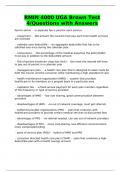
fee-for-serive - -a separate fee is paid for each service
- copayment - -flat amount the insured must pay each time health services
are received
- calendar year deductible - -an aggregate deductible that has to be
satisfied only once during the calendar year
- coinsurance - -the percentage of the medical expenses the policyholder
must pay in addition to the deductible amount
- Out-of-pocket maximum (stop-loss limit) - -the most the insured will have
to pay out-of-pocket in a calendar year
- managed care plan - -a health care plan that is designed to lower costs for
both the insurer and the consumer while maintaining a high standard of care
- health maintenance organization (HMO) - -system that provides
healthcare to its members on a prepaid basis in a particular area
- capitation fee - -a fixed annual payment for each plan member regardless
of the frequency or type of service provided
- advantages of HMO - -low cost sharing, good communication between
providers
- disadvantages of HMO - -no out of network coverage, must get referrals
- preferred provider organizations (PPO) - -plan that contracts with
healthcare providers to provide certain medical services at discounted fees
- advantages of PPO - -no referral needed, can see out of network providers
- disadvantages of PPO - -more cost-sharing, less efficient communication,
more complicated billing
- point of service plan (POS) - -hybrid of HMO and PPO
- consumer directed health care plan (CDHP) - -plan that combines a high-
deductible plan with a health savings account
, - health savings account (HSA) - -tax exempt account established
exclusively for the purpose of lying medical expenses - high deductible plans
only
- flexible spending account (FSA) - -permits employees to pay for certain
unreimbursed medical expenses with before tax dollars - cannot be used
with high deductible plan
- long-term care insurance - -pays a daily/monthly benefit for medical or
custodial care received in a nursing facility, hospital, or at home
- disability-income insurance - -provides income payments when the
insured is unable to work because of sickness or injury
- total disability - -inability to perform the material and substantial duties of
your regular occupation
- partial disability - -you can perform some but not all of the duties of your
occupation
- residual disability - -applies when you are gainfully employed and not
totally disabled but, solely because of sickness or injury, our loss of income is
at least 15 percent of your prior income
- dental insurance - -pays the cost of norma dental care, orthodontics not
usually covered
- vision insurance - -coverage for routine eyesore, usually does not cover
the full cost of glasses or contacts
- types of legal wrongs - -crime, breach of contract, tort
- tort - -a legal wrong for which the court allows a remedy in the form of
monetary damages
- 3 categories of tort - -intentional, strict liability, negligence
- intentional tort - -intentional act or omission resulting in harm or injury to
another person or damage to their property
- strict liability - -liability imposed regardless of negligence or fault (ex:
defective products, workers comp)
- negligence - -failure to exercise the standard of care required by law to
protect others from an unreasonable risk of harm
4/Questions with Answers
fee-for-serive - -a separate fee is paid for each service
- copayment - -flat amount the insured must pay each time health services
are received
- calendar year deductible - -an aggregate deductible that has to be
satisfied only once during the calendar year
- coinsurance - -the percentage of the medical expenses the policyholder
must pay in addition to the deductible amount
- Out-of-pocket maximum (stop-loss limit) - -the most the insured will have
to pay out-of-pocket in a calendar year
- managed care plan - -a health care plan that is designed to lower costs for
both the insurer and the consumer while maintaining a high standard of care
- health maintenance organization (HMO) - -system that provides
healthcare to its members on a prepaid basis in a particular area
- capitation fee - -a fixed annual payment for each plan member regardless
of the frequency or type of service provided
- advantages of HMO - -low cost sharing, good communication between
providers
- disadvantages of HMO - -no out of network coverage, must get referrals
- preferred provider organizations (PPO) - -plan that contracts with
healthcare providers to provide certain medical services at discounted fees
- advantages of PPO - -no referral needed, can see out of network providers
- disadvantages of PPO - -more cost-sharing, less efficient communication,
more complicated billing
- point of service plan (POS) - -hybrid of HMO and PPO
- consumer directed health care plan (CDHP) - -plan that combines a high-
deductible plan with a health savings account
, - health savings account (HSA) - -tax exempt account established
exclusively for the purpose of lying medical expenses - high deductible plans
only
- flexible spending account (FSA) - -permits employees to pay for certain
unreimbursed medical expenses with before tax dollars - cannot be used
with high deductible plan
- long-term care insurance - -pays a daily/monthly benefit for medical or
custodial care received in a nursing facility, hospital, or at home
- disability-income insurance - -provides income payments when the
insured is unable to work because of sickness or injury
- total disability - -inability to perform the material and substantial duties of
your regular occupation
- partial disability - -you can perform some but not all of the duties of your
occupation
- residual disability - -applies when you are gainfully employed and not
totally disabled but, solely because of sickness or injury, our loss of income is
at least 15 percent of your prior income
- dental insurance - -pays the cost of norma dental care, orthodontics not
usually covered
- vision insurance - -coverage for routine eyesore, usually does not cover
the full cost of glasses or contacts
- types of legal wrongs - -crime, breach of contract, tort
- tort - -a legal wrong for which the court allows a remedy in the form of
monetary damages
- 3 categories of tort - -intentional, strict liability, negligence
- intentional tort - -intentional act or omission resulting in harm or injury to
another person or damage to their property
- strict liability - -liability imposed regardless of negligence or fault (ex:
defective products, workers comp)
- negligence - -failure to exercise the standard of care required by law to
protect others from an unreasonable risk of harm