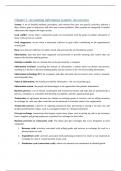
Chapter 1: Accounting information systems: An overview
System: A set of detailed methods, procedures, and routines that carry out specific activities, perform a
duty, achieve goals or objectives, and solve one or more problems. Most systems are composed of smaller
subsystems that support the larger system.
Goal conflict: occurs when a subsystem's goals are inconsistent with the goals of another subsystem or
those of the system as a whole.
Goal congruence: occurs when a subsystem achieves its goal while contributing to the organization's
overall goal.
Data: facts that are collected, recorded, stored, and processed by an information system.
Information: data that have been organized and processed to provide meaning and context that can
improve the decision-making process.
Machine-readable: data in a format that can be processed by a computer.
Information overload: exceeding the amount of information a human mind can absorb and process,
resulting in a decline in decision-making quality and an increase in the cost of providing information.
Information technology (IT): the computers and other electronic devices used to store, retrieve, transmit,
and manipulate data.
Value of information: the benefit provided by information – the cost of producing it.
Information system: the people and technologies in an organization that produce information.
Business process: a set of related, coordinated, and structured activities and tasks that are performed by a
person, a computer, or a machine and that help accomplish a specific organizational goal.
Transaction: an agreement between two entities to exchange goods or services, such as selling inventory
in exchange for cash; any other event that can be measured in economic terms of an organization.
Transaction process: a process of capturing transaction data, processing it, storing it for later use, and
producing information output, such as a managerial report or a financial statement.
Give-get exchange: transactions that happen a great many times, such as giving up cash to get inventory
from a supplier and giving employees a paycheck in exchange for their labor.
Business processes or transaction cycle: The major give-get exchanges that occur frequently in most
companies.
1. Revenue cycle: activities associated with selling goods and services in exchange for cash or a
future promise to cash.
2. Expenditure cycle: activities associated with purchasing inventory for resale or raw materials in
exchange for cash or a future promise to pay cash.
3. Production cycle (conversion cycle): where raw materials are transformed in finished goods
, 4. Human resource/payroll cycle: where employees are hired, trained, compensated, evaluated,
promoted, and terminated.
5. Financing cycle: where companies sell shares in the company to investors and borrow money,
and where investors are paid dividends and interest is paid on loans.
General ledger and reporting system: Information processing operations are involved in updating the
general ledger and preparing reports for both management and external parties.
Accounting information system (AIS): a system that collects, records, stores, and processes data to
produce information technology infrastructure, and internal controls and security measures. An AIS
processes data to produce information for decision-makers.
Accounting: The systematic and comprehensive recording of an organization's finance transactions,
including summarizing, analyzing, and reporting these transactions to all users.
Six components of AIS:
- The people who use the system;
- The procedures and instructions used to collect, process, and store data;
- The data about the organization and its business activities;
- The software used to process the data;
- The information technology infrastructure, including the computers, devices, and network
communications devices used in the AIS;
- The internal controls and security measures that safeguard AIS data.
-
These components enable an AIS to fulfill three important business functions:
1. Collect and store data;
2. Transform data into information;
3. Provide adequate controls to safeguard.
-
A well-designed AIS can add value to an organization by:
1. Improving quality and reducing the cost of products or services;
2. Improving efficiency;
3. Sharing knowledge;
4. Improving efficiency and effectiveness of its supply chain;
5. Improving the internal control structure;
6. Improving decision-making.
Artificial intelligence (AI): the use of computer systems to simulate human intelligence processes such as
learning, reasoning, and self-improvement.
Data analytics: use of software and algorithms to find and solve problems and improve business
performance.
System: A set of detailed methods, procedures, and routines that carry out specific activities, perform a
duty, achieve goals or objectives, and solve one or more problems. Most systems are composed of smaller
subsystems that support the larger system.
Goal conflict: occurs when a subsystem's goals are inconsistent with the goals of another subsystem or
those of the system as a whole.
Goal congruence: occurs when a subsystem achieves its goal while contributing to the organization's
overall goal.
Data: facts that are collected, recorded, stored, and processed by an information system.
Information: data that have been organized and processed to provide meaning and context that can
improve the decision-making process.
Machine-readable: data in a format that can be processed by a computer.
Information overload: exceeding the amount of information a human mind can absorb and process,
resulting in a decline in decision-making quality and an increase in the cost of providing information.
Information technology (IT): the computers and other electronic devices used to store, retrieve, transmit,
and manipulate data.
Value of information: the benefit provided by information – the cost of producing it.
Information system: the people and technologies in an organization that produce information.
Business process: a set of related, coordinated, and structured activities and tasks that are performed by a
person, a computer, or a machine and that help accomplish a specific organizational goal.
Transaction: an agreement between two entities to exchange goods or services, such as selling inventory
in exchange for cash; any other event that can be measured in economic terms of an organization.
Transaction process: a process of capturing transaction data, processing it, storing it for later use, and
producing information output, such as a managerial report or a financial statement.
Give-get exchange: transactions that happen a great many times, such as giving up cash to get inventory
from a supplier and giving employees a paycheck in exchange for their labor.
Business processes or transaction cycle: The major give-get exchanges that occur frequently in most
companies.
1. Revenue cycle: activities associated with selling goods and services in exchange for cash or a
future promise to cash.
2. Expenditure cycle: activities associated with purchasing inventory for resale or raw materials in
exchange for cash or a future promise to pay cash.
3. Production cycle (conversion cycle): where raw materials are transformed in finished goods
, 4. Human resource/payroll cycle: where employees are hired, trained, compensated, evaluated,
promoted, and terminated.
5. Financing cycle: where companies sell shares in the company to investors and borrow money,
and where investors are paid dividends and interest is paid on loans.
General ledger and reporting system: Information processing operations are involved in updating the
general ledger and preparing reports for both management and external parties.
Accounting information system (AIS): a system that collects, records, stores, and processes data to
produce information technology infrastructure, and internal controls and security measures. An AIS
processes data to produce information for decision-makers.
Accounting: The systematic and comprehensive recording of an organization's finance transactions,
including summarizing, analyzing, and reporting these transactions to all users.
Six components of AIS:
- The people who use the system;
- The procedures and instructions used to collect, process, and store data;
- The data about the organization and its business activities;
- The software used to process the data;
- The information technology infrastructure, including the computers, devices, and network
communications devices used in the AIS;
- The internal controls and security measures that safeguard AIS data.
-
These components enable an AIS to fulfill three important business functions:
1. Collect and store data;
2. Transform data into information;
3. Provide adequate controls to safeguard.
-
A well-designed AIS can add value to an organization by:
1. Improving quality and reducing the cost of products or services;
2. Improving efficiency;
3. Sharing knowledge;
4. Improving efficiency and effectiveness of its supply chain;
5. Improving the internal control structure;
6. Improving decision-making.
Artificial intelligence (AI): the use of computer systems to simulate human intelligence processes such as
learning, reasoning, and self-improvement.
Data analytics: use of software and algorithms to find and solve problems and improve business
performance.