Advanced Research Methods
Knowledge clip 1
Dag theory
Research question
o Must satisfy two conditions
Open ended question
Needs to include some causal language
Dag theory
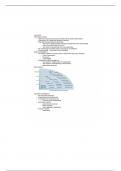
o Directed acyclic graphs are graphical representations of the
causal structure underlying a research question
Exposure X to outcome Y
o Unbiased
Correct for other factors such as diet and lifestyle (in this
case)
Remove disruptive influence of other factors
o Dags
Dags help to visualize the causal structure underlying a
research question
You need a priori theoretical/subject knowledge about
the causal structure to draw a DAG
E.g. from previous studies, literature, common
sense, etc.
Collect data on all relevant variables
Simle rules can be applied to determine for which
variables to add in regression analysis and how to
interpret the results
Dag terminology
o Paths
RQ: influence of x on y?
A path is any route between exposure x and outcome y
Paths do not have to follow the directions of the arrow
,
o Causal paths and backdoor paths
A causal path follows the direction of the arrows
A backdoor path does not
o Open and closed paths, and colliders
All paths are open, unless they collide somewhere on a
path
A path is closed if arrows collide in one variable on that
path
A variable in which the arrows collide = a collider
,
o Blocking open paths
Open (causal or backdoor) paths transmit association
The association between x and y consists of the
combination of all open paths between them
Here: all paths except x w Y
To examine the influence of x on y, and only that, the
other associations that are not directly relevant need to
be removed > blocking those open paths
Block those open paths block open backdoor paths by
including a variable on that backdoor path in the
regression analysis
An open path is blocked when we adjust for a variable L
along the …
This means that we remove the disruptive influence of L
from the association between X and Y
How? By including variable L in the regression analysis
Backdoor paths always need to be closed
Causal paths need to be open/closed depending on RQ
o Opening blocked path
Include a collider in the analysis means you open the
blocked backdoor path
Opening a backdoor path is disruptive for the association
between x and y introduce bias of the influence
Avoid bias by closing the backdoor path again remove
the collider or add another variable that removes the
disruption
Lecture 1 causal inference
Developments in quantitative research
o 1960-2010: focus on statistical methods
Development of new techniques
Improvements in computers and software
Standardization of tests, focus on objectivity and
replicability
, Helpful and harmful
o Since 2010: statistics is not so black and white
Causal theory
What (variables) should be part of a quantitative
analysis
Statistics is not just about numbers
Interpretation: meaning of results depends on context
moving beyond p-value < 0.05
o Three different reasons for examining relationship between x
and y
Description: patterns X and Y
Prediction: Y given X
Causal inference: Effect X on Y
o Causal inference
Not interested in outcome per se
Interested in the role of the treatment X on the outcome
In an individual, a treatment has a causal effect if the
outcome under treatment 1 would be different from the
outcome under treatment 2
o Causal effect formal notation
Knowledge clip 1
Dag theory
Research question
o Must satisfy two conditions
Open ended question
Needs to include some causal language
Dag theory
o Directed acyclic graphs are graphical representations of the
causal structure underlying a research question
Exposure X to outcome Y
o Unbiased
Correct for other factors such as diet and lifestyle (in this
case)
Remove disruptive influence of other factors
o Dags
Dags help to visualize the causal structure underlying a
research question
You need a priori theoretical/subject knowledge about
the causal structure to draw a DAG
E.g. from previous studies, literature, common
sense, etc.
Collect data on all relevant variables
Simle rules can be applied to determine for which
variables to add in regression analysis and how to
interpret the results
Dag terminology
o Paths
RQ: influence of x on y?
A path is any route between exposure x and outcome y
Paths do not have to follow the directions of the arrow
,
o Causal paths and backdoor paths
A causal path follows the direction of the arrows
A backdoor path does not
o Open and closed paths, and colliders
All paths are open, unless they collide somewhere on a
path
A path is closed if arrows collide in one variable on that
path
A variable in which the arrows collide = a collider
,
o Blocking open paths
Open (causal or backdoor) paths transmit association
The association between x and y consists of the
combination of all open paths between them
Here: all paths except x w Y
To examine the influence of x on y, and only that, the
other associations that are not directly relevant need to
be removed > blocking those open paths
Block those open paths block open backdoor paths by
including a variable on that backdoor path in the
regression analysis
An open path is blocked when we adjust for a variable L
along the …
This means that we remove the disruptive influence of L
from the association between X and Y
How? By including variable L in the regression analysis
Backdoor paths always need to be closed
Causal paths need to be open/closed depending on RQ
o Opening blocked path
Include a collider in the analysis means you open the
blocked backdoor path
Opening a backdoor path is disruptive for the association
between x and y introduce bias of the influence
Avoid bias by closing the backdoor path again remove
the collider or add another variable that removes the
disruption
Lecture 1 causal inference
Developments in quantitative research
o 1960-2010: focus on statistical methods
Development of new techniques
Improvements in computers and software
Standardization of tests, focus on objectivity and
replicability
, Helpful and harmful
o Since 2010: statistics is not so black and white
Causal theory
What (variables) should be part of a quantitative
analysis
Statistics is not just about numbers
Interpretation: meaning of results depends on context
moving beyond p-value < 0.05
o Three different reasons for examining relationship between x
and y
Description: patterns X and Y
Prediction: Y given X
Causal inference: Effect X on Y
o Causal inference
Not interested in outcome per se
Interested in the role of the treatment X on the outcome
In an individual, a treatment has a causal effect if the
outcome under treatment 1 would be different from the
outcome under treatment 2
o Causal effect formal notation