Summary
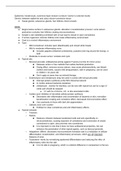
Chapter 3 ‘Time value of money’
Time value of money = having a Euro today is more valuable than having a Euro next year or ten
years from now. (Nathan zou zeggen: Inflatie! Spenden die saaf!)
There are multiple reasons for why the present sum of money is worth more than the same sum in
the future:
The money you have today can be used immediately, e.g. put on a bank account and receive
interest
Inflation – prices go up over time, so the purchasing power of a Euro goes down
The associated risk involved with potentially not receiving the future amount
Formulas:
Index:
R = Interest rate (discount rate)
N = Number of periods
I = Interest
PV = Present value
FV = Future value
P = perpetuity
A = Annuity
G = Growing rate (perpetiuty)
S = Single sum (single amount)
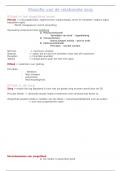
,Annuity
Equal amounts of cash each interest period ( END of the period, otherwise it is an
annuity due)
Interest periods of equal length
An equal interest rate each interest period
Glossary
Interest = The cost of borrowing money. It is a percentage over the sum of money
borrowed.
Principal = The sum of money borrowed.
Expense = when borrowing money
Return = when lending money
Annuity = a series of consecutive/equal payments/receipts over a number of periods.
Annuity due = If the payments or receipts occur at the beginning of the year
Perpetuity = an annuity that continues forever.
Growing perpetuity = a stream of cash flows that occur at regular intervals and grow at a
constant rate forever
Discount rate = the percentage of a compensation for inflation, risk and patience.
Lesson 1
Financial management
Two Main Issues:
• What Should the Business Invest In?
• How Should the Investment Be Financed?
Overall Decision Criterion & Yardstick
• Increase (Maximize) Company Value
Value, what value?
Accounting (Book) Value
• Balance sheet Entity
• Historic Orientation
Market Value
• Price Investors Are Willing to Pay
• Future Orientation
• Future Performance
• In Financial Management the focus is on Market Value!
,Goodwill
• Balance sheet is an incomplete document
• Does not show future profit potential
• Does not show items like strength of brand name, skills of personal etc
• Value of these kind of ‘assets’ is called goodwill
Market value of an investment
• Depends on expected future performance
• Performance expressed as Cash Flows available to investors
• Cash Flows are uncertain so there is risk
• Cash Flows happen in the future
• How can we compare these cash flows?
• By calculating the Present Value (PV)?
Key concepts
• Cash Flows versus Profit
• Profit is affected by accounting decisions
• Depreciation Method
• Inventory Valuation (FIFO, LIFO etc..)
• Cash Flow not affected by accounting decisions
• Profit is an Opinion, Cash is a Fact
• Present Value of Cash Flows (Today’s Value of Future Cash Flows with discount rate )
• Risk Return Tradeoff
, Discount rate
• Discount rate is Cost of Capital aka the Required Rate of Return of Investors
Q: How High is the Discount Rate?
A: Depends on Risk of Investment
• Higher Risk → Higher Discount rate
Q: Who Determines Cost of Capital
A: The Market (Not the Company)
• Risk Free Rate: Government Interest Rate
• Discount Rate = Risk Free Rate + Risk Premium
• Common abbreviation: r
Valuation formulas recap
1. In case of n cash flows (=Annuity): PV = CF1/(1+rr) + CF2/(1+rr)² +..+CFn/(1+rr)n
• Or use formula PV = CF * {1 – 1/(1+rr) n}/rr
(formula can only be used when CF remains the same)
2. In case of perpetual level cash flow: PV = CF/rr
3. In case of perpetual growing cash flow: PV = CF/(rr – g)
Summary
• Value of an investment = PV of all future cash flows available to investors
• Discount rate = Required Rate of Investors (interest rate or require rate on equity)
• RR depends on the risk of the investment
Lesson 2
Capital Structure, Cost of Capital & Required Rate
• CC = Cost of Funding
• Required Rate = Reward for Supplying Funds
• Market Equilibrium: CC = RR
• Two sides of the same ‘coin’
• CC & RR Depends on Risk Level
Chapter 3 ‘Time value of money’
Time value of money = having a Euro today is more valuable than having a Euro next year or ten
years from now. (Nathan zou zeggen: Inflatie! Spenden die saaf!)
There are multiple reasons for why the present sum of money is worth more than the same sum in
the future:
The money you have today can be used immediately, e.g. put on a bank account and receive
interest
Inflation – prices go up over time, so the purchasing power of a Euro goes down
The associated risk involved with potentially not receiving the future amount
Formulas:
Index:
R = Interest rate (discount rate)
N = Number of periods
I = Interest
PV = Present value
FV = Future value
P = perpetuity
A = Annuity
G = Growing rate (perpetiuty)
S = Single sum (single amount)
,Annuity
Equal amounts of cash each interest period ( END of the period, otherwise it is an
annuity due)
Interest periods of equal length
An equal interest rate each interest period
Glossary
Interest = The cost of borrowing money. It is a percentage over the sum of money
borrowed.
Principal = The sum of money borrowed.
Expense = when borrowing money
Return = when lending money
Annuity = a series of consecutive/equal payments/receipts over a number of periods.
Annuity due = If the payments or receipts occur at the beginning of the year
Perpetuity = an annuity that continues forever.
Growing perpetuity = a stream of cash flows that occur at regular intervals and grow at a
constant rate forever
Discount rate = the percentage of a compensation for inflation, risk and patience.
Lesson 1
Financial management
Two Main Issues:
• What Should the Business Invest In?
• How Should the Investment Be Financed?
Overall Decision Criterion & Yardstick
• Increase (Maximize) Company Value
Value, what value?
Accounting (Book) Value
• Balance sheet Entity
• Historic Orientation
Market Value
• Price Investors Are Willing to Pay
• Future Orientation
• Future Performance
• In Financial Management the focus is on Market Value!
,Goodwill
• Balance sheet is an incomplete document
• Does not show future profit potential
• Does not show items like strength of brand name, skills of personal etc
• Value of these kind of ‘assets’ is called goodwill
Market value of an investment
• Depends on expected future performance
• Performance expressed as Cash Flows available to investors
• Cash Flows are uncertain so there is risk
• Cash Flows happen in the future
• How can we compare these cash flows?
• By calculating the Present Value (PV)?
Key concepts
• Cash Flows versus Profit
• Profit is affected by accounting decisions
• Depreciation Method
• Inventory Valuation (FIFO, LIFO etc..)
• Cash Flow not affected by accounting decisions
• Profit is an Opinion, Cash is a Fact
• Present Value of Cash Flows (Today’s Value of Future Cash Flows with discount rate )
• Risk Return Tradeoff
, Discount rate
• Discount rate is Cost of Capital aka the Required Rate of Return of Investors
Q: How High is the Discount Rate?
A: Depends on Risk of Investment
• Higher Risk → Higher Discount rate
Q: Who Determines Cost of Capital
A: The Market (Not the Company)
• Risk Free Rate: Government Interest Rate
• Discount Rate = Risk Free Rate + Risk Premium
• Common abbreviation: r
Valuation formulas recap
1. In case of n cash flows (=Annuity): PV = CF1/(1+rr) + CF2/(1+rr)² +..+CFn/(1+rr)n
• Or use formula PV = CF * {1 – 1/(1+rr) n}/rr
(formula can only be used when CF remains the same)
2. In case of perpetual level cash flow: PV = CF/rr
3. In case of perpetual growing cash flow: PV = CF/(rr – g)
Summary
• Value of an investment = PV of all future cash flows available to investors
• Discount rate = Required Rate of Investors (interest rate or require rate on equity)
• RR depends on the risk of the investment
Lesson 2
Capital Structure, Cost of Capital & Required Rate
• CC = Cost of Funding
• Required Rate = Reward for Supplying Funds
• Market Equilibrium: CC = RR
• Two sides of the same ‘coin’
• CC & RR Depends on Risk Level