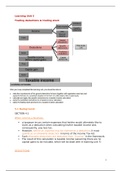
Learning Unit 5
Trading deductions & trading stock
5.1 Background:
SECTION 4.1
When running a business,
a taxpayer incurs certain expenses that he/she would ultimately like to
claim as a deduction when calculating his/her taxable income and,
consequently, pay less tax.
However, before an expense may be claimed as a deduction, it must
qualify as an allowable deduction in terms of the Income Tax Act.
Such allowable deductions are deducted from “income” in the framework.
The result of this calculation is taxable income (assuming there are no
capital gains to be included, which will be dealt with in learning unit 7)
DEDUCTIONS
1
, Deductions for income tax purposes and accounting expenses will differ in
some instances because deductions are provided for in the Income Tax
Act and expenses are provided for by the IFRS.
This means that taxable income will not be the same as the accounting
net profit for any year.
The Act makes provision for the general deduction formula in terms of
which most operating expenses, incurred by the taxpayer during the
operation of an entity, may qualify as allowable deductions
5.2 General deduction formula:
SECTION 4.2.1
Taxable income (before including capital gains):
= is equal to ‘income’ minus ‘deductions’
These deductions are allowed in terms of
the general deduction formula – section 11(a) read with section 23(g)
specific deductions – section 11 (mainly)
SECTION 11 (a) – GENERAL DEDUCTION
11 – General deductions allowed in determination of taxable income:
= For purpose of determining taxable income derived by any person from
carrying on any trade, there shall be allowed as deductions from the income of
such person so derived –
(a) expenditure & losses actually incurred in production of income,
provided such expenditure & losses are not of a capital nature
SECTION 23 (g) – SPECIFIC DEDUCTIONS
23 – Deductions not allowed in the determination of taxable income:
=No deduction shall in any case be made in respect of the following matter:
Any moneys,
claimed as a deduction from income derived from trade,
to extent to which such moneys were not laid out or expended for the
purpose of trade
General deduction contained in section 11 (a) & its limitations in section 23 (g)
are vitally important – for it is in terms of these sections that the majority of
deductions are determined
2
,COMPONENTS OF THE GENERAL DEDUCTION
THE PREAMNLE TO SECTION 11 – WHICH REQUIRES
A trade to be carried on
Income to be derived from such trade
SECTION 11 (a) – WHICH REQUIRES THAT THERE BE:
Expenditure & losses
Actually incurred
During year of assessment
In production of income
Not of a capital nature
SECTION 23 (g) – WHICH PROHIBITS THE DEDUCTION OF
Any moneys claimed as a deduction
To the extent which
The moneys are not laid out or expended for purposes of trade
Section 23H limits the deduction to
= a portion of the expenditure where the benefits from the expenditure are for a
period which extends beyond the year of assessment
Not part of general deduction but has an important effect on the deduction, it
is included in this chapter
(EXAMPLE – PAGE 92)
QUALIFYING FOR A GENERAL DEDUCTION:
= requires consideration of two section:
1. Section 11 (a) provides positively for what may be deducted &
2. Section 23 (g) is a general prohibition section that provides negatively for
what may not be deducted
= deduction claimed must satisfy both sections
GENERAL INTRODUCTION TO SECTION 11
Two requirements:
3
, Taxpayer must be carrying on a trade
Income must be derived from that trade
= both must be satisfied before an amount qualifies as a deduction in terms of
section 11 (unless a specific subsection provides that one or the other need not
apply
5.2.1 Case law:
RELEVANCE OF CASE LAW
Not all criteria for the general deduction formula are easily interpreted in
different situations and,
as a consequence of decided tax cases,
many important legal principles have been established.
Legal precedent must be followed to help us apply some of the principles of
the general deduction formula to situations where interpretation is not
straightforward.
IMPORTANT NOTE
= You will need to memorise the names (only the names, not the numbers
that are also added for the sake of completeness) of the tax court cases
mentioned in this learning unit.
You will be required to list them under the appropriate criteria for the
general deduction formula when you consider whether an amount will
qualify as a deduction.
You do not have to learn the content (the facts and conclusion) of these
tax cases, as it will be considered in detail in TAX3701.
However, you are expected to be able to apply basic principles from these
tax cases.
4
Trading deductions & trading stock
5.1 Background:
SECTION 4.1
When running a business,
a taxpayer incurs certain expenses that he/she would ultimately like to
claim as a deduction when calculating his/her taxable income and,
consequently, pay less tax.
However, before an expense may be claimed as a deduction, it must
qualify as an allowable deduction in terms of the Income Tax Act.
Such allowable deductions are deducted from “income” in the framework.
The result of this calculation is taxable income (assuming there are no
capital gains to be included, which will be dealt with in learning unit 7)
DEDUCTIONS
1
, Deductions for income tax purposes and accounting expenses will differ in
some instances because deductions are provided for in the Income Tax
Act and expenses are provided for by the IFRS.
This means that taxable income will not be the same as the accounting
net profit for any year.
The Act makes provision for the general deduction formula in terms of
which most operating expenses, incurred by the taxpayer during the
operation of an entity, may qualify as allowable deductions
5.2 General deduction formula:
SECTION 4.2.1
Taxable income (before including capital gains):
= is equal to ‘income’ minus ‘deductions’
These deductions are allowed in terms of
the general deduction formula – section 11(a) read with section 23(g)
specific deductions – section 11 (mainly)
SECTION 11 (a) – GENERAL DEDUCTION
11 – General deductions allowed in determination of taxable income:
= For purpose of determining taxable income derived by any person from
carrying on any trade, there shall be allowed as deductions from the income of
such person so derived –
(a) expenditure & losses actually incurred in production of income,
provided such expenditure & losses are not of a capital nature
SECTION 23 (g) – SPECIFIC DEDUCTIONS
23 – Deductions not allowed in the determination of taxable income:
=No deduction shall in any case be made in respect of the following matter:
Any moneys,
claimed as a deduction from income derived from trade,
to extent to which such moneys were not laid out or expended for the
purpose of trade
General deduction contained in section 11 (a) & its limitations in section 23 (g)
are vitally important – for it is in terms of these sections that the majority of
deductions are determined
2
,COMPONENTS OF THE GENERAL DEDUCTION
THE PREAMNLE TO SECTION 11 – WHICH REQUIRES
A trade to be carried on
Income to be derived from such trade
SECTION 11 (a) – WHICH REQUIRES THAT THERE BE:
Expenditure & losses
Actually incurred
During year of assessment
In production of income
Not of a capital nature
SECTION 23 (g) – WHICH PROHIBITS THE DEDUCTION OF
Any moneys claimed as a deduction
To the extent which
The moneys are not laid out or expended for purposes of trade
Section 23H limits the deduction to
= a portion of the expenditure where the benefits from the expenditure are for a
period which extends beyond the year of assessment
Not part of general deduction but has an important effect on the deduction, it
is included in this chapter
(EXAMPLE – PAGE 92)
QUALIFYING FOR A GENERAL DEDUCTION:
= requires consideration of two section:
1. Section 11 (a) provides positively for what may be deducted &
2. Section 23 (g) is a general prohibition section that provides negatively for
what may not be deducted
= deduction claimed must satisfy both sections
GENERAL INTRODUCTION TO SECTION 11
Two requirements:
3
, Taxpayer must be carrying on a trade
Income must be derived from that trade
= both must be satisfied before an amount qualifies as a deduction in terms of
section 11 (unless a specific subsection provides that one or the other need not
apply
5.2.1 Case law:
RELEVANCE OF CASE LAW
Not all criteria for the general deduction formula are easily interpreted in
different situations and,
as a consequence of decided tax cases,
many important legal principles have been established.
Legal precedent must be followed to help us apply some of the principles of
the general deduction formula to situations where interpretation is not
straightforward.
IMPORTANT NOTE
= You will need to memorise the names (only the names, not the numbers
that are also added for the sake of completeness) of the tax court cases
mentioned in this learning unit.
You will be required to list them under the appropriate criteria for the
general deduction formula when you consider whether an amount will
qualify as a deduction.
You do not have to learn the content (the facts and conclusion) of these
tax cases, as it will be considered in detail in TAX3701.
However, you are expected to be able to apply basic principles from these
tax cases.
4