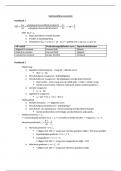
Samenvatting economie
Hoofdstuk 1
∆ x wijziging∈hoeveelheid productie ∂ x x
MPl = = = => GP =
∆l wijziging∈hoeveelheid arbeid ∂l l
- PMC f(x1) = x2
o Input afzonderen in beide functies
o Invullen in inputbeperking
o Omzetten in f(x1) = x2 (bv x2 = 16 – 3x1) => grafiek met x1 op x-as, x2 op y-as
MP arbeid Productiemogelijkheden curve Opportuniteitskosten
Stijgend & constant Convex (hol) Dalend
Dalend & constant Concaaf (bol) Stijgend
Constant & constant Lineair (rechte) Constant
Hoofdstuk 2
- Marktvraag
o Negatief verband prijs (p) – vraag (x) = dalende curve
X(v) = a – bp
o Verschuiving op vraagcurve = prijswijzigingen
o Verschuiving van vraagcurve = bij wijzigingen overige determinanten
Naar rechts = meer vraag voor de zelfde prijs links = minder vraag
Aantal consumenten, inkomen, prijs goed, prijzen andere goederen,…
o Lineaire vraagcurve
xv = a – bp
o Loglineaire vraagcurve
xv = αpβ ln xv = ln α – β ln p
- Marktaanbod
o Positief verband p – x = stijgende curve
o Verschuiving op aanbodcurve = prijswijzingen
o Verschuiven van aanbodcurve = bij verschuiving overige determinanten
Aantal producenten, technologie, productiekosten, prijs goed,…
- Marktevenwicht xv = xa
=> evenwichtsprijs bereken via xv = xa => p invullen in beide functies => snijpunt x v - xa = e
v d xv y
- Inkomenselasticiteit ε y = .
dy x v
o Normale goederen = 0 ≤ ε vy
Y stijgen met 10% => vraag naar normale goederen stijgt < 10% maar positief
Noodzakelijke goederen = 0 ≤ ε vy ≤ 1
Luxegoederen = 1 < ε vy < ∞
Y stijgen met 10% => vraag naar luxegoederen stijgt > 10%
o Inferieure goederen = -∞ < ε vy < 0
Y stijgen met 10% => vraag naar inferieure goederen daalt
, i i
v ∆ xv p j d xv p j
- Kruislingse elasticiteit ε ij= . = .
∆ p j xiv d p j x iv
v
o ε ij <0 complementaire goederen (koffie en koffiemelk)
o ε vij >0 substituten (privé vs openbaar vervoer)
v
o ε ij=0 onafhankelijke goederen (tandpasta en brood)
∆xv
x ∆ x v p dx p
- Prijselasticiteit ε vp=% verandering∈ gevr .hoeveelheid = v = . = .
% verandering∈ prijs ∆ p ∆ p x v dp x
p
=> vraagfunctie afleiden naar p => zoek punt p => zoek x v in dat punt door p in te vullen in
gewone vraagfunctie => formule toepassen (zelfde werkwijze voor andere elasticiteiten)
o |e| < 1: prijsinelastische vraag (hoe verticaler)
Bij prijstoename prijsinelastische vraag => stijging uitgave consument
o |e| > 1: prijselastische vraag (hoe horizontaler)
Bij prijstoename prijselastische vraag => daling uitgave consument
o |e| = 1 : unitair elastisch
Bij prijstoename unitair elastische vraag => constante uitgave consument
a ∆ x a p dx p
o Prijselasticiteit aanbod ε p= . = .
∆ p x a dp x
Positief getal maar daalt wanneer hoeveelheid toeneemt
o Afgeleide uitgaven consument
∂ Xv ( p ) ∂p ∂ Xv ( p ) ∂ Xv ( p ) X ( p)
¿ ∙ p+¿ X v ( p ) ∙ =¿ ∙ p+ ¿ X v ( p ) ¿ ∙ p ∙ v +¿
∂p ∂p ∂p ∂p Xv ( p )
X v ( p )=¿ X v ( p )
(
∂ X v ( p)
∂p
∙
p
X v ( p) )
+1 =¿ X v ( p ) ∙ ( ε pv +1 )
- Overheidsinterventies
o Direct
minimum/maximumprijzen
Maximumprijs => vraagoverschot/tekort
Minimumprijs => aanbodoverschot/tekort
o Indirect
belastingen, subsidies
Belastingafwenteling op consumt: pv – pe voor belasting
Belastingopbrengst: t . verhandelde hoeveelheid (x v)
Netto-ontvangst producent: pa . xv
BELAST
Producent Pa = p v – t
Consument Pv = p a + t
SUBSIDIES
Producent Pa = p v + s
consument Pv = p a - s
, Hoofdstuk 3
- Indifferentiecurve
o Dalend
meer consumptie van 1 nodig om nut constant te houden indien minder van 2
beschikbaar is
o Convex t.o.v. oorsprong
betalingsbereidheid van consument voor extra eenheden van willekeurig goed daalt
naarmate zij er meer van consumeert
Uitzonderingen
perfecte substituten: evenveel nut voor elke combinatie van 1 en 2
perfecte complementen: bepaalde verhouding tussen 1 en 2
Hoe verder van oorsprong = hoe hoger nutsniveau
o 2 indifferentiecurven kunnen elkaar niet raken/snijden
−∆ x 2
o Subjectieve ruilverhouding SV21 =
∆ x1
= subsitutieverhouding goed 2 door goed 1 = helling indifferentiecurve
- Nutfunctie
o Eigenschappen
Ordinale interpretatie: relatieve waarde = betekenisvol
Continu, differentieerbaar
Bijhorende differentiecurven = convex
∂ u( x 1 , x 2 )
∆ x2 MN 1 x1
o Marginale substitutiegraad MSG21 ¿− = =
∆ x1 MN 2 ∂ u( x 1 , x 2 )
x2
- Budgetrestrictie y = p1x1 + p2x2
o Relatieve prijsverhouding van 2 goederen
dx 2 − p1
Helling budgetrechte: =
dx 1 p2
o Grafische variaties
Inkomenswijziging: stijging => budgetlijn verschuift parallel naar rechts
Prijswijziging: duurder => budgetlijn wordt steiler
Promotiestunt
Eerste x aantal eenheden gratis van 1=> budgetlijn verschuift naar rechts
Van de xste hoeveelheid krijg je een korting bij goed 1 => niet lineair
MN 1 p1
- Optimum =
MN 2 p 2
=> inkomensconsumptiecurve ICC (= 45° lijn): f(x1) = x2
Hoofdstuk 1
∆ x wijziging∈hoeveelheid productie ∂ x x
MPl = = = => GP =
∆l wijziging∈hoeveelheid arbeid ∂l l
- PMC f(x1) = x2
o Input afzonderen in beide functies
o Invullen in inputbeperking
o Omzetten in f(x1) = x2 (bv x2 = 16 – 3x1) => grafiek met x1 op x-as, x2 op y-as
MP arbeid Productiemogelijkheden curve Opportuniteitskosten
Stijgend & constant Convex (hol) Dalend
Dalend & constant Concaaf (bol) Stijgend
Constant & constant Lineair (rechte) Constant
Hoofdstuk 2
- Marktvraag
o Negatief verband prijs (p) – vraag (x) = dalende curve
X(v) = a – bp
o Verschuiving op vraagcurve = prijswijzigingen
o Verschuiving van vraagcurve = bij wijzigingen overige determinanten
Naar rechts = meer vraag voor de zelfde prijs links = minder vraag
Aantal consumenten, inkomen, prijs goed, prijzen andere goederen,…
o Lineaire vraagcurve
xv = a – bp
o Loglineaire vraagcurve
xv = αpβ ln xv = ln α – β ln p
- Marktaanbod
o Positief verband p – x = stijgende curve
o Verschuiving op aanbodcurve = prijswijzingen
o Verschuiven van aanbodcurve = bij verschuiving overige determinanten
Aantal producenten, technologie, productiekosten, prijs goed,…
- Marktevenwicht xv = xa
=> evenwichtsprijs bereken via xv = xa => p invullen in beide functies => snijpunt x v - xa = e
v d xv y
- Inkomenselasticiteit ε y = .
dy x v
o Normale goederen = 0 ≤ ε vy
Y stijgen met 10% => vraag naar normale goederen stijgt < 10% maar positief
Noodzakelijke goederen = 0 ≤ ε vy ≤ 1
Luxegoederen = 1 < ε vy < ∞
Y stijgen met 10% => vraag naar luxegoederen stijgt > 10%
o Inferieure goederen = -∞ < ε vy < 0
Y stijgen met 10% => vraag naar inferieure goederen daalt
, i i
v ∆ xv p j d xv p j
- Kruislingse elasticiteit ε ij= . = .
∆ p j xiv d p j x iv
v
o ε ij <0 complementaire goederen (koffie en koffiemelk)
o ε vij >0 substituten (privé vs openbaar vervoer)
v
o ε ij=0 onafhankelijke goederen (tandpasta en brood)
∆xv
x ∆ x v p dx p
- Prijselasticiteit ε vp=% verandering∈ gevr .hoeveelheid = v = . = .
% verandering∈ prijs ∆ p ∆ p x v dp x
p
=> vraagfunctie afleiden naar p => zoek punt p => zoek x v in dat punt door p in te vullen in
gewone vraagfunctie => formule toepassen (zelfde werkwijze voor andere elasticiteiten)
o |e| < 1: prijsinelastische vraag (hoe verticaler)
Bij prijstoename prijsinelastische vraag => stijging uitgave consument
o |e| > 1: prijselastische vraag (hoe horizontaler)
Bij prijstoename prijselastische vraag => daling uitgave consument
o |e| = 1 : unitair elastisch
Bij prijstoename unitair elastische vraag => constante uitgave consument
a ∆ x a p dx p
o Prijselasticiteit aanbod ε p= . = .
∆ p x a dp x
Positief getal maar daalt wanneer hoeveelheid toeneemt
o Afgeleide uitgaven consument
∂ Xv ( p ) ∂p ∂ Xv ( p ) ∂ Xv ( p ) X ( p)
¿ ∙ p+¿ X v ( p ) ∙ =¿ ∙ p+ ¿ X v ( p ) ¿ ∙ p ∙ v +¿
∂p ∂p ∂p ∂p Xv ( p )
X v ( p )=¿ X v ( p )
(
∂ X v ( p)
∂p
∙
p
X v ( p) )
+1 =¿ X v ( p ) ∙ ( ε pv +1 )
- Overheidsinterventies
o Direct
minimum/maximumprijzen
Maximumprijs => vraagoverschot/tekort
Minimumprijs => aanbodoverschot/tekort
o Indirect
belastingen, subsidies
Belastingafwenteling op consumt: pv – pe voor belasting
Belastingopbrengst: t . verhandelde hoeveelheid (x v)
Netto-ontvangst producent: pa . xv
BELAST
Producent Pa = p v – t
Consument Pv = p a + t
SUBSIDIES
Producent Pa = p v + s
consument Pv = p a - s
, Hoofdstuk 3
- Indifferentiecurve
o Dalend
meer consumptie van 1 nodig om nut constant te houden indien minder van 2
beschikbaar is
o Convex t.o.v. oorsprong
betalingsbereidheid van consument voor extra eenheden van willekeurig goed daalt
naarmate zij er meer van consumeert
Uitzonderingen
perfecte substituten: evenveel nut voor elke combinatie van 1 en 2
perfecte complementen: bepaalde verhouding tussen 1 en 2
Hoe verder van oorsprong = hoe hoger nutsniveau
o 2 indifferentiecurven kunnen elkaar niet raken/snijden
−∆ x 2
o Subjectieve ruilverhouding SV21 =
∆ x1
= subsitutieverhouding goed 2 door goed 1 = helling indifferentiecurve
- Nutfunctie
o Eigenschappen
Ordinale interpretatie: relatieve waarde = betekenisvol
Continu, differentieerbaar
Bijhorende differentiecurven = convex
∂ u( x 1 , x 2 )
∆ x2 MN 1 x1
o Marginale substitutiegraad MSG21 ¿− = =
∆ x1 MN 2 ∂ u( x 1 , x 2 )
x2
- Budgetrestrictie y = p1x1 + p2x2
o Relatieve prijsverhouding van 2 goederen
dx 2 − p1
Helling budgetrechte: =
dx 1 p2
o Grafische variaties
Inkomenswijziging: stijging => budgetlijn verschuift parallel naar rechts
Prijswijziging: duurder => budgetlijn wordt steiler
Promotiestunt
Eerste x aantal eenheden gratis van 1=> budgetlijn verschuift naar rechts
Van de xste hoeveelheid krijg je een korting bij goed 1 => niet lineair
MN 1 p1
- Optimum =
MN 2 p 2
=> inkomensconsumptiecurve ICC (= 45° lijn): f(x1) = x2