AP Computer Science Principles EXAM
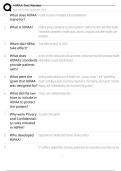
What is a bit? - a single unit of data that can only have one of two values (such as
a 1 or 0)
What is a byte? - Eight bits (e.g.10110101)
What is bandwidth? - the transmission capacity of a system (measured by the
amount of data (measured in bits) that can be sent in a specific amount of time)
What is latency? - time between the transmission and the receipt of a message
How can number storage limitation cause overflow errors? - Certain programs
limit how many numbers they can store (e.g. if limit is 4 bits, then storage goes up
to 1010). After a number that is long enough goes over the limit, it causes
overflow, which returns an overflow error (e.g. infinity or NaN)
What are floating point numbers? - a binary version of scientific notation. It's
called floating point because the decimal point "floats" to just after the first digit.
(e.g. 2.1273647e+32)
How can floating points lead to round-off errors? - Floating points round off the
last digits of a infinite/large number, which can cause a rounding that might be
, AP Computer Science Principles EXAM
incorrect when manipulated (e.g. 1/3=0.3333, but when multiplied by 3, it states
0.99999 and not 1)
What does an ethernet cable use? What are its features? - It uses electricity to
send bits. Best for close distances, but cheap and has potential signal loss
What does an fiber optic cable use? What are its features? - It uses light to send
bits. Best for far distances, fast, and lower potential signal loss, but expensive and
hard to work with
What is a web browser? - An app used to access web pages
What is an URL? - Uniform Resource Locator: an address for accessing specific web
data located on a server
What is a DNS server? - Domain Name System server: a computer or computers
hosting data for other to access
What is HTTP? - HyperText Transfer Protocol: language used to communicate
between web browsers and servers
What is a bit? - a single unit of data that can only have one of two values (such as
a 1 or 0)
What is a byte? - Eight bits (e.g.10110101)
What is bandwidth? - the transmission capacity of a system (measured by the
amount of data (measured in bits) that can be sent in a specific amount of time)
What is latency? - time between the transmission and the receipt of a message
How can number storage limitation cause overflow errors? - Certain programs
limit how many numbers they can store (e.g. if limit is 4 bits, then storage goes up
to 1010). After a number that is long enough goes over the limit, it causes
overflow, which returns an overflow error (e.g. infinity or NaN)
What are floating point numbers? - a binary version of scientific notation. It's
called floating point because the decimal point "floats" to just after the first digit.
(e.g. 2.1273647e+32)
How can floating points lead to round-off errors? - Floating points round off the
last digits of a infinite/large number, which can cause a rounding that might be
, AP Computer Science Principles EXAM
incorrect when manipulated (e.g. 1/3=0.3333, but when multiplied by 3, it states
0.99999 and not 1)
What does an ethernet cable use? What are its features? - It uses electricity to
send bits. Best for close distances, but cheap and has potential signal loss
What does an fiber optic cable use? What are its features? - It uses light to send
bits. Best for far distances, fast, and lower potential signal loss, but expensive and
hard to work with
What is a web browser? - An app used to access web pages
What is an URL? - Uniform Resource Locator: an address for accessing specific web
data located on a server
What is a DNS server? - Domain Name System server: a computer or computers
hosting data for other to access
What is HTTP? - HyperText Transfer Protocol: language used to communicate
between web browsers and servers