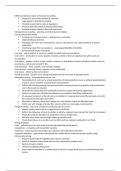
Difference between mgmt. & financial accounting
Financial is more clearly defined & narrower
Legal aspect to financial accounting
Financial is governed by rules & regulations
Financial deal with historical financial information
Financial produce statutory financial statements
Management accounting – planning, control & decision making
Cost transformation model
Creating cost conscious culture – aiming to be a cost leader
Understanding cost drivers
Managing risks from cost consciousness, such as reducing cost may reduce quality & customer
satisfaction
Maximising value from new products – assessing profitability & flexibility
Environmental impact of products
Cost unit – unit of product or service in relation to which costs are ascertained
Cost centre – production or service location, function, activity or item of equipment for which costs are
accumulated
Cost object – product, service, centre, activity, customer or distribution channel in relation to which costs are
ascertained, units & centres both fit this.
Cost behaviour – fixed, variable, semi-variable, stepped
Cost element – materials, labour, expense, can be subdivided
Cost nature – direct (prime cost), indirect
Period or product - product occur during production, period occurs due to passage of time
Absorption costing – full production cost per unit
Fixed production costs can be a large proportion of total production costs, so without absorbing them
a large % of cost would be excluded from measurements
Follows the matching concept (accruals concept) by carrying forward a proportion of the production
cost in the inventory valuation
Necessary for fixed production overheads in inventory values for financial statements
Analysis of under/over absorbed overheads can be useful for identifying inefficiencies
An argument long term is that all costs are variable & it’s appropriate to identify overhead costs with
the products/services that cause them
Allocation is arbitrary, there won’t always be a clear obvious choice for allocation basis
Profits vary with changes in production volume, which can encourage overproduction
Marginal costing – extra cost arising from producing one more unit
Simpler costing system due to no apportion of overheads
Reflects the behaviour of costs in relation to activity, making it more relevant for short term decisions
Avoids the arbitrary allocations & production volume change issues
Not ideal when fixed costs are high relative to variable costs
Treats direct labour as a variable cost, but often staff are salaried, making their cost fixed
Pricing strategies
Costs – sufficient price to cover costs of producing product/providing service
Competitors – competing with competitor’s pricing
Customers – value placed on the product by customers often determines the price
Corporate objectives – gain market share/break into market/attract customers/project quality image
Full cost plus pricing
Required profit made if budgeted sales volumes achieved
Useful in industries where fixed costs are low compared to variable ones
Quick & cheap to employ
Useful for justifying selling prices
Issues with the selection of a suitable basis on which to charge fixed costs, can unintentionally lose
money
, If prices are set on the basis of normal volume, then volume is below, overheads won’t be fully
recovered
Mark up can be arbitrary & reduce competitiveness
Marginal cost-plus pricing
Accurate as total cost-plus pricing
Knowledge of marginal cost allows pricing below total cost when times are bad to fill capacity
Particularly useful in pricing one off contracts
Recognises the existence of scarce of limiting resources
Ignores other factors such as levels of competition, customer attitudes, etc.
Mark-up is even more arbitrary than in full cost plus, as it has to subjectively include extra to cover
fixed costs
ABC
Modern production environments have changed production:
More machinery & computers
Smaller batch sizes
Less use of ‘direct’ labour, causing:
More indirect overheads
Less direct labour costs
This has meant tradition costing methods aren’t so useful due to:
Indirect overheads being the largest production cost, meaning proper cost control can’t be
implemented
Direct labour hours is a smaller proportion of product costs, making it not a useful form of allocation
Total production costs can be wrong, leading to poor pricing & production decisions
ABC is relevant when:
Indirect costs are high relative to direct costs
Products/services are complex, or tailored to customer specifications
Some products are sold in large numbers, others small numbers
More accuracy
Better cost understanding
Fairer allocation of costs
Better cost control
Works in complex situations
Applied beyond production
Used in service industries
Not always relevant
Still arbitrary cost allocations
Need to choose appropriate drivers & activities
Complex & expensive to operate
Joint product costing
Specific order costing – costs of distinct products or services are collected, individual cost units are different
according to individual customer requirements. Batch costing fits this too.
Continuous costing – costs are collected & averaged over no. of products produced.
Joint product costs can be apportioned based on da variety methods, physical measurement, market value or
NRV.
Throughput accounting – similar to marginal costing, but can be used to make long term decisions.
Throughput contribution = revenue – direct material costs (totally variable costs)
Return per factory hour = throughput contribution / product’s time on bottleneck resource
Cost per factory hour = total factory cost / total time on bottleneck resource
Throughput accounting ratio = return per factory hour / cost per factory hour
Throughput focuses on the short term, when business have fixed supplies of resources & operating expenses
are largely fixed.
Digital costs
Financial is more clearly defined & narrower
Legal aspect to financial accounting
Financial is governed by rules & regulations
Financial deal with historical financial information
Financial produce statutory financial statements
Management accounting – planning, control & decision making
Cost transformation model
Creating cost conscious culture – aiming to be a cost leader
Understanding cost drivers
Managing risks from cost consciousness, such as reducing cost may reduce quality & customer
satisfaction
Maximising value from new products – assessing profitability & flexibility
Environmental impact of products
Cost unit – unit of product or service in relation to which costs are ascertained
Cost centre – production or service location, function, activity or item of equipment for which costs are
accumulated
Cost object – product, service, centre, activity, customer or distribution channel in relation to which costs are
ascertained, units & centres both fit this.
Cost behaviour – fixed, variable, semi-variable, stepped
Cost element – materials, labour, expense, can be subdivided
Cost nature – direct (prime cost), indirect
Period or product - product occur during production, period occurs due to passage of time
Absorption costing – full production cost per unit
Fixed production costs can be a large proportion of total production costs, so without absorbing them
a large % of cost would be excluded from measurements
Follows the matching concept (accruals concept) by carrying forward a proportion of the production
cost in the inventory valuation
Necessary for fixed production overheads in inventory values for financial statements
Analysis of under/over absorbed overheads can be useful for identifying inefficiencies
An argument long term is that all costs are variable & it’s appropriate to identify overhead costs with
the products/services that cause them
Allocation is arbitrary, there won’t always be a clear obvious choice for allocation basis
Profits vary with changes in production volume, which can encourage overproduction
Marginal costing – extra cost arising from producing one more unit
Simpler costing system due to no apportion of overheads
Reflects the behaviour of costs in relation to activity, making it more relevant for short term decisions
Avoids the arbitrary allocations & production volume change issues
Not ideal when fixed costs are high relative to variable costs
Treats direct labour as a variable cost, but often staff are salaried, making their cost fixed
Pricing strategies
Costs – sufficient price to cover costs of producing product/providing service
Competitors – competing with competitor’s pricing
Customers – value placed on the product by customers often determines the price
Corporate objectives – gain market share/break into market/attract customers/project quality image
Full cost plus pricing
Required profit made if budgeted sales volumes achieved
Useful in industries where fixed costs are low compared to variable ones
Quick & cheap to employ
Useful for justifying selling prices
Issues with the selection of a suitable basis on which to charge fixed costs, can unintentionally lose
money
, If prices are set on the basis of normal volume, then volume is below, overheads won’t be fully
recovered
Mark up can be arbitrary & reduce competitiveness
Marginal cost-plus pricing
Accurate as total cost-plus pricing
Knowledge of marginal cost allows pricing below total cost when times are bad to fill capacity
Particularly useful in pricing one off contracts
Recognises the existence of scarce of limiting resources
Ignores other factors such as levels of competition, customer attitudes, etc.
Mark-up is even more arbitrary than in full cost plus, as it has to subjectively include extra to cover
fixed costs
ABC
Modern production environments have changed production:
More machinery & computers
Smaller batch sizes
Less use of ‘direct’ labour, causing:
More indirect overheads
Less direct labour costs
This has meant tradition costing methods aren’t so useful due to:
Indirect overheads being the largest production cost, meaning proper cost control can’t be
implemented
Direct labour hours is a smaller proportion of product costs, making it not a useful form of allocation
Total production costs can be wrong, leading to poor pricing & production decisions
ABC is relevant when:
Indirect costs are high relative to direct costs
Products/services are complex, or tailored to customer specifications
Some products are sold in large numbers, others small numbers
More accuracy
Better cost understanding
Fairer allocation of costs
Better cost control
Works in complex situations
Applied beyond production
Used in service industries
Not always relevant
Still arbitrary cost allocations
Need to choose appropriate drivers & activities
Complex & expensive to operate
Joint product costing
Specific order costing – costs of distinct products or services are collected, individual cost units are different
according to individual customer requirements. Batch costing fits this too.
Continuous costing – costs are collected & averaged over no. of products produced.
Joint product costs can be apportioned based on da variety methods, physical measurement, market value or
NRV.
Throughput accounting – similar to marginal costing, but can be used to make long term decisions.
Throughput contribution = revenue – direct material costs (totally variable costs)
Return per factory hour = throughput contribution / product’s time on bottleneck resource
Cost per factory hour = total factory cost / total time on bottleneck resource
Throughput accounting ratio = return per factory hour / cost per factory hour
Throughput focuses on the short term, when business have fixed supplies of resources & operating expenses
are largely fixed.
Digital costs