100% tevredenheidsgarantie Direct beschikbaar na je betaling Lees online óf als PDF Geen vaste maandelijkse kosten 4.2 TrustPilot
logo-home
Tentamen (uitwerkingen)

CCRN GI Questions and Answers well Explained Latest 2024/2025 Update 100% Correct.

Beoordeling
-
Verkocht
-
Pagina's
14
Cijfer
A+
Geüpload op
09-09-2024
Geschreven in
2024/2025

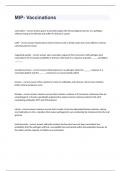
You have a pt you are admitting that suffered an assault from which an individual used a metal pipe. You assess your patient to have ecchymosis to his left flank. You determine that your pt most likely has which of the following? a) hypocalcemia b) a ruptured spleen c) hemorrhagic pancreatitis d)retroperitoneal bleeding - d) retroperitoneal bleeding --The flank ecchymosis is indicative of Grey Turner's sign in the setting of recent trauma, this may have lead to the retroperitoneal bleeding. Although Grey Turner's sign may be due to acute hemorrhagic pancreatitis, the patient trauma is a more likely etiology. Your coworker goes on break and asks you to "look out" for her patients. Her pt then calls you to the room w/a complaint of "something doesn't feel right in my abdomen". After auscultating the pt's bowel sounds, which of the following is present in an early mechanical bowel obstruction? a) normal bowel sounds b) hypoactive bowel sounds c) hyperactive bowel sounds d) absent bowel sounds - c) hyperactive bowel sounds --In early bowel obstruction, the bowel sounds become hyperactive. In a late bowel obstruction, bowel sounds become hypoactive or absent. Upon your assessment of your patient, who has pancreatitis, you find the following values: temp 37.1C, BP 98/64, HR 110, RR 28, SpO2 88% on 2L NC. Her labs are WBC 19,000, Hgb 8.9, HCT 39%, Na 144, K 3.1, Ca 7.7, and glucose 224.Your remaining assessment reveals LLL crackles of the lungs and her abdomen w/ Cullen's sign. Besides pancreatitis, what else do you think your patient may have? a) SIRS, hemorrhagic pancreatitis, MODs and needing fluids b) hemorrhagic shock, stress hyperglycemia, hypoxemia, and needing blood c) dehydration, ARDS, stress hyperglycemia, and needs intubation d) hypovolemic shock, diabetes, severe sepsis, and needing antibiotics - a) SIRS, hemorrhagic pancreatitis, MODS and needing fluids --Your patient has SIRS bc of the increased RR, HR, and WBC. Due to the Cullen's sign, your patient most likely has hemorrhagic pancreatitis, w/signs of MODS by the low SpO2 and the low BP. Fluids are needed r/t the massive fluid shifts in acute pancreatitis --This pt does not have diabetes and does not need antibiotics. However, is at a high risk of ARDS but does not have bilateral infiltrates or refractory hypoxemia A new patient just arrived to the hospital s/p acute abdominal trauma. The patient is now experiencing Kehr's sign. Which of the following may be the cause of Kehr's sign? a) diaphragmatic irritation b) liver contusion c) ruptured kidney d) ruptured bladder - a) diaphragmatic irritation --Trauma that causes splenic rupture also causes diaphragmatic irritation and subsequent referred pain to the left shoulder (Kehr's sign). The other choices do not cause Kehr's sign. You are assisting on the admission of a new patient into the ICU for a diagnosis of bleeding esophageal varies and hypovolemic shock. Which of the following closely resembles compensation for the hypovolemic shock?a) vasodilation b) capillary fluid shift into the interstitial space c) decrease in renin secretion d) increase in re-absorption of sodium and water - d) an increase in re-absorption of sodium and water --W/ volume depletion, aldosterone is released by the renin-angiotensin-aldosterone mechanis which will allow extra Na and water to be reabsorbed in an attempt to increase the vascular volume. The other choices are not signs of a compensatory response. You suspect acute appendicitis w/ a bowel perforation being present in your new patient. Which of the following answers closely describes pain/discomfort associated w/ peritoneal irritation? a) becoming increasingly severe b) generalized to the abdominal area c) greater than a 6hr duration d) lessens while lying still w/both knees in a flexed position - d) lessens while lying still w/both knees in a flexed position --Peritonitis causes exacerbation of abdominal pain upon movement, therefore lying still w/knees in a flexed position relaxes the abdomen and helps to prevent movement, therefore helping to reduce abdominal pain The patient just admitted to your unit has abdominal distention, complaints of dull abdominal pain, lowpitched bowel sounds, and a recent change in the patient's bowel habitus. The pt is experiencing which diagnosis? a) large bowel obstruction b) acute pancreatitis c) small bowel obstruction d) acute appendicitis - a) a large bowel obstruction--W/ the low pitched sounds and change of bowel habitus the pt most likely has a large bowel obstruction. A small bowel obstruction presents w/ high-pitched bowel sounds and dull pain is not present in pancreatitis, in which a "boring" type pain is more typical The MD just ordered a vasopressin gtt for your pt who recently developed an acute GI bleed. After starting the vasopressin gtt, what is now a priority assessment for the patient? a) monitor for bowel obstruction b) monitor for cardiac arrhythmias c) monitor for hypotension d) monitor the ECG for ST changes - d) monitor the ECG for ST changes --It is important when starting vasopressin on the pt to watch for ST changes bc the patient can experience cardiac ischemia (also may have chest pain). A cardiac arrhythmia may occur, however,the symptoms of ischemia present more commonly and usually before an arrhythmia occurs Your patient, a 29-year old male, recently got into an altercation that lead to a fight. From the fight, he sustained multiple rib fractures bilaterally. You also assess mult. abrasions on his face and chest. Now, he is complaining for sharp left shoulder pain while at rest in bed. Which of the following should you assess for? a) pulmonary contusion b) rotator cuff injury c) fractured left scapula d) a ruptured spleen - d) a ruptured spleen --This is due to the symptom presenting at rest. All of the other choices typically do not display at rest. More signs to look for in a ruptured spleen include absent bowel sounds and a distended abdomen When providing your patient w/enteral feeding, which of the following is contraindicated? a)ensure free water is administeredb)keep the HOB flat c)using a small-bore feeding tube d)check for gastric residuals every four hours - b) keep the HOB flat --The HOB should be at 30degrees or higher as to help reduce the risk of aspiration. You receive report on your new pt and discover the pt has an upper GIB, hypotension, and tachycardia. Which of the following labs would be the most expected? a) elevated BUN, elevated serum sodium b) a decreased PT, metabolic acidosis c) decreased sodium and elevated PTT d) decreased WBC and elevated platelets - a) elevated BUN, elevated serum sodium --This is a presentation of volume depletion and factitious dehydration demonstrated by an elevated BUN level and an increased sodium level. Once the volume is restored, the levels will normalize.

Meer zien Lees minder
Instelling
CCRN GI
Vak
CCRN GI


Oeps! We kunnen je document nu niet laden. Probeer het nog eens of neem contact op met support.

Geschreven voor

Instelling
CCRN GI
Vak
CCRN GI

Documentinformatie

Geüpload op
9 september 2024
Aantal pagina's
14
Geschreven in
2024/2025
Type
Tentamen (uitwerkingen)
Bevat
Vragen en antwoorden

Onderwerpen

Voorbeeld van de inhoud

CCRN GI Questions
You have a pt you are admitting that suffered an assault from which an individual used a metal pipe. You
assess your patient to have ecchymosis to his left flank. You determine that your pt most likely has which
of the following?


a) hypocalcemia

b) a ruptured spleen

c) hemorrhagic pancreatitis

d)retroperitoneal bleeding - d) retroperitoneal bleeding


--The flank ecchymosis is indicative of Grey Turner's sign in the setting of recent trauma, this may have
lead to the retroperitoneal bleeding. Although Grey Turner's sign may be due to acute hemorrhagic
pancreatitis, the patient trauma is a more likely etiology.


Your coworker goes on break and asks you to "look out" for her patients. Her pt then calls you to the
room w/a complaint of "something doesn't feel right in my abdomen". After auscultating the pt's bowel
sounds, which of the following is present in an early mechanical bowel obstruction?


a) normal bowel sounds

b) hypoactive bowel sounds

c) hyperactive bowel sounds

d) absent bowel sounds - c) hyperactive bowel sounds


--In early bowel obstruction, the bowel sounds become hyperactive. In a late bowel obstruction, bowel
sounds become hypoactive or absent.


Upon your assessment of your patient, who has pancreatitis, you find the following values:

temp 37.1C, BP 98/64, HR 110, RR 28, SpO2 88% on 2L NC.

Her labs are WBC 19,000, Hgb 8.9, HCT 39%, Na 144, K 3.1, Ca 7.7, and glucose 224.

, Your remaining assessment reveals LLL crackles of the lungs and her abdomen w/ Cullen's sign. Besides
pancreatitis, what else do you think your patient may have?


a) SIRS, hemorrhagic pancreatitis, MODs and needing fluids

b) hemorrhagic shock, stress hyperglycemia, hypoxemia, and needing blood

c) dehydration, ARDS, stress hyperglycemia, and needs intubation

d) hypovolemic shock, diabetes, severe sepsis, and needing antibiotics - a) SIRS, hemorrhagic
pancreatitis, MODS and needing fluids


--Your patient has SIRS bc of the increased RR, HR, and WBC. Due to the Cullen's sign, your patient most
likely has hemorrhagic pancreatitis, w/signs of MODS by the low SpO2 and the low BP. Fluids are needed
r/t the massive fluid shifts in acute pancreatitis


--This pt does not have diabetes and does not need antibiotics. However, is at a high risk of ARDS but
does not have bilateral infiltrates or refractory hypoxemia


A new patient just arrived to the hospital s/p acute abdominal trauma. The patient is now experiencing
Kehr's sign. Which of the following may be the cause of Kehr's sign?


a) diaphragmatic irritation

b) liver contusion

c) ruptured kidney

d) ruptured bladder - a) diaphragmatic irritation


--Trauma that causes splenic rupture also causes diaphragmatic irritation and subsequent referred pain
to the left shoulder (Kehr's sign). The other choices do not cause Kehr's sign.


You are assisting on the admission of a new patient into the ICU for a diagnosis of bleeding esophageal
varies and hypovolemic shock. Which of the following closely resembles compensation for the
hypovolemic shock?

€6,99
Krijg toegang tot het volledige document:

100% tevredenheidsgarantie
Direct beschikbaar na je betaling
Lees online óf als PDF
Geen vaste maandelijkse kosten


Ook beschikbaar in voordeelbundel

Maak kennis met de verkoper

Seller avatar
De reputatie van een verkoper is gebaseerd op het aantal documenten dat iemand tegen betaling verkocht heeft en de beoordelingen die voor die items ontvangen zijn. Er zijn drie niveau’s te onderscheiden: brons, zilver en goud. Hoe beter de reputatie, hoe meer de kwaliteit van zijn of haar werk te vertrouwen is.
ACADEMICMATERIALS City University New York
Volgen Je moet ingelogd zijn om studenten of vakken te kunnen volgen
Verkocht
562
Lid sinds
2 jaar
Aantal volgers
186
Documenten
10590
Laatst verkocht
2 weken geleden

4,1

95 beoordelingen

5
53
4
11
3
21
2
3
1
7

Recent door jou bekeken

Waarom studenten kiezen voor Stuvia

Gemaakt door medestudenten, geverifieerd door reviews

Kwaliteit die je kunt vertrouwen: geschreven door studenten die slaagden en beoordeeld door anderen die dit document gebruikten.

Niet tevreden? Kies een ander document

Geen zorgen! Je kunt voor hetzelfde geld direct een ander document kiezen dat beter past bij wat je zoekt.

Betaal zoals je wilt, start meteen met leren

Geen abonnement, geen verplichtingen. Betaal zoals je gewend bent via Bancontact, iDeal of creditcard en download je PDF-document meteen.

Student with book image

“Gekocht, gedownload en geslaagd. Zo eenvoudig kan het zijn.”

Alisha Student

Veelgestelde vragen