B cells, antibodies, affinity & apoptosis – Eric Eldering
4-1
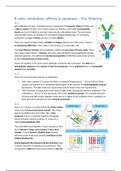
IgG antibodies are large (150 kDa) and are composed of 2 heavy/H chains (50 kDa) and
2 light/L chains (25 kDa). The 2 heavy chains are linked to each other by disulphide
bonds and each is linked to one light chain also by a disulphide bond. The two heavy
and two light chains are identical 2 identical antigen binding sites increasing
interaction strength (avidity, just one is called affinity).
There are 2 types of light chains: Lambda and kappa (always has 2 the same). There is
no functional difference. Mice ratio is 1:20, humans 2:1 and cattle 1:20.
The class/effector function of an antibody is defined by structure of heavy chain. There
are 5 heavy chain classes = isotypes. IgG is the most abundant immunoglobulin and has
several subclasses. The distinctive functional properties of different (sub)classes are due
to the C terminal part of heavy chain.
The B cell receptor is the same as the antibody, except for the C terminus. The BCR has a
hydrophobic sequence that anchors it into the membrane, in the antibody there is a hydrophilic
sequence for secretion.
4-2
There are two important features of antibodies:
Each chain consists of a series of similar (or identical) sequences of ~ 110 aa. Each of these
repeats corresponds to a compactly folded region of the protein immunoglobulin domain
(Ig domain). The light chain has 2 Ig domains and the heavy chain has 4 Ig domains.
The N terminal aa sequences of the heavy & light chain vary greatly between antibodies. This
is limited to ~ 110 aa first Ig domain, this is the variable Ig domain. The variable domains
of heavy and light chains together make up the V region of the antibody where a peptide can
bind. The other domains are the constant Ig domains.
4-3
Each V or C domain is constructed from 2 beta sheets
which is built from several beta strands. The 2 beta
sheets are folded onto each other, like a beta
sandwich and are covalently linked by disulphide
bonds between cysteine residues structure is
called immunoglobulin fold.
The main difference between V and C domains is that
the V domain is larger and contains 2 extra beta
strands. In the V domain, flexible loops formed
between some of the beta strands contribute to the
antigen binding site.
Immunoglobulin like domains (Ig-like domains) have
a similar structure & sequences to Ig domains. They
are present in KIRs (NK cells) and involved in cell-cell
, recognition and adhesion together with immunoglobulins and T cell receptors. All together they are
the immunoglobulin superfamily.
4-4
When an antibody is assembled, it consists of 3 globular portions with its 2 arms joined to the trunk
by the hinge region.
Each arm: Association light chain with N terminal half of heavy chain. V domains of heavy &
light chain are together.
The trunk is formed by pairing C terminal halves of the heavy chains. The CH3 domains pair
(bottom) but the CH2 domains do not interact (right below hinge), side chains lie here.
Papain cuts the antibody on the N terminal side of disulphide
bonds that link the two heavy chains two arms are released
Fab fragments. The other fragment is named the Fc fragment
and interacts with effector molecules and cells (not with antigen
like Fab).
Pepsin cuts the C terminal side of disulphide bonds you get
the F(ab’)2 fragment where two antigen binding arms remain
linked. Pepsin cuts the remaining part of the trunk in small
fragments. The F(ab’)2 fragment can bind antigens but cannot
interact with effector molecules.
4-5
The hinge region between the Fc and
Fab regions allow movement of two Fab arms. Flexibility can be revealed
by studies of antibodies bound to small antigens (haptens). These are
molecules that are about the size of a tyrosine side chain. They can
stimulate the production of anti-hapten antibodies when linked to a
protein. Two identical hapten molecules joined by a flexible region can link
two or more anti-hapten molecules dimers, trimers, tetramers and so
on. This shows that the antibodies are flexible at hinge region.
Some flexibility is found between V and C domains bending and
rotation of V domain relative to C domain.
Together this enables the 2 arms of the antibody to bind sites some
distance apart repeating sites on bacterial cell wall polysaccharides. It
also enables antibodies to interact with antibody-binding proteins for
effector mechanisms.
4-6
The V region of every antibody differs from every other antibody. Variability
is concentrated in certain segments as can be seen in a variability plot. 3
variable segments can be identified in the variable domains of both the
heavy and light chain hypervariable regions (HV1, HV2 and HV3). The
most variable one is the HV3 region. The regions between these variable
regions are called framework regions (FR1,FR2, FR3 and FR4). The
framework regions form beta sheets and the hypervariable regions are the
3 loops.
4-1
IgG antibodies are large (150 kDa) and are composed of 2 heavy/H chains (50 kDa) and
2 light/L chains (25 kDa). The 2 heavy chains are linked to each other by disulphide
bonds and each is linked to one light chain also by a disulphide bond. The two heavy
and two light chains are identical 2 identical antigen binding sites increasing
interaction strength (avidity, just one is called affinity).
There are 2 types of light chains: Lambda and kappa (always has 2 the same). There is
no functional difference. Mice ratio is 1:20, humans 2:1 and cattle 1:20.
The class/effector function of an antibody is defined by structure of heavy chain. There
are 5 heavy chain classes = isotypes. IgG is the most abundant immunoglobulin and has
several subclasses. The distinctive functional properties of different (sub)classes are due
to the C terminal part of heavy chain.
The B cell receptor is the same as the antibody, except for the C terminus. The BCR has a
hydrophobic sequence that anchors it into the membrane, in the antibody there is a hydrophilic
sequence for secretion.
4-2
There are two important features of antibodies:
Each chain consists of a series of similar (or identical) sequences of ~ 110 aa. Each of these
repeats corresponds to a compactly folded region of the protein immunoglobulin domain
(Ig domain). The light chain has 2 Ig domains and the heavy chain has 4 Ig domains.
The N terminal aa sequences of the heavy & light chain vary greatly between antibodies. This
is limited to ~ 110 aa first Ig domain, this is the variable Ig domain. The variable domains
of heavy and light chains together make up the V region of the antibody where a peptide can
bind. The other domains are the constant Ig domains.
4-3
Each V or C domain is constructed from 2 beta sheets
which is built from several beta strands. The 2 beta
sheets are folded onto each other, like a beta
sandwich and are covalently linked by disulphide
bonds between cysteine residues structure is
called immunoglobulin fold.
The main difference between V and C domains is that
the V domain is larger and contains 2 extra beta
strands. In the V domain, flexible loops formed
between some of the beta strands contribute to the
antigen binding site.
Immunoglobulin like domains (Ig-like domains) have
a similar structure & sequences to Ig domains. They
are present in KIRs (NK cells) and involved in cell-cell
, recognition and adhesion together with immunoglobulins and T cell receptors. All together they are
the immunoglobulin superfamily.
4-4
When an antibody is assembled, it consists of 3 globular portions with its 2 arms joined to the trunk
by the hinge region.
Each arm: Association light chain with N terminal half of heavy chain. V domains of heavy &
light chain are together.
The trunk is formed by pairing C terminal halves of the heavy chains. The CH3 domains pair
(bottom) but the CH2 domains do not interact (right below hinge), side chains lie here.
Papain cuts the antibody on the N terminal side of disulphide
bonds that link the two heavy chains two arms are released
Fab fragments. The other fragment is named the Fc fragment
and interacts with effector molecules and cells (not with antigen
like Fab).
Pepsin cuts the C terminal side of disulphide bonds you get
the F(ab’)2 fragment where two antigen binding arms remain
linked. Pepsin cuts the remaining part of the trunk in small
fragments. The F(ab’)2 fragment can bind antigens but cannot
interact with effector molecules.
4-5
The hinge region between the Fc and
Fab regions allow movement of two Fab arms. Flexibility can be revealed
by studies of antibodies bound to small antigens (haptens). These are
molecules that are about the size of a tyrosine side chain. They can
stimulate the production of anti-hapten antibodies when linked to a
protein. Two identical hapten molecules joined by a flexible region can link
two or more anti-hapten molecules dimers, trimers, tetramers and so
on. This shows that the antibodies are flexible at hinge region.
Some flexibility is found between V and C domains bending and
rotation of V domain relative to C domain.
Together this enables the 2 arms of the antibody to bind sites some
distance apart repeating sites on bacterial cell wall polysaccharides. It
also enables antibodies to interact with antibody-binding proteins for
effector mechanisms.
4-6
The V region of every antibody differs from every other antibody. Variability
is concentrated in certain segments as can be seen in a variability plot. 3
variable segments can be identified in the variable domains of both the
heavy and light chain hypervariable regions (HV1, HV2 and HV3). The
most variable one is the HV3 region. The regions between these variable
regions are called framework regions (FR1,FR2, FR3 and FR4). The
framework regions form beta sheets and the hypervariable regions are the
3 loops.