MEMORY
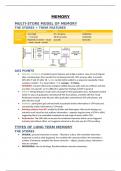
MULTI-STORE MODEL OF MEMORY
THE STORES + THEIR FEATURES
SENSORY REGISTERS STM LTM
CAPACITY Very high 7(+/-2) items Unlimited
DURATION < ½ second 18-30 seconds Unlimited
CODING Depends on sense - visual acoustic Semantic
= ionic, sound = echoic
AO3 POINTS
Peterson + Peterson 24 students given trigrams and 3-digit numbers. Have to recall trigram
after counting down from number for increasing intervals. 90% accuracy after 3 seconds,
20% after 9 and 2% after 18. Jacobs number/letter added to a sequence repeatedly. Mean
numbers recalled = 9.3, mean letters = 7.3, average – 5-9 items
HOWEVER, research often lacks ecological validity because tasks used are artificial, and they
are often very specific, so it is difficult to apply their findings to EWT in general
Bahrick: 400 participants recall names of people in their graduation class. Participants tested
within 15 years of graduation remembered 90% from photos, and 60% with free recall.
Participants tested at least 48 years after graduation remembered 70% with photos, and
30% with free recall
Baddeley: participants get confused with acoustically similar information in STM tasks and
semantically similar information in LTM tasks
Refuting evidence from KF: studied by Shallice and Warrington. After brain damage can
instantly recall visual but not auditory information – opposes singular-store of STM in MSM,
suggesting there is an unstudied complexity to and range of stores within STM.
Reductionist: The MSM fails to account for emotional memories which can be triggered
instantly and without effort, as it suggests rehearsal as the only way for LTM encoding
TYPES OF LONG TERM MEMORY
THE STORES
EPISODIC: personal memories or events – likened to a diary. We remember when they
happened as well as what happened. Are recalled with conscious effort. We remember a
number of elements compiled into these memories – objects, people, places, behaviours –
they are complex.
PROCEDURAL: how to do things. Recalled without conscious awareness.
, SEMANTIC: facts + knowledge. Likened to a combination of an encyclopaedia and dictionary.
Less vulnerable to distortion/forgetting than episodic memory. Memories are not ‘time
stamped’.
AO3 POINTS
HM: Suffers brain damage – can form new procedural memories but not semantic.
HOWEVER, this is idiographic and only reflects an individual experience, not the general
structure of memory. We don’t know about his memory before
Tulving: Participants scanned by PET scanner, and it was found the left prefrontal cortex was
active when recalling semantic memories, and the right prefrontal cortex was active when
recalling episodic ones
Cohen and squire: suggests episodic and semantic memories are stored together in one LTM
store called declarative memory (can be consciously recalled), and procedural memory is
non-declarative memory
Positive application in memory treatments: memory issues can be broken down and issues
targeted more specifically. Belleville et al intervention improves episodic memory in old
people who perform better than a control group after training
THE WORKING MEMORY MODEL
THE MODEL + ITS FEATURES
CENTRAL EXECUTIVE = attentional process that monitors incoming data and allocates slave
systems to tasks
o Capacity - limited
THE PHONOLOGICAL LOOP = deals with auditory
information. Can be subdivded into phonological store
(inner ear) and articulatory control system (inner voice)
o Duration – 2 seconds
VISUO-SPATIAL SKETCHPAD = inner eye. Logie
subdivides it into visual cache (stores visual data) and inner scribe (deals with spatial
relations + arrangement of objects in visual field). Improves understanding of ‘visual
semantics’, the meanings of objects in visual environment
o Capacity – limited
EPISODIC BUFFER = brings material from subsystems into a single memory to construct
mental episodes of experiences. Seen as the storage component of the CE. It maintains a
sense of time-sequencing. Links working memory to LTM and wider cognitive processes.
o Capacity = limited, around 4 items
AO3 POINTS
Baddeley: Participants were shown to be more successful at performing a visual and a verbal
task simultaneously than two visual ones BUT this is an artificial task that doesn’t reflect
real-life usage of STM so low internal validity
Shallice and Warrington: after suffering brain damage, KF had could immediately call visual
but not verbal information BUT idiographic as it is a case study so reflects an individual
experience but not memory in all humans
Incomplete: lack of clarity over the central executive – not explained in any detail or
understood and can’t be tested on as it handles internal processes. It may actually be made
up of several sub-components.
MULTI-STORE MODEL OF MEMORY
THE STORES + THEIR FEATURES
SENSORY REGISTERS STM LTM
CAPACITY Very high 7(+/-2) items Unlimited
DURATION < ½ second 18-30 seconds Unlimited
CODING Depends on sense - visual acoustic Semantic
= ionic, sound = echoic
AO3 POINTS
Peterson + Peterson 24 students given trigrams and 3-digit numbers. Have to recall trigram
after counting down from number for increasing intervals. 90% accuracy after 3 seconds,
20% after 9 and 2% after 18. Jacobs number/letter added to a sequence repeatedly. Mean
numbers recalled = 9.3, mean letters = 7.3, average – 5-9 items
HOWEVER, research often lacks ecological validity because tasks used are artificial, and they
are often very specific, so it is difficult to apply their findings to EWT in general
Bahrick: 400 participants recall names of people in their graduation class. Participants tested
within 15 years of graduation remembered 90% from photos, and 60% with free recall.
Participants tested at least 48 years after graduation remembered 70% with photos, and
30% with free recall
Baddeley: participants get confused with acoustically similar information in STM tasks and
semantically similar information in LTM tasks
Refuting evidence from KF: studied by Shallice and Warrington. After brain damage can
instantly recall visual but not auditory information – opposes singular-store of STM in MSM,
suggesting there is an unstudied complexity to and range of stores within STM.
Reductionist: The MSM fails to account for emotional memories which can be triggered
instantly and without effort, as it suggests rehearsal as the only way for LTM encoding
TYPES OF LONG TERM MEMORY
THE STORES
EPISODIC: personal memories or events – likened to a diary. We remember when they
happened as well as what happened. Are recalled with conscious effort. We remember a
number of elements compiled into these memories – objects, people, places, behaviours –
they are complex.
PROCEDURAL: how to do things. Recalled without conscious awareness.
, SEMANTIC: facts + knowledge. Likened to a combination of an encyclopaedia and dictionary.
Less vulnerable to distortion/forgetting than episodic memory. Memories are not ‘time
stamped’.
AO3 POINTS
HM: Suffers brain damage – can form new procedural memories but not semantic.
HOWEVER, this is idiographic and only reflects an individual experience, not the general
structure of memory. We don’t know about his memory before
Tulving: Participants scanned by PET scanner, and it was found the left prefrontal cortex was
active when recalling semantic memories, and the right prefrontal cortex was active when
recalling episodic ones
Cohen and squire: suggests episodic and semantic memories are stored together in one LTM
store called declarative memory (can be consciously recalled), and procedural memory is
non-declarative memory
Positive application in memory treatments: memory issues can be broken down and issues
targeted more specifically. Belleville et al intervention improves episodic memory in old
people who perform better than a control group after training
THE WORKING MEMORY MODEL
THE MODEL + ITS FEATURES
CENTRAL EXECUTIVE = attentional process that monitors incoming data and allocates slave
systems to tasks
o Capacity - limited
THE PHONOLOGICAL LOOP = deals with auditory
information. Can be subdivded into phonological store
(inner ear) and articulatory control system (inner voice)
o Duration – 2 seconds
VISUO-SPATIAL SKETCHPAD = inner eye. Logie
subdivides it into visual cache (stores visual data) and inner scribe (deals with spatial
relations + arrangement of objects in visual field). Improves understanding of ‘visual
semantics’, the meanings of objects in visual environment
o Capacity – limited
EPISODIC BUFFER = brings material from subsystems into a single memory to construct
mental episodes of experiences. Seen as the storage component of the CE. It maintains a
sense of time-sequencing. Links working memory to LTM and wider cognitive processes.
o Capacity = limited, around 4 items
AO3 POINTS
Baddeley: Participants were shown to be more successful at performing a visual and a verbal
task simultaneously than two visual ones BUT this is an artificial task that doesn’t reflect
real-life usage of STM so low internal validity
Shallice and Warrington: after suffering brain damage, KF had could immediately call visual
but not verbal information BUT idiographic as it is a case study so reflects an individual
experience but not memory in all humans
Incomplete: lack of clarity over the central executive – not explained in any detail or
understood and can’t be tested on as it handles internal processes. It may actually be made
up of several sub-components.