5.2 Excre*on notes
5.2.1 Importance of Excre*on
- Excre'on = process of removing toxic metabolic waste that are in excess of requirement from the body
- Key in homeostasis and in maintaining metabolism as metabolic waste is dangerous if it accumulates
Metabolic waste
- Mammals are ac've, warm-blooded animals so have high metabolic rates and hence produce large
amounts of metabolic waste e.g. CO2 from decarboxyla'on of respiratory substrates, nitrogenous waste
(ammonia from the deamina'on of excess amino acids/urea/uric acid), bile pigments
- If these two waste products are not excreted properly they can accumulate and change the cytoplasm and
body fluid pH -> enzymes work less efficiently
5.2.2 Mammalian Liver Structure
External Structure
- Liver has mul'ple roles inc. breakdown of unwanted/toxic substances AND produc'on of excretory waste
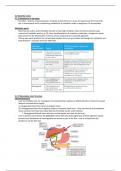
- Requires constant blood supply:
1a. Oxygenated blood from heart via hepa'c artery
1b. Deoxygenated blood from diges've system via hepa'c portal vein -> liver can absorb and metabolise
many nutrients that have been absorbed into the blood via the small intes'ne
2. Deoxygenated blood leaves the liver via the hepa'c vein back to the heart
- Liver is directly connected to the gallbladder where bile salts (help digest fats) and bile pigments (waste
product from breakdown of haemoglobin) are stored as part of the bile -> bile is released into the
duodenum via the bile duct
, Internal Structure
- Mainly made up of hepatocyte cells that carry out almost all required func'ons
- Liver is divided into many lobules separated from one another by connec've 'ssue (consis'ng of cells that
secrete an extracellular matrix)
- Branches of the hepa'c artery and hepa'c portal vein supply each lobule with blood
- Blood is carried in wide capillaries called sinusoids lined with an incomplete layer of endothelial cells
which allows blood to reach hepatocytes, allowing substances to be exchanged between blood and cells
(so hepatocytes are adapted to have a large surface area in contact with blood to maximise exchange)
- Each lobule is also connected to a branch of the hepa'c vein that drains blood away from the lobule
- The lobule is the func'onal unit of the liver as all the func'ons of the liver occur within each lobule
5.2.3 Mammalian Liver Func*on
- 3 main func'ons:
1. Storage of glycogen
2. Forma'on of urea
3. Detoxifica'on
Storage of glycogen
- Liver plays vital role in conver'ng glucose into glycogen (process of glycogenesis) to regulate blood glucose
concentra'on
- Insulin triggers glycogenesis (synthesis of glycogen from glucose molecules) a[er it detects increased
blood glucose conc. -> this removes glucose from the bloodstream and decreases blood glucose conc. to
the normal range
- Glycogen acts as a compact and efficient carbohydrate storage molecule
Forma*on of urea
- Protein is digested into amino acids -> absorbed into the blood -> transported to the liver
- Excess amino acids are deaminated so the rest of the molecule can be used as a good energy source
- Process of deamina'on:
1. Amino group (-NH2) removed with an extra hydrogen atom
2. These combine to form ammonia (NH3) -> forms ammonium ions (NH4+) in the cytoplasm
3. Remaining keto acid may enter the Krebs cycle in mitochondria to be respired/converted to
glucose/converted to glycogen or fat for storage
5.2.1 Importance of Excre*on
- Excre'on = process of removing toxic metabolic waste that are in excess of requirement from the body
- Key in homeostasis and in maintaining metabolism as metabolic waste is dangerous if it accumulates
Metabolic waste
- Mammals are ac've, warm-blooded animals so have high metabolic rates and hence produce large
amounts of metabolic waste e.g. CO2 from decarboxyla'on of respiratory substrates, nitrogenous waste
(ammonia from the deamina'on of excess amino acids/urea/uric acid), bile pigments
- If these two waste products are not excreted properly they can accumulate and change the cytoplasm and
body fluid pH -> enzymes work less efficiently
5.2.2 Mammalian Liver Structure
External Structure
- Liver has mul'ple roles inc. breakdown of unwanted/toxic substances AND produc'on of excretory waste
- Requires constant blood supply:
1a. Oxygenated blood from heart via hepa'c artery
1b. Deoxygenated blood from diges've system via hepa'c portal vein -> liver can absorb and metabolise
many nutrients that have been absorbed into the blood via the small intes'ne
2. Deoxygenated blood leaves the liver via the hepa'c vein back to the heart
- Liver is directly connected to the gallbladder where bile salts (help digest fats) and bile pigments (waste
product from breakdown of haemoglobin) are stored as part of the bile -> bile is released into the
duodenum via the bile duct
, Internal Structure
- Mainly made up of hepatocyte cells that carry out almost all required func'ons
- Liver is divided into many lobules separated from one another by connec've 'ssue (consis'ng of cells that
secrete an extracellular matrix)
- Branches of the hepa'c artery and hepa'c portal vein supply each lobule with blood
- Blood is carried in wide capillaries called sinusoids lined with an incomplete layer of endothelial cells
which allows blood to reach hepatocytes, allowing substances to be exchanged between blood and cells
(so hepatocytes are adapted to have a large surface area in contact with blood to maximise exchange)
- Each lobule is also connected to a branch of the hepa'c vein that drains blood away from the lobule
- The lobule is the func'onal unit of the liver as all the func'ons of the liver occur within each lobule
5.2.3 Mammalian Liver Func*on
- 3 main func'ons:
1. Storage of glycogen
2. Forma'on of urea
3. Detoxifica'on
Storage of glycogen
- Liver plays vital role in conver'ng glucose into glycogen (process of glycogenesis) to regulate blood glucose
concentra'on
- Insulin triggers glycogenesis (synthesis of glycogen from glucose molecules) a[er it detects increased
blood glucose conc. -> this removes glucose from the bloodstream and decreases blood glucose conc. to
the normal range
- Glycogen acts as a compact and efficient carbohydrate storage molecule
Forma*on of urea
- Protein is digested into amino acids -> absorbed into the blood -> transported to the liver
- Excess amino acids are deaminated so the rest of the molecule can be used as a good energy source
- Process of deamina'on:
1. Amino group (-NH2) removed with an extra hydrogen atom
2. These combine to form ammonia (NH3) -> forms ammonium ions (NH4+) in the cytoplasm
3. Remaining keto acid may enter the Krebs cycle in mitochondria to be respired/converted to
glucose/converted to glycogen or fat for storage