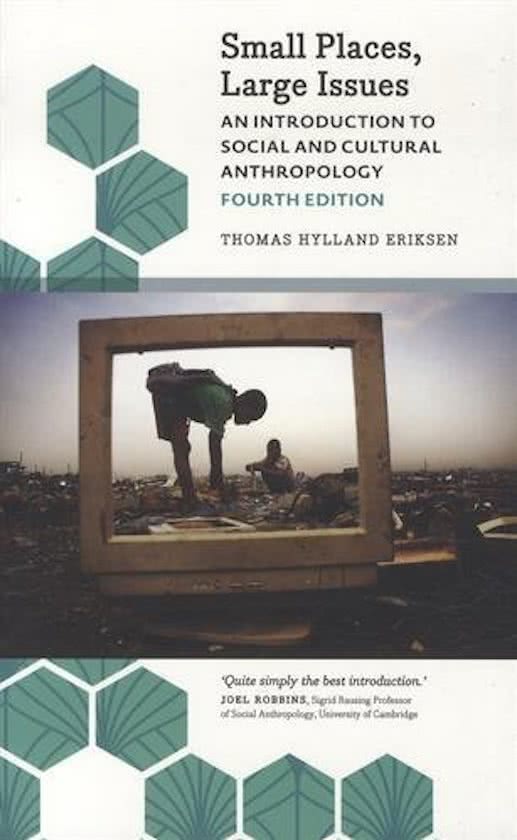
CORE THEMES IN ANTHROPOLOGY – BOOK
CHAPTER 1: COMPARISON AND CONTEXT
Anthropology
• Anthropology tries to account for the social and cultural variation in the world, but a crucial part
of the anthropological project also consists in conceptualising and understanding similarities
between social systems and human relationships
• Anthropology is about how different people can be, but it also tries to find out in what sense it
can be said that all humans have something in common
• The ways in which human lives are unique, but also similar
What do anthropologists do?
• Trying to understand both connections within societies and between societies
• Accounting for different aspects of human existence and investigating these interrelationships
taking as their point of departure a detailed study of local life in a particular society
• Asking large questions, while at the same time drawing most insights from small places
What is anthropology?
• Knowledge about humans
o Anthropos = human
o Logos = reason
• Social anthropology → knowledge about humans in societies
• Cultural anthropology → knowledge about cultivated humans
o Colere = to cultivate
o Knowledge about those aspects of humanity which are not natural, but which are related
to that which is acquired
Culture
• On the one hand, every human is equally cultural
o In this sense, the term 'culture' refers to a basic similarity within humanity distinguishing us
from other animals
• On the other hand, people have acquired different abilities, notions, etc.
o And are thereby different because of culture
• Geertz depicted a culture both as an integrated whole and as a system of meanings that was
largely shared by a population
• Culture thus appeared as integrated, shared within the group and bounded
o In many cases it should be said that a national or local culture is neither shared by all or
most of the inhabitants, nor bounded
The relationship between culture and society
• Culture = the acquired, cognitive and symbolic aspects of existence
• Society = the social organisation of human life, patterns of interaction and power relationships
Anthropology
= the comparative study of cultural and social life
• Most important method → participant observation, which consists in lengthy fieldwork in a
specific social setting
• Anthropology compares aspects of different societies and continuously searches for interesting
dimensions for comparison
1
,The universal and the particular
• The central problem of anthropology is the diversity of human social life
• Anthropology tries to strike a balance between similarities and differences
• Universality = to what extent do all humans, cultures or societies have something in common?
• Relativism = to what extent is each of them unique?
• Structural-functionalism = all societies operate according to the same general principles
• Structuralism = the human mind has a common architecture expressed through myth, kinship
and other cultural phenomena
• Transactionalism = the logic of human action is the same everywhere
• Materialist approaches = culture and society are determined by ecological and/or technological
factors
The problem of Ethnocentrism
• A society or a cultural world must be understood on its own terms. In saying this, we warn
against the application of a shared, universal scale to be used in the evaluation of every society
• In order to understand people's lives, it is therefore necessary to try to grasp the totality of their
experiential world; and in order to succeed at this project, it is adequate to look at selected,
isolated variables
• Ethnocentrism
= evaluating other people from one's own vantage-point and describing them in one's own terms
o One's own ethnos, including one's cultural values, is literally placed at the centre
o Fails to allow other peoples to be different from ourselves on their own terms, and can be
a serious obstacle to understanding
o Anthropology calls for an understanding of different societies as they appear from the
inside
• Cultural relativism
= Societies or cultures are qualitatively different and have their own unique inner logic, and it is
therefore scientifically absurd to rank them on a scale
o Sometimes posited as the opposite of ethnocentrism
o Indispensable and unquestionable theoretical premise
o Methodological rule-of-thumb in our attempts to understand other societies in an as
unprejudiced way as possible
o However, it is impossible in practice, since it seems to indicate that everything is as good
as everything else, provided it makes sense in a particular social context
2
, CHAPTER 2: A BRIEF HISTORY OF ANTHROPOLOGY
Periods in the history of Anthropology
• Proto-anthropology
o Roots in the ancient Greeks
o During the Renaissance in Europe
▪ Thinking about cultural variability and global cultural history
o 18th century
▪ Universalism vs relativism
▪ Ethnocentrism vs cultural relativism
▪ Humanity vs the animal kingdom
• Victorian anthropology
o 19th century
o Belief in social evolution
▪ The idea that human societies developed in a particular direction
▪ The notion that European societies were the end-product of development which
began with savagery
o Optimistic belief in technological progress and European colonialism
o Maine: difference between status and contract
o Bastian: all humans have the same pattern of thinking based on elementary ideas
• Boas and Cultural Relativism
o Four-field approach
▪ Cultural and social anthropology
▪ Physical anthropology
▪ Archaeology
▪ Anthropological linguistics
o Each culture had to be understood on its own terms and it would be misleading to judge
and rank other cultures according to a Western, ethnocentric typology gauging levels of
development
o Historical particularism = the view that all societies or cultures had their own unique
history that could not be reduced to a category in some universalist scheme of
development
o Sapir-Whorf hypothesis = language determines cognition, and the world's languages differ
profoundly in this respect
▪ Implies that different peoples perceive the world in a fundamentally different way,
due to differences in the structure of their languages
• The two British Schools
o Malinowski
o Radcliffe-Brown
• Mauss
o Maus's theoretical position → He believed strongly in systematic comparison and in the
existence of recurrent patterns in social life at all times and in all places
▪ Yet he often ends on a relativist note in his reasoning about similarities and
differences between societies
• The second half of the 20th century
o New specialisations
▪ Psychological anthropology
▪ Political anthropology
▪ Anthropology of ritual
• Structuralism
o First major theory to emerge after WW2
o Structuralism by Claude Lévi-Strauss
3
CHAPTER 1: COMPARISON AND CONTEXT
Anthropology
• Anthropology tries to account for the social and cultural variation in the world, but a crucial part
of the anthropological project also consists in conceptualising and understanding similarities
between social systems and human relationships
• Anthropology is about how different people can be, but it also tries to find out in what sense it
can be said that all humans have something in common
• The ways in which human lives are unique, but also similar
What do anthropologists do?
• Trying to understand both connections within societies and between societies
• Accounting for different aspects of human existence and investigating these interrelationships
taking as their point of departure a detailed study of local life in a particular society
• Asking large questions, while at the same time drawing most insights from small places
What is anthropology?
• Knowledge about humans
o Anthropos = human
o Logos = reason
• Social anthropology → knowledge about humans in societies
• Cultural anthropology → knowledge about cultivated humans
o Colere = to cultivate
o Knowledge about those aspects of humanity which are not natural, but which are related
to that which is acquired
Culture
• On the one hand, every human is equally cultural
o In this sense, the term 'culture' refers to a basic similarity within humanity distinguishing us
from other animals
• On the other hand, people have acquired different abilities, notions, etc.
o And are thereby different because of culture
• Geertz depicted a culture both as an integrated whole and as a system of meanings that was
largely shared by a population
• Culture thus appeared as integrated, shared within the group and bounded
o In many cases it should be said that a national or local culture is neither shared by all or
most of the inhabitants, nor bounded
The relationship between culture and society
• Culture = the acquired, cognitive and symbolic aspects of existence
• Society = the social organisation of human life, patterns of interaction and power relationships
Anthropology
= the comparative study of cultural and social life
• Most important method → participant observation, which consists in lengthy fieldwork in a
specific social setting
• Anthropology compares aspects of different societies and continuously searches for interesting
dimensions for comparison
1
,The universal and the particular
• The central problem of anthropology is the diversity of human social life
• Anthropology tries to strike a balance between similarities and differences
• Universality = to what extent do all humans, cultures or societies have something in common?
• Relativism = to what extent is each of them unique?
• Structural-functionalism = all societies operate according to the same general principles
• Structuralism = the human mind has a common architecture expressed through myth, kinship
and other cultural phenomena
• Transactionalism = the logic of human action is the same everywhere
• Materialist approaches = culture and society are determined by ecological and/or technological
factors
The problem of Ethnocentrism
• A society or a cultural world must be understood on its own terms. In saying this, we warn
against the application of a shared, universal scale to be used in the evaluation of every society
• In order to understand people's lives, it is therefore necessary to try to grasp the totality of their
experiential world; and in order to succeed at this project, it is adequate to look at selected,
isolated variables
• Ethnocentrism
= evaluating other people from one's own vantage-point and describing them in one's own terms
o One's own ethnos, including one's cultural values, is literally placed at the centre
o Fails to allow other peoples to be different from ourselves on their own terms, and can be
a serious obstacle to understanding
o Anthropology calls for an understanding of different societies as they appear from the
inside
• Cultural relativism
= Societies or cultures are qualitatively different and have their own unique inner logic, and it is
therefore scientifically absurd to rank them on a scale
o Sometimes posited as the opposite of ethnocentrism
o Indispensable and unquestionable theoretical premise
o Methodological rule-of-thumb in our attempts to understand other societies in an as
unprejudiced way as possible
o However, it is impossible in practice, since it seems to indicate that everything is as good
as everything else, provided it makes sense in a particular social context
2
, CHAPTER 2: A BRIEF HISTORY OF ANTHROPOLOGY
Periods in the history of Anthropology
• Proto-anthropology
o Roots in the ancient Greeks
o During the Renaissance in Europe
▪ Thinking about cultural variability and global cultural history
o 18th century
▪ Universalism vs relativism
▪ Ethnocentrism vs cultural relativism
▪ Humanity vs the animal kingdom
• Victorian anthropology
o 19th century
o Belief in social evolution
▪ The idea that human societies developed in a particular direction
▪ The notion that European societies were the end-product of development which
began with savagery
o Optimistic belief in technological progress and European colonialism
o Maine: difference between status and contract
o Bastian: all humans have the same pattern of thinking based on elementary ideas
• Boas and Cultural Relativism
o Four-field approach
▪ Cultural and social anthropology
▪ Physical anthropology
▪ Archaeology
▪ Anthropological linguistics
o Each culture had to be understood on its own terms and it would be misleading to judge
and rank other cultures according to a Western, ethnocentric typology gauging levels of
development
o Historical particularism = the view that all societies or cultures had their own unique
history that could not be reduced to a category in some universalist scheme of
development
o Sapir-Whorf hypothesis = language determines cognition, and the world's languages differ
profoundly in this respect
▪ Implies that different peoples perceive the world in a fundamentally different way,
due to differences in the structure of their languages
• The two British Schools
o Malinowski
o Radcliffe-Brown
• Mauss
o Maus's theoretical position → He believed strongly in systematic comparison and in the
existence of recurrent patterns in social life at all times and in all places
▪ Yet he often ends on a relativist note in his reasoning about similarities and
differences between societies
• The second half of the 20th century
o New specialisations
▪ Psychological anthropology
▪ Political anthropology
▪ Anthropology of ritual
• Structuralism
o First major theory to emerge after WW2
o Structuralism by Claude Lévi-Strauss
3