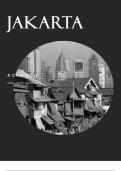
Jakarta
A CASE STUDY
Margarida Veríssimo
, TABLE OF
CONTENTS
01 A MEGACITY
02 A GROWING CITY
03 TOURISM
04 THE FUTURE
1
, Jakarta – a
megacity
AN INTRODUCTION
Jakarta is the capital of
Indonesia. It is located in East
Asia, on the island of Java
(figure 1). Jakarta is home to
11.2 million people, and 32
million people live in the
Greater Area of Jakarta
(figure 2). The urban
population grows by 1.57 %
Figure 1 – Jakarta and Indonesia annually, a rate that matches
Source: @googlemaps
the global average. The city
covers an area of 664.1 km².
The population density in Jakarta is 15 327 inhabitants per km2.
Demographic-wise Jakarta is home to 60 % of Indonesia's total population but
almost half of Jakarta's population are immigrants. Among them, many are
Chinese and Sumatrans. The predominant religion is Islam. And, the largest age
groups in the city are between 25 and 45 years old and make up almost half of
the population. Teenagers follow right behind with 25 percent of the total
population of the city. All and all, Jakarta is a young and international city.
Jakarta has a very particular
topography. The north of
Jakarta is plain, but the south
is hilly. There are 13 rivers that
cross the city, being the
biggest one the Citarum.
Since the city is located on the
coast and in a fluvial plain,
meaning, a plain composed
of sediments, the city is also
Figure 2 – Jakarta metropolitan area slowly sinking.
Source: @googlemaps
1
A CASE STUDY
Margarida Veríssimo
, TABLE OF
CONTENTS
01 A MEGACITY
02 A GROWING CITY
03 TOURISM
04 THE FUTURE
1
, Jakarta – a
megacity
AN INTRODUCTION
Jakarta is the capital of
Indonesia. It is located in East
Asia, on the island of Java
(figure 1). Jakarta is home to
11.2 million people, and 32
million people live in the
Greater Area of Jakarta
(figure 2). The urban
population grows by 1.57 %
Figure 1 – Jakarta and Indonesia annually, a rate that matches
Source: @googlemaps
the global average. The city
covers an area of 664.1 km².
The population density in Jakarta is 15 327 inhabitants per km2.
Demographic-wise Jakarta is home to 60 % of Indonesia's total population but
almost half of Jakarta's population are immigrants. Among them, many are
Chinese and Sumatrans. The predominant religion is Islam. And, the largest age
groups in the city are between 25 and 45 years old and make up almost half of
the population. Teenagers follow right behind with 25 percent of the total
population of the city. All and all, Jakarta is a young and international city.
Jakarta has a very particular
topography. The north of
Jakarta is plain, but the south
is hilly. There are 13 rivers that
cross the city, being the
biggest one the Citarum.
Since the city is located on the
coast and in a fluvial plain,
meaning, a plain composed
of sediments, the city is also
Figure 2 – Jakarta metropolitan area slowly sinking.
Source: @googlemaps
1